Beyond Tools: Introducing the Atlassian System of Work for Enterprise Transformation
The role of IT leadership is evolving. CIOs, CTOs, and Directors of IT are no longer just stewards of infrastructure—they’re strategic partners guiding transformation, innovation, and business agility. But modern organizations are facing an all-too-familiar challenge: fragmented tools, siloed teams, and slow decision-making.
To meet this moment, Atlassian has introduced a new way of working—one that goes beyond the traditional approach to platforms and products. It’s called the System of Work, and it’s changing how leading organizations connect strategy to execution, streamline collaboration, and scale with clarity.
What Is the System of Work?
At its core, the Atlassian System of Work is a philosophy—not a product—that brings teams, goals, tools, and knowledge together in a unified digital environment. It’s designed for today’s connected enterprise, where business, IT, and software teams need to move fast and stay aligned.
Atlassian’s System of Work is built on four foundational principles:
Align work to goals – Connect day-to-day work to enterprise strategy.
Plan and track together – Break down silos between departments and coordinate with shared visibility.
Unleash knowledge – Make institutional knowledge accessible and searchable across the business.
Embrace AI as teammates – Use intelligent agents to reduce busywork and support decision-making.
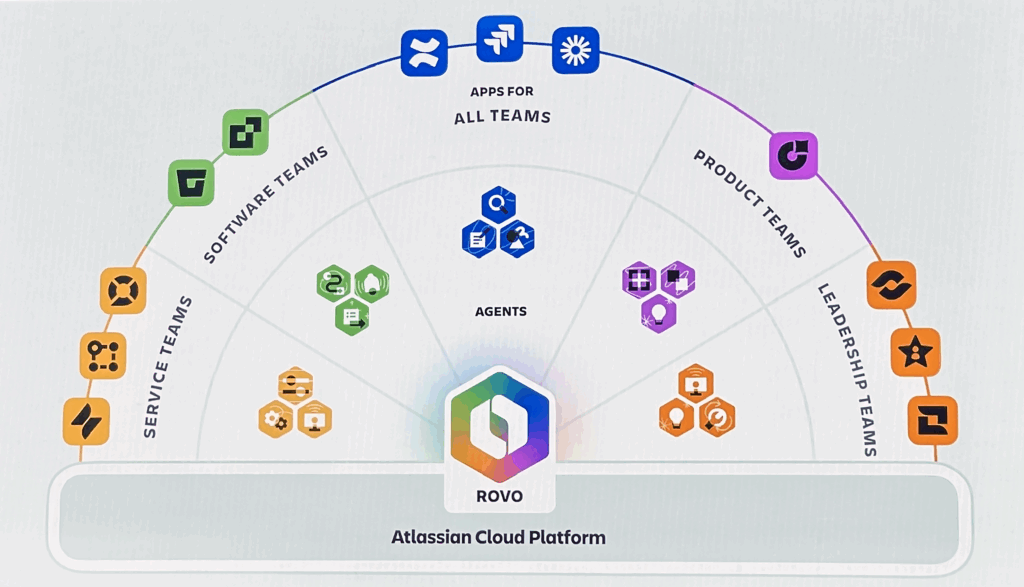
This philosophy is fully embedded into Atlassian’s cloud platform and supported by an integrated suite of tools: Jira Software, Jira Service Management, Confluence, Jira Align, Atlas, and now Rovo—the AI-powered teammate.
Increased visibility: From high-level goals in Jira Align to work-in-progress in Jira Software and documentation in Confluence, everything is interconnected—reducing duplication and improving trust in status updates.
Strategic agility: With the new Atlassian Focus platform, leadership can define OKRs, track progress, and adjust priorities dynamically.
Reduced overhead: AI tools like Rovo summarize meetings, draft reports, and surface relevant documentation—freeing teams to focus on high-value work.
A Day in the Life of the System of Work
Imagine this scenario in a complex enterprise environment:
A VP of IT defines quarterly strategic goals in Atlassian Focus—one objective is to modernize the organization’s customer support system.
The portfolio team breaks this goal down into epics in Jira Align, aligned with business value streams.
The software team plans sprints in Jira Software, linking stories to those strategic epics.
The IT service team uses Jira Service Management to capture feedback and support tickets, automatically connected to the development backlog.
Throughout the project, documentation is created and shared in Confluence, automatically linked to the related Jira issues.
The leadership team uses Atlas to get real-time updates and status without weekly check-ins.
And Rovo, Atlassian’s AI teammate, proactively answers stakeholder questions, suggests knowledge base articles, and summarizes team meetings into Jira tickets.
This is not a future-state—it’s happening today in organizations like Reddit, Procore, and Thumbtack. In one case, Procore reduced roadmap planning time by 75% using Rovo. In another, a virtual agent resolved 15% of IT requests without human intervention, improving SLA compliance across the board.
The Power of an Integrated Platform
The magic of the System of Work lies not just in the tools, but in how they work together:
Jira Software: Agile project management for software and business teams
Jira Service Management: ITSM with real-time collaboration and DevOps integration
Confluence: Centralized knowledge sharing and documentation
Jira Align: Strategic portfolio management and enterprise agility
Focus: Goal and OKR tracking for leadership visibility
Atlas: Contextual updates and team alignment
Rovo: AI-powered search, summarization, and workflow automation
Teamwork Graph: The data fabric that connects it all—people, work, knowledge, and goals
Enterprise teams can collaborate more effectively and achieve greater results together.
This white paper introduces the Atlassian System of Work, explains how it transforms organizational operations, and highlights why Oxalis is the ideal partner to help implement and succeed with this model.
Together, these tools form a single source of truth—a system that adapts to your business, scales across functions, and evolves as your teams do.
How Oxalis Can Help
At Oxalis, we specialize in helping organizations adopt and operationalize the Atlassian System of Work. We’ve guided complex, highly regulated enterprises—from shipyards and government agencies to healthcare and higher education—through successful transformation.
Here’s what sets us apart:
Strategic alignment: We design solutions that tie work to your top-level business goals.
Toolchain optimization: We connect your Atlassian tools into one coherent ecosystem.
Cloud migrations: We help you transition to Atlassian Cloud while ensuring performance, security, and compliance.
Training and change enablement: We work with your teams to ensure adoption and long-term success.
AI enablement: We implement Rovo and configure intelligent agents to support your teams from day one.
If you’re ready to unify your teams, reduce inefficiency, and move from reactive to strategic execution—Oxalis is here to help.
Let’s Build Your System of Work Together
Schedule a discovery session with our experts to learn how Oxalis can bring the Atlassian System of Work to life in your organization.
Cloud or Data Center? The Best Atlassian Deployment for Healthcare
For healthcare organizations using Atlassian products like Jira or Confluence, navigating the shift to a cloud-first strategy is more important than ever. With Atlassian discontinuing Server support in 2024, organizations must decide whether to migrate to Atlassian Cloud, adopt Data Center, or implement a hybrid approach.
For highly regulated industries like healthcare, compliance, security, and data control are top priorities. The critical question is: Does Atlassian Cloud meet HIPAA requirements, or is Data Center the better choice?
This guide explores your options, addresses HIPAA compliance concerns, and provides expert insights into making the best decision for your organization.
Atlassian Cloud vs. Data Center: What Healthcare Organizations Need to Know
Atlassian Data Center: A Behind-the-Firewall Option
For healthcare organizations needing full control over their infrastructure, Atlassian’s Data Center products offer a self-hosted, behind-the-firewall solution. This is particularly important for organizations that must store PHI/PII in Jira or Confluence but cannot meet compliance requirements in a cloud environment.
Key Advantages of Data Center:
Increased Security & Compliance – Full control over hosting, access, and compliance settings.
Scalability & High Availability – Load balancing and disaster recovery support.
Customization & Integration Flexibility – Ability to customize workflows and integrate with on-premises systems and security tools for enhanced compliance.
Atlassian Cloud’s Compliance and Security Features
Atlassian has made significant investments in security, compliance, and scalability for its Cloud offerings. Jira Software, Jira Service Management, and Confluence on the Enterprise plan are HIPAA-compliant, and Atlassian is prepared to sign Business Associate Agreements (BAAs) for them.
However, Jira Work Management is not HIPAA-compliant, and Atlassian has no plans to certify it. If your organization is not on the Enterprise plan, other considerations, such as Data Loss Prevention (DLP) tools and controlled third-party plugin usage, become essential.
HIPAA Compliance – Available on Enterprise plans with a signed BAA.
Data Loss Prevention (DLP) Tools – Critical for enforcing PHI/PII storage policies.
Third-Party Plugins – Vendors may or may not be HIPAA-compliant; review all Marketplace apps carefully.
Process & Policy for Reporting and Remediation – A structured approach is needed to flag, review, and remove PHI. If your organization needs assistance evaluating whether Atlassian Cloud is the right fit, Oxalis can help assess your compliance needs and implementation strategy.
Considerations for Data Center:
Higher Hosting & Maintenance Costs – Requires dedicated IT resources and infrastructure investment.
User Minimums – Higher licensing costs with a 500-user minimum for Jira Software.
For organizations prioritizing compliance, security, and control, Data Center remains a viable alternative to Cloud, particularly for those not yet ready to fully migrate.
A Hybrid Approach: The Best of Both Worlds?
For organizations looking to balance security and efficiency, a hybrid cloud approach may offer the best of both worlds. This strategy allows teams to use Atlassian Cloud for non-sensitive operations while keeping PHI/PII in a secure Data Center environment.
Common Hybrid Cloud Scenarios:
Customer-Facing Services on Cloud, Internal Systems on Data Center
Example: A healthcare IT company uses Jira Service Management on Data Center for handling PHI in customer support requests, while Jira Software and Confluence remain in the Cloud for agile development and knowledge management.
Sensitive Workflows in Data Center, General Operations in Cloud
Example: A multi-state healthcare provider operates Quality Management in Jira Cloud, but runs compliance-sensitive projects in Jira Data Center to meet regulatory requirements.
Making the Right Decision for Your Healthcare Organization
Choosing between Atlassian Cloud, Data Center, or a hybrid approach depends on your security needs, compliance requirements, and IT infrastructure.
If you need a fully managed solution with built-in compliance, Atlassian Cloud (Enterprise Plan) is a strong option.
If you require full control over data storage, security, and compliance policies, Atlassian Data Center is the better fit.
If you want flexibility, a hybrid approach offers tailored security and scalability.
Atlassian’s Compliance Roadmap
The chart below details current and future Cloud compliance standards according to the Atlassian Cloud compliance roadmap.
UPDATE
STATUS
TIMEFRAME
FedRAMP Moderate Authority to Operate (ATO)
Coming Soon
Q2-Q3 2025
FedRAMP Moderate Security Assessment and Agency Review
Oxalis’ Proven Methodology: Your Atlassian Cloud Migration, Simplified
As your trusted Atlassian Cloud Migration advisors, we’ve distilled our extensive experience into a step-by-step eBook. Whether you’re transitioning from Server or Data Center, this guide covers every aspect of your journey.
How Oxalis Can Help
At Oxalis, we specialize in helping healthcare organizations navigate Atlassian deployments while ensuring compliance with HIPAA and other regulatory frameworks. Our team provides:
Compliance Assessments – Evaluating Cloud vs. Data Center fit for your organization.
Is Jira HIPAA Compliant? What Healthcare Organizations Need to Know
For healthcare organizations and businesses handling protected health information (PHI), compliance with the Health Insurance Portability and Accountability Act (HIPAA) is a fundamental requirement. However, as organizations increasingly adopt modern cloud-based collaboration and service management tools, ensuring compliance becomes more complex. Atlassian’s suite of products—particularly Jira and Confluence—offers powerful solutions for enterprise teams, but are they suitable for HIPAA-compliant environments? This guide breaks down the current state of Atlassian’s HIPAA compliance, comparing Cloud and Data Center deployment options and providing best practices for maintaining compliance.
What You’ll Learn
An overview of HIPAA compliance
The HIPAA compliance status of Jira and Confluence Cloud
The HIPAA compliance considerations for Jira and Confluence Data Center
Best practices for using Jira in HIPAA-compliant environments
Is Jira HIPAA-Compliant?
HIPAA compliance is a critical concern for healthcare organizations and any entity handling protected health information (PHI). Atlassian has made strides in ensuring HIPAA compliance for select products. As of February 2023, Atlassian has implemented HIPAA compliance for specific Cloud products on its Enterprise plan. Additionally, Atlassian Data Center products continue to provide a self-hosted alternative for organizations that require full control over their compliance framework.
However, achieving HIPAA compliance is not solely about using a compliant product. Organizations must ensure their hosting, access controls, and plugin usage align with their HIPAA compliance program.
Interested in learning more about HIPAA compliance with Atlassian? Oxalis can help guide you through the decision-making and implementation process. Contact us below to get in touch. Keep reading to learn more about which Atlassian products are now HIPAA-compliant.
The short answer: partially. Atlassian provides HIPAA compliance for select Cloud products, but only under its Enterprise plan. Atlassian is also prepared to sign Business Associate Agreements (BAAs) for the following products:
Jira Software Cloud
Jira Service Management Cloud
Confluence Cloud
Notably, Jira Work Management is not HIPAA-compliant, and Atlassian has no current plans to make it so. Organizations using non-Enterprise Cloud plans should anticipate future expansions of HIPAA compliance, but currently, only Enterprise customers can fully leverage HIPAA protections.
For organizations considering Atlassian Cloud, it is essential to follow Atlassian’s HIPAA Implementation Guide to configure their environment properly.
Is Jira/Confluence Data Center HIPAA Compliant?
The answer: it depends on your hosting strategy.
Atlassian Data Center offers a viable solution for organizations handling PHI, as it can be self-hosted or managed by a healthcare-oriented Managed Service Provider (MSP). This model provides greater control over compliance policies, security configurations, and access permissions. When properly implemented, Jira and Confluence Data Center can be part of a HIPAA-compliant infrastructure.
Organizations should ensure their Data Center deployment includes:
Secure hosting (on-premises or through an MSP with HIPAA safeguards)
Role-based access controls and audit logging
Regular security assessments and compliance audits
Regardless of whether you use Atlassian’s Cloud or Data Center products, we recommend the following:
Ensure your infrastructure’s configuration and controls (internally hosted or managed by an MSP) are aligned with your organization’s HIPAA Compliance Program.
Leverage a Data Loss Prevention (DLP) tool to keep PHI/PII out of your system, and eliminate it if found.
Analyze which plugins you intend to use, and whether the third party vendor is considered a business associate subject to a BAA.
Consider your options for remediating PHI/PII accidentally stored in issue data/history, pages, and attachments.
Best Practices for HIPAA Compliance with Atlassian Products
Regardless of whether you choose Atlassian Cloud or Data Center, ensuring HIPAA compliance requires careful planning. Oxalis recommends the following best practices:
Align Hosting and Configuration with HIPAA Requirements Ensure your Cloud or Data Center infrastructure aligns with your organization’s HIPAA compliance program.
Use a Data Loss Prevention (DLP) Tool Implement a DLP solution to prevent PHI from being stored inadvertently and ensure it is removed when necessary.
Evaluate Third-Party Apps and Plugins Review third-party apps and integrations to determine if vendors qualify as business associates and require a BAA.
Develop a Remediation Plan for PHI Storage Establish procedures for identifying and removing PHI/PII that may have been accidentally stored in issues, pages, or attachments.
How Oxalis Can Help
At Oxalis, we understand that security and compliance are critical for healthcare organizations. Our team has extensive experience helping organizations determine whether Atlassian Cloud or Data Center is the right fit for their HIPAA compliance needs. We provide expert guidance on implementation, configuration, and ongoing compliance management.
If you need assistance navigating HIPAA compliance with Atlassian products, contact Oxalis today to schedule a consultation with our experts.
To learn more about making the right choice for your organization, download our whitepaper: Atlassian Cloud vs. Data Center: Key Considerations for Enterprise, Compliance-Heavy Organizations.
In today’s business world, where 86% of companies recognize the importance of agility for success, many still struggle to achieve it. Traditional project management methods are often too slow and rigid to keep up with the ever-changing demands of the market. This is where Agile-at-Scale (now called “Enterprise Strategy & Planning”) comes in. Scaling Agile helps organizations implement agile principles not just within individual teams, but across the entire enterprise, fostering adaptability, collaboration, and customer-centricity.
The Why
The modern business landscape is a whirlwind of technological advancements, evolving customer expectations, and fierce competition. Traditional hierarchical structures and waterfall methodologies, once reliable, now struggle to keep pace. Agile methodologies, with their iterative approach, collaborative spirit, and focus on customer value, offer a way to navigate this dynamic environment effectively. Companies like Spotify and Netflix, pioneers in Agile-at-Scale, demonstrate its potential to drive innovation and achieve remarkable results.
The What
Agile at Scale is not simply about implementing Scrum or Kanban across multiple teams. It’s a holistic approach that involves:
Agile Frameworks: Adopting a suitable framework like SAFe, LeSS, or Scrum@Scale can provide a structured approach to scaling agile.
Organizational Structure: Embracing a leaner, more decentralized structure empowers teams and enables faster decision-making.
Agile Values and Principles: Integrating agile values and principles into the organizational culture is essential for lasting change.
Continuous Improvement: Cultivating a mindset of continuous learning, adaptation, and improvement ensures ongoing progress.
The How
Implementing Agile at Scale is a journey that requires careful planning and execution. Here’s a high-level overview of the process:
Assessment: Begin by evaluating the organization’s current Agile maturity level to identify areas for improvement. Analyze baseline metrics and determine the objectives and key results (OKRs) you aim to achieve through this transformation.
Training and Coaching: Invest in training and coaching to equip teams with the knowledge and skills necessary to succeed in an Agile environment. Foster a shared understanding of Agile principles and practices.
Framework Adoption/Adaptation: Decide whether to adopt or adapt an existing Agile at Scale framework for your organization. While there’s no one-size-fits-all solution, leveraging an existing framework can reduce initial friction, promote learning, and provide a common language for teams.
Pilot Project: Start with a pilot project to gain practical experience, build momentum, and demonstrate value.
Re-evaluate OKRs: After the pilot project, re-evaluate progress toward your OKRs. Compare the current state to the baseline and identify what worked, what didn’t, and what exceeded expectations. This allows you to pivot or pause as needed, ensuring continuous improvement and value delivery.
Scaling Up: Gradually scale Agile across the organization, learning and adapting along the way to ensure a smooth transition.
Remember that tools and technologies, such as Jira Align, can play a crucial role in supporting Agile at Scale implementations by providing visibility, facilitating coordination, and promoting alignment.
To illustrate the power of Agile at Scale, consider the case of the California Department of Health Care Services (DHCS). With the help of Oxalis’ expertise in Jira Align and Agile methodologies, DHCS successfully navigated a complex Agile transformation, resulting in improved efficiency, increased agility, and better strategic alignment.
Agile-at-Scale empowers organizations to navigate today’s dynamic business landscape with confidence. By understanding its core principles and partnering with experienced guides like Oxalis, your organization can embark on a transformative journey toward increased agility, efficiency, and customer-centricity.
Ready to embrace the power of Agile-at-Scale? Partner with Oxalis and unlock your organization’s full potential. Contact us today to learn more about how we can guide your Agile transformation journey.
Revolutionizing ITSM: A Guide to Jira Service Management Fundamentals
IT Service Management (ITSM) isn’t just about managing IT work; it’s about transforming the way your entire organization functions. From simple end-user requests (like a new Adobe account) to complex infrastructure needs (like provisioning a server), ITSM streamlines every IT process. Jira Service Management (JSM) is revolutionizing this landscape, going beyond traditional ITSM to optimize how you design, deliver, and support IT services. In this guide, we’ll dive into some Jira Service Management fundamentals and show you how Atlassian’s powerful tool is reshaping the future of IT.
Modern ITSM software must empower IT teams and their global collaborators to manage work seamlessly and collaborate effortlessly. It needs to provide the agility and scalability needed to meet evolving business and technology demands, while supercharging customer service — all without creating data silos or process bottlenecks.
High-performing teams thrive when empowered to work in ways that best suit their needs while aligning with the organization’s goals; it’s a delicate balance of autonomy and alignment. Poorly implemented autonomy breeds data silos, obscures visibility, and wastes time as IT grapples with disjointed tools. Mistaking alignment for control stifles innovation, slows progress, hinders collaboration, and limits scalability.
Jira Service Management is designed to empower all types of teams, and mastering its fundamentals unlocks that value from the start.
Atlassian’s Jira Service Management strikes a balance between autonomy and alignment, fueling its rising popularity. Gartner recognized this strength by naming Atlassian a Leader in the 2022 Magic Quadrant for ITSM Tools.
JSM’s genius lies in its versatility and unifying power:
Empowering all teams: JSM recognizes that virtually any team can elevate customer service, collaboration, and efficiency by adopting a service management approach.
Unifying IT and business: By bringing IT and business teams onto a single platform, JSM delivers unparalleled data breadth and depth. This empowers leaders at every level with the insights needed to ensure alignment with overarching business goals, while saving time and eliminating the frustrations caused by disjointed tools.
Balancing autonomy with security: JSM grants teams significant control over their workflows within Jira, while administrators retain essential permissions to uphold organizational security policies. This fosters a healthy balance of empowerment and oversight.
Grounded in the latest ITIL practices, Jira Service Management unites all teams on a powerful, scalable platform with a single, intuitive interface designed to elevate customer service. However, even the most advanced tools require a strategic approach to maximize their value. Let’s dive into the Jira Service Management fundamentals that will unlock your full potential and deliver the highest return on investment.
Establishing a Strong Foundation
Request forms power Jira Service Management’s customer portals, serving as the primary interaction point for both internal and external users. They’re the engine that unlocks JSM’s full value, as customer portals don’t mandate a JSM license for access (although you can configure JSM to require an Atlassian account). Even with robust knowledge bases integrated into your portals, users will inevitably submit requests. Therefore, creating exceptional portals and request forms is the critical first step in mastering Jira Service Management fundamentals.
Streamlining Your Service Request Forms
Customers, both internal and external, benefit from a well-balanced selection of request types and groups. Too many options can overwhelm, while too few can limit their ability to find the right fit. If you’re just starting, begin with fewer options and add more as needed based on user feedback and JSM’s reporting features. Additionally, tailor the visible request types to each customer’s needs for a more personalized experience.
Craft request type names and descriptions from the customer’s perspective, not the agent’s. “Provision new hardware” might resonate with IT, but users are more likely to search for “request new computer or mobile device.”
Make request forms user-friendly with clear descriptions and instructions. Guide users to provide the precise information JSM agents need to fulfill requests promptly. Use hidden fields to automatically route requests to the right team without requiring any extra effort from the customer.
Leverage Jira’s Forms feature to create dynamic forms with conditional field display. This reduces clutter by showing only relevant fields based on the user’s selections. For example, the form for “Request new computer or mobile device” could first ask the user to specify the hardware type, then display only the fields relevant to that choice. By minimizing irrelevant information, you streamline the process, reduce confusion, and enhance the user experience. This conditional logic can also help consolidate request types, making it easier for customers to find what they need.
Crafting an Intuitive Customer Portal: A Step-by-Step Guide
Effective Jira Service Management (JSM) portals go beyond well-designed request types and forms. Let’s explore additional steps you can take to ensure your portals deliver exceptional support to your customers.
1. Optimize the Portal Home Page
The portal home page serves as a central hub where customers can search and access all configured portals within your JSM instance. Its importance grows with the number of portals you have, as it allows users to easily navigate and find the resources they need.
Add a login message: Orient new users with helpful information and instructions.
Set the Help Center Name: This appears in browser tabs and navigation breadcrumbs, providing context for users.
Set the Home Page Title: Displayed above the search bar, this title clearly indicates which portal the user is currently viewing.
Add your logo: Reinforce your branding and provide a link back to the portal home page.
Upload a Help Center Banner image: Customize the visual appearance of your portal with a background image that aligns with your brand.
Set banner background color and link/button colors: Further tailor the portal’s appearance by choosing specific colors.
Set Home Page Title color: Ensure optimal readability against the banner image or color.
Add “topics”: Organize request forms, external resources, and knowledge articles into collections for easy browsing.
Highlight “featured portals”: Increase visibility for frequently used portals.
Hide portals: Restrict access to specific portals by requiring direct URLs.
2. Customize Each Customer Portal
Each portal can be further customized to cater to specific customer needs.
Add introduction text: Provide guidance, tips, or instructions to assist users.
Add external websites: Share relevant resources in a “Related Resources” section.
Group request forms: Enhance browsing by organizing forms into logical groups.
Highlight knowledge base articles: Promote self-service by showcasing helpful articles in categories.
Prioritize User Experience
By following these steps, you empower customers with a user-friendly, informative, and visually appealing portal experience. This not only streamlines their interactions but also sets your service teams up for success by ensuring efficient and effective communication.
Harnessing Automation for Efficiency
Every team grapples with repetitive, time-consuming tasks that drain valuable resources. Why burden your employees with tracking down signatures or navigating complex approval processes?
Free your team to focus on high-value work that drives your organization forward. Jira Service Management offers two powerful features designed to eliminate manual effort and streamline workflows.
Optimizing Processes with Automation
Automated Ticket Actions and Approvals
JSM’s project-level Automation feature enables you to create simple “if-then” rules that trigger specific actions when predefined events occur. You have complete control over the setup:
Triggers: Define the events that initiate the rule, such as issue creation or status changes.
Conditions: Specify additional criteria that must be met for the rule to execute.
Actions: Choose the automated response, such as commenting on an issue, sending an email, or assigning the issue to a specific team member.
You can also leverage built-in templates or create custom rules tailored to your specific needs. Common use cases include automatically setting reviewers or approvers based on priority, risk level, or customer.
Streamlined Workflows
Automation rules are easily configurable and can be toggled on or off as needed, providing flexibility for project-specific adjustments. For more complex automation scenarios, JSM offers workflow customizations that are shareable and more powerful, giving you a comprehensive toolkit to optimize your processes.
Seamless Integrations
JSM’s automation seamlessly integrates with various external systems, allowing you to trigger actions in other tools or receive data from them. For example, you can automatically update your ERP system when a critical bug fix is released in Jira Software, ensuring smooth coordination between teams. You can also use webhooks to establish two-way communication between JSM and other systems, enabling real-time updates and seamless collaboration.
Empowering Teams Through Automation
JSM’s automation capabilities offer a wealth of possibilities, with a wide range of triggers, conditions, and actions to choose from. You can even create custom variables and lookup tables to enhance the flexibility of your automation rules.
To maximize the benefits of automation, start by engaging your team in brainstorming sessions to identify the most time-consuming and repetitive tasks. Once you’ve gathered their insights, your project or Jira administrators can then translate these ideas into actionable automation rules.
By harnessing the power of automation, you free your employees from mundane tasks, allowing them to focus on meaningful work that drives your organization forward.
Mastering Intelligent Workflows
Jira Service Management projects come equipped with built-in workflows, which you can customize or replace entirely. Each workflow can be tailored to specific issue types and, unlike automation rules, can be reused across multiple projects. While workflows primarily track a ticket’s state or phase (e.g., In Progress, Submitted for Review), JSM workflows offer much more through three powerful features:
Conditions: These logic tests determine whether a transition is visible to the user. You can control visibility based on user roles, specific field values, or other criteria. This ensures users only see relevant options, streamlining their interaction with the workflow and reducing administrative overhead.
Validators: These checkpoints verify the content of ticket fields against your predefined criteria. By blocking transitions with incomplete or inaccurate data, validators guarantee data integrity, preventing downstream delays and frustration.
Post Functions: Executed during status transitions, post functions perform actions such as reassigning tickets, clearing or setting field values, sending notifications, and triggering web hooks to interact with external systems. While some overlap exists with automation functionality, workflows offer several advantages:
No usage limits: Unlike some JSM Cloud plans, workflows have no execution limits. Clearer troubleshooting: Workflows provide a transparent, sequential execution order, which makes it easier to identify and resolve issues compared to the simultaneous firing of multiple automation rules. Field validation: Workflows offer field validation capabilities not available in automation. Reusability: Workflows can be reused across projects, eliminating the need to recreate automation rules for each project or make them global.
By understanding and leveraging these features, you can create intelligent workflows that optimize your processes, improve data quality, and enhance overall efficiency within Jira Service Management.
Amplify Efficiency with Integrated Automation
By automating repetitive tasks and customizing workflows, you empower your existing employees to work more efficiently, enabling your organization to scale faster. Jira Service Management’s seamless integration with other Atlassian products like Jira, Bamboo, and Bitbucket unlocks even greater potential. Imagine these possibilities:
Automated updates: Every time one product updates another, a comment is automatically added to the relevant issue, keeping everyone informed.
Streamlined change management: Code commits in Jira Software automatically trigger change requests in JSM.
Effortless approvals: Standard change requests are auto-approved, with relevant information like service impact and risk level automatically populated.
Seamless communication: When a new product feature is released, related development issues are automatically closed, and sales and marketing teams receive notifications.
Rapid incident response: Critical service outages automatically trigger a master incident ticket, assigned to the appropriate team or individual for immediate action.
Dynamic approvals: Approval workflows adapt based on the type of change, associated risk, or procedures defined by your change advisory board.
This is just a glimpse of what’s possible when you integrate JSM with your existing tools and processes. By harnessing the power of automation and integration, you can create a truly efficient and responsive IT service management ecosystem.
Maximizing the Power of Your Knowledge Bases
Studies show that knowledge workers spend a staggering 20–30% of their time searching for information, disrupting productivity and hindering efficiency. Recognizing this challenge, ITIL 4 includes Knowledge Management as a core ITSM practice.
At the heart of Knowledge Management lies the knowledge base (KB): a self-service online library of information about products, services, departments, or topics, all easily accessible through a powerful search engine. Each KB article you create becomes a reusable resource, answering customer questions time and again. While KBs are often seen as customer-facing tools for self-service, Jira Service Management also leverages KBs to empower team members working on service requests.
Empowering Customers with Self-Service
It’s a win-win: when customers find answers to their questions or the right forms for their needs through your knowledge base (KB), it saves your team’s time and your organization’s money. This is the power of request deflection. Moreover, many customers prefer self-service, so offering a comprehensive, user-friendly KB with robust search capabilities significantly boosts customer satisfaction.
Jira Service Management (JSM) seamlessly integrates with your knowledge bases. As customers start entering their request summary in a JSM portal connected to a KB, the portal dynamically searches the KB for relevant articles and displays them as “Suggested Articles” for the user to review.
To ensure a targeted experience, Confluence (where JSM’s KBs reside) allows you to label articles. You can then configure each JSM project to use specific labels when suggesting articles. For example, label HR-related articles as “hr” and set the Billing request type to only consider articles labeled “billing.” This prevents customers from wading through irrelevant search results, saving them valuable time.
The best part? Your portal searches become smarter over time. JSM employs machine learning to analyze user search behavior, article views, and engagement, continuously refining its suggestions for a more personalized and effective self-service experience.
Empowering Agents with Knowledge
While your customer portal’s KB search aims to provide relevant articles, it might not always capture every nuance of a user’s query. That’s where JSM’s agent-facing KB integration comes in.
Within a KB-connected JSM project, agents can easily access potentially helpful articles while viewing a ticket. A Knowledge Base field dynamically updates, indicating the number of articles that match the keywords in the ticket’s Summary. Agents can then quickly review and search the list, and with a single click, share a relevant article directly with the customer through a comment. Even better, agents can create new KB articles directly from the ticket, ensuring your knowledge base continuously grows and evolves.
Prioritize Knowledge Base Quality
Even if a portal user finds the perfect KB article for their needs, it won’t be helpful if it’s poorly written. While optimizing KB articles is a complex topic that deserves its own discussion, let’s cover some essential best practices:
Not everyone possesses strong writing skills. Often, subject matter experts are tasked with creating KB articles, but technical writing requires a separate skill set. It involves presenting complex information in a way that resonates with the target audience. While hiring dedicated writers might incur additional costs, it’s an investment in your customers’ experience. Providing clear, concise, and engaging content can ultimately save you money by reducing support requests and boosting user satisfaction.
Engage visually, not distractingly. Most KB users seek specific information within an article. A wall of undifferentiated text with no visual cues makes it difficult for users to find what they need. Visual learners require more than just text to comprehend complex concepts, and visual variety can help maintain reader engagement. Utilize headers, formatting, layout, and relevant images to create a visually appealing and easy-to-navigate article. However, avoid excessive visual clutter, as it can hinder readability. Strive for a balance that enhances the user experience.
Maintain knowledge base accuracy. Your knowledge base is a living resource that requires ongoing attention. Implement a process to ensure KB articles remain accurate and up-to-date. Ideally, every system change should trigger a review of relevant KB articles. Even with this practice, regular audits are essential. Outdated or incorrect information can be more harmful than no information at all.
By prioritizing the quality and usability of your KB articles, you empower your customers with the tools they need to self-serve, reducing the burden on your support team and fostering a positive user experience.
Gaining Insights for Continuous Improvement
As your organization grows, maintaining efficiency and exceptional customer service becomes paramount. Jira Service Management equips you with the tools to strike that balance. By continuously collecting real-time data on your team’s service delivery, you unlock valuable insights that drive improvement.
With Jira’s native search and filtering capabilities, built-in reporting, and powerful reporting plugins available in the Atlassian Marketplace, you can harness this data to analyze and understand crucial aspects of your operations:
Employee needs and pain points: Identify what employees truly need from different teams, gaining valuable insights into their work experience and uncovering opportunities for improvement.
Interdepartmental bottlenecks: Pinpoint and address inefficiencies that hinder cross-functional collaboration and service delivery.
Internal team bottlenecks: Uncover approval process bottlenecks or other internal roadblocks that slow down your team’s progress.
Process optimization: Analyze your data to discover best practices for managing process changes within and between teams, ensuring continuous evolution and refinement.
Think of it as fine-tuning your organization’s engine for peak performance. Just as a winning Indy 500 car requires constant measurement, analysis, and adjustment, your organization thrives on data-driven insights that fuel ongoing improvement.
Reporting and Dashboards: Your Real-Time Insight Engine
In Jira Service Management (JSM), a “report” typically refers to a chart generated within a project’s Reports page. However, it can also describe a table of search results delivered via email. Both types of reports seamlessly integrate into JSM dashboards, providing dynamic, real-time insights.
Jira Service Management Reports: Your Performance Snapshot
JSM provides a variety of reports to give you insights into your team’s performance and customer satisfaction. While you cannot modify the default reports, the time-based ones allow you to select the desired time period. Here’s what you’ll find in every JSM project:
Default Reports
Workload: Tracks the number of requests assigned to each agent, allowing you to identify and address workload imbalances.
Satisfaction: (Requires enabling Collect satisfaction (CSAT) feedback) Displays the average customer satisfaction rating for your team, providing valuable feedback on service quality.
Requests deflected: Measures the effectiveness of your knowledge bases by showing how many times customers found KB articles helpful in the portal.
Requests resolved: Shows the number of requests resolved with and without KB articles, offering additional insights into KB effectiveness.
You can run these reports individually or add them to a dashboard for real-time monitoring and easy access to the latest data.
Custom Reports
Custom reports come pre-configured for immediate use, but you can also tailor them by changing the name and modifying the data series displayed in the chart. Add new series or modify existing ones to meet your specific needs. The following custom reports are available in every JSM project unless otherwise specified, each plotting the specified data per day for the selected time period:
Created vs. Resolved:Compare the number of requests created and resolved over time to gauge your team’s workload management and identify any potential bottlenecks. Are you keeping up with demand? Are there weekly or monthly patterns in request creation? This report reveals it all.
Time to Resolution:Track the average time it takes to resolve requests for different types, priorities, and other configurable parameters. Discover if your team is improving resolution times or facing challenges. Are there recurring patterns? This report helps you pinpoint areas for optimization.
SLA Met vs. Breached:Monitor your adherence to service level agreements (SLAs). Identify how often SLAs are met or breached and investigate any patterns. This report is crucial for maintaining service commitments and identifying improvement opportunities.
SLA Success Rate: Evaluate your team’s overall performance against SLA goals. Track each SLA individually and identify areas where your team excels or needs improvement. This report helps you proactively address issues and enhance service delivery.
Service Requests:Analyze the volume of requests by type to understand customer needs and trends. Discover if specific request types are increasing or decreasing, and uncover any patterns that can inform your resource allocation and service prioritization.
Incidents by Priority (Incident Management):If you’re using JSM’s Incident Management feature, this report compares the priority of reported incidents. It helps you monitor trends in high-priority incidents, identify potential problem areas, and allocate resources effectively.
Problems by Priority (Incident Management):Similar to the previous report, this one focuses on problem priorities. By analyzing trends and patterns, you can proactively address recurring issues and minimize their impact on service delivery.
Changes by Type (Change Management):With the Change Management feature enabled, this report shows the distribution of standard, normal, and emergency changes. Monitor trends in emergency changes and identify any patterns that can help you optimize your change management process.
Time to Approve Normal Change (Change Management):Evaluate your team’s adherence to SLAs for normal changes. Identify how often SLAs are met or breached and uncover any recurring patterns. This report is essential for improving the efficiency and effectiveness of your change approval process.
Tailor Your Custom Reports for Actionable Insights
With JSM’s custom reports, you have the power to modify, delete, and add to the pre-configured data series, as well as rename the reports themselves. This flexibility allows you to tailor your reports to your specific needs and gain deeper insights into your service desk performance.
Need a detailed SLA breakdown? Modify the SLA Met vs Breached report to display each SLA criterion as a separate series.
Curious if request volume impacts SLAs? Add series for each SLA (or criterion) to the Support Requests report.
Investigating a correlation between emergency changes and problem reports? Add a series for emergency changes to the Problems by Priority report.
The possibilities are endless. You can run these custom reports on demand or add them to a dashboard that automatically refreshes, ensuring you always have the most up-to-date information at your fingertips.
Filter Reports and Dashboards: Visualizing Your Data
Filtering reports offers a powerful way to slice and dice your JSM data based on specific criteria. By applying filters to your searches, you can create focused reports that answer specific questions and highlight key trends.
Dashboards
Dashboards in JSM provide a centralized view of your most important metrics and insights. With a variety of gadgets to choose from, you can create custom dashboards tailored to your team’s needs.
Standard Gadgets
JSM offers over two dozen standard gadgets, including:
Activity Stream: Displays recent activities in configured projects and issue types.
Filter Results: Shows issues returned by a saved filter, allowing you to visualize filtered data.
Issues Calendar: Presents a calendar view of issue due dates, aiding in deadline management.
Pie Chart: Displays a pie chart breakdown of issues based on a selected field, providing a quick overview of data distribution.
You can also find additional gadgets in the Atlassian Marketplace or even develop your own custom gadgets.
Real-Time Dashboards
By default, gadgets display data as of when the dashboard loads. However, you can configure any gadget to refresh every 15 minutes. This allows you to create real-time dashboards, also known as wallboards, that continuously display up-to-date information to your team.
Turning Feedback into Action: A Guide to CSAT Data
“You can’t improve what you don’t understand.” This fundamental principle applies to all customer service interactions, including those facilitated through your portal.
Imagine onboarding new team members to handle portal requests. While JSM’s reports measure their performance within the system, they don’t reveal the crucial element: customer satisfaction.
Enter CSAT (customer satisfaction) measurement. By enabling CSAT Feedback in your project settings, the “request resolved” email sent to customers includes a 1-5 star rating option. Upon selecting a rating, a webpage opens, allowing them to confirm or change their rating and provide additional comments.
JSM’s built-in Customer Satisfaction report presents the average rating, comment count, and detailed feedback data, including comments, ratings, request IDs, assignees, and dates received.
You can also design custom reports that leverage the Satisfaction and Satisfaction Date fields. Analyze feedback by request type, issue type, agent, team, or other relevant dimensions. If the standard CSAT survey is too limited, you can customize the resolution email using Automation or explore apps from the Atlassian Marketplace to expand JSM’s capabilities.
CSAT reports work synergistically with custom reports. For instance, if one request type receives lower satisfaction scores, understanding its frequency is crucial. A request type accounting for 75% of the total warrants more attention than one representing 25%. Similarly, if your team’s average CSAT rating drops, you can investigate if it’s due to a specific agent’s performance or an uneven workload distribution.
JSM’s Customer Satisfaction feature illuminates your path, enabling you to make informed decisions and drive continuous improvement in your customer service efforts.
Embracing Collaboration and Integrations: Empowering Every Team
While Jira Service Management (JSM) originated as a tool for IT teams, it has evolved into a comprehensive Enterprise Service Management (ESM) platform that empowers all types of business teams. By providing a seamless and predictable help experience for both internal and external stakeholders, JSM’s value multiplies as more teams adopt it. Even Atlassian itself leverages 130 internal service desks, demonstrating the power and scalability of ESM.
Every team handles requests, whether from colleagues or external customers. HR manages time-off requests, Facilities addresses maintenance issues, Finance allocates budgets, Legal reviews contracts, and the list goes on. Instead of each team relying on separate software and processes, JSM offers a unified solution. Each team can establish its own JSM service portal and knowledge base (KB), streamlining interactions and eliminating confusion for both employees and IT.
But JSM’s benefits for business teams extend beyond standardized service portals. The ITIL 4 practices that underpin JSM’s features offer advantages for teams across the entire organization. Here are a few examples:
Change Management: While business teams may not have the sort of mission-critical infrastructure as IT, their services are often time-sensitive and vital to organizational success. For example, swift collaboration between HR and IT is crucial when a delayed project requires an emergency contractor. Additionally, in a growing organization, every team’s ability to adapt processes smoothly is paramount.
JSM’s Change Management establishes a framework that streamlines the change process, prioritizing critical changes, allocating resources effectively, and involving necessary stakeholders from dev and IT for approvals.
Incident and Problem Management: Even well-defined business processes can encounter hiccups. Incidents like payroll errors can cause confusion, frustration, and lost productivity. While identifying the immediate cause is important, truly improving service quality requires delving deeper. JSM empowers teams to investigate the underlying factors and conditions that led to the incident.
With JSM’s Incident and Problem Management, business teams can continuously learn from incidents, track and assess known problems, conduct thorough investigations, and create a record of known errors, ultimately leading to improved procedures and enhanced service delivery.
Low-Code Automation: Repetitive tasks plague every team, wasting valuable time and resources. JSM’s Automation feature provides a solution.
As discussed above, JSM’s project-level Automation allows you to create simple “if-then” rules that trigger automated actions based on predefined events. These digital workflows handle routing, information gathering, SLA application, approvals, escalations, notifications, and much more. By automating mundane tasks, you free your employees to focus on strategic initiatives that drive your organization’s growth.
JSM offers a range of project templates tailored for HR, Facilities, Legal, Finance, Marketing, and other departments. These templates provide pre-built components like request types, forms, queues, and workflows that are ready to use out of the box. You can easily customize these components to perfectly align with your team’s specific needs.
However, the true power of JSM emerges when multiple teams embrace it. Imagine a new employee onboarding request submitted to HR. With JSM, this single request can automatically trigger a cascade of actions:
A request to IT for desk equipment.
A request to Facilities for a security access card.
And any other necessary requests for different departments.
All these requests are linked, providing HR agents with a comprehensive view of the onboarding progress directly within the ticket. You can even add a custom status to indicate that HR has completed their tasks but is awaiting responses from other departments. Once all related requests are resolved, the original onboarding request automatically closes.
This is just one example of how JSM fosters seamless collaboration and streamlines cross-functional processes. By integrating JSM across your organization, you create a unified platform where teams work together efficiently, eliminating silos and accelerating service delivery.
Integrations for a Unified Ecosystem: Amplifying JSM’s Impact
Beyond mastering JSM’s core features, two additional strategies can significantly enhance your return on investment: integrating with other Atlassian products and connecting to external systems.
In today’s data-driven world, work often revolves around information. When data remains isolated in disparate systems, it hinders your ability to form a comprehensive understanding of your organization. However, as Big Data tools evolve, integrating your tools allows you to access a richer, more granular view of the big picture. Each integration you add to JSM eliminates errors, delays, and inefficiencies caused by siloed data.
The Atlassian Cloud Platform: A Connected Ecosystem
The Atlassian Cloud platform boasts 19 products, many of which seamlessly integrate with JSM to unify data and workflows across your organization. Here are a few standout tools:
Jira Software (now Jira): Collaborate on big ideas and manage projects for all teams with this powerful project management tool.
Confluence: Organize work, create documents, and foster discussions in one central hub.
Statuspage: Keep users informed during incidents and minimize support requests with transparent communication.
Opsgenie: Ensure timely incident response with powerful alerting and on-call scheduling.
Trello: Boost collaboration and productivity with fun, flexible, and visually engaging project boards.
Beacon: Safeguard your Atlassian Cloud products with intelligent threat detection, investigation, and remediation capabilities.
Many of these products offer free plans, making it easy to explore and experience their benefits firsthand.
Atlassian’s mission extends beyond helping teams; it aims to revolutionize how teams work, transforming them into powerful, efficient, and user-centric engines of productivity. Atlassian products serve as the components of this engine, and the more you incorporate, the greater the transformation.
For instance, Confluence not only provides the knowledge base for JSM but also serves as a versatile platform for internal documentation, project plans, meeting notes, brainstorming sessions, and more. You can even create overview pages that display real-time JSM data.
Similarly, Trello empowers teams and individuals to manage their work independently. Its intuitive interface facilitates task management, project tracking, meeting organization, editorial calendars, client management, and various other use cases.
By leveraging the Atlassian Cloud platform, you create a cohesive ecosystem where tools work together seamlessly, enhancing collaboration, streamlining processes, and unlocking your team’s full potential.
Integrating with Other Systems: Enhancing Connectivity and Data Flow
While specialized systems like CRM and DevOps tools are essential, most organizations also rely on external systems for specific functions. Often, data in these systems overlaps with JSM data. For example, JSM maintains customer lists, while your CRM tool handles detailed customer information. Integrating your CRM with JSM allows you to leverage the specialized features of both tools while eliminating duplicate customer data.
JSM’s extensibility enables seamless integration with a wide range of systems, unlocking significant efficiency gains. Let’s explore the different integration methods available:
System-specific apps: Available in the Atlassian Marketplace, these apps are designed to integrate specific systems with JSM, such as Microsoft 365, Structure PPM, or Salesforce. They can synchronize data sets between the two systems, allowing you to manage data in the external system without duplicating efforts in JSM. Additionally, they can bring external system functionality into JSM or enable you to interact with JSM through the external system. For example, you can work with Sharepoint content directly in JSM while creating and accessing JSM issues from your Outlook email.
Web requests: Many modern systems offer REST APIs that enable custom interactions. You can send data to the external system and receive a response, or have it send data to JSM for processing. This can involve retrieving data for display, updating records, creating new entries, triggering notifications, and more. In JSM, you can add a “Send web request” action to an Automation rule or a “Trigger a Webhook” post function to a workflow (created by an admin). This method allows you to create precise, tailored interactions between JSM and external systems without relying on third-party apps.
Custom workflow development: This is the most powerful, yet most complex, integration option. By leveraging Atlassian Marketplace apps like Scriptrunner, you can write custom code for workflow conditions, validators, or post functions, enabling highly sophisticated interactions with external systems. You can utilize the Jira API, as well as any other APIs you have access to, and even interact directly with the Jira database. This flexibility allows you to work with data beyond JSM’s standard capabilities. However, custom code requires careful maintenance and testing to ensure compatibility with updates to JSM, its database, or the external system.
Unleash Your Organization’s Potential with Jira Service Management
Jira Service Management (JSM) is more than just a tool; it’s a catalyst for transformation. By implementing the fundamentals we’ve explored, you can unlock a multitude of benefits:
Deflect tickets: Empower customers with self-service through comprehensive knowledge bases.
Reduce triage time: Automate routing and prioritization for faster response times.
Escalate efficiently: Streamline escalation processes for critical issues.
Accelerate resolution: Improve time-to-resolution through automation and collaboration.
Eliminate waste: Optimize processes and eliminate manual bottlenecks.
Enhance customer satisfaction: Deliver exceptional service experiences that build loyalty.
Empower employees: Enable teams to work autonomously and efficiently.
Scale rapidly: Adapt and grow your service operations with ease.
$1.4 million in productivity improvements over three years
$2 million in cost savings
115 hours recovered per month for IT Ops, with 25% faster change request approvals
Return on investment within six months
A staggering 277% ROI
$4.19 million in total benefits over three years
Atlassian’s commitment to delivering value is evident in every JSM feature. They often develop these features internally, ensuring they are battle-tested and proven to benefit teams and organizations before becoming available to you.
By mastering the fundamentals of JSM and embracing its full potential, you set your organization on a path toward increased efficiency, transparency, velocity, alignment, and ultimately, a greater return on your investment.
Atlassian Support: Documentation and resources for all Atlassian products
Jira Support: Troubleshooting and how-to articles for Jira products
Atlassian Community: Get product advice from experts, take free classes, and more.
ESM – The Natural Extension of ITSM: Introduction to ESM, its relationship to ITSM, and how Jira Service Management’s ESM features enable continuous improvement.
ESM Practices: Improving interdepartmental efficiency and collaboration
Take the next step towards a more efficient, collaborative, and customer-centric IT service organization. Contact Oxalis today for a personalized demo of Jira Service Management.
Remedyforce Replacement Made Easy: The Jira Service Management Advantage
The end-of-life announcement for Remedyforce has undoubtedly sparked a search for the next best ITSM solution. Fortunately, the transition doesn’t have to be a headache. Jira Service Management (JSM) offers a modern, streamlined Remedyforce replacement that not only replaces Remedyforce’s capabilities but elevates your entire IT service experience.
What Remedyforce’s End of Life (EOL) Means for Your Business
The end-of-life (EOL) announcement for Remedyforce isn’t just a technicality; it’s a wake-up call for businesses that rely on this platform. Here’s what Remedyforce’s EOL means for you:
No More Updates or Support: After September 30, 2026, BMC will no longer provide updates, patches, or technical support for Remedyforce. This leaves you vulnerable to security risks, compatibility issues with other systems, and potential disruptions to your IT operations.
Limited Functionality: As technology advances and new standards emerge, Remedyforce will become increasingly outdated. You may find it difficult to integrate with newer tools and technologies, hindering your ability to adapt to evolving business needs.
Increased Risk of Downtime: Without ongoing maintenance and support, the risk of system failures and downtime increases significantly. This can lead to costly disruptions, lost productivity, and dissatisfied users.
Missed Opportunities for Innovation: Sticking with an outdated platform like Remedyforce prevents you from taking advantage of the latest advancements in IT service management. You’ll miss out on features like automation,AI-powered insights, and improved collaboration capabilities that can significantly enhance your service delivery.
In short, Remedyforce’s EOL presents a significant risk to your business continuity, productivity, and overall IT effectiveness. It’s a clear signal that it’s time to start exploring your options for a modern, future-proof ITSM solution.
Transitioning from Remedyforce: A Seamless Path to Jira Service Management
Migrating from Remedyforce doesn’t have to be a daunting task. With the right approach and expert guidance, your transition to Jira Service Management can be remarkably smooth. When Oxalis helps clients migrate from another platform to Jira Service Management — our ITSM solution of choice — we advocate several best practices:
Build Your Dream Team: A successful migration starts with assembling a cross-functional team of champions. Think of it as your ITSM Avengers,each member bringing a unique skillset to the table. This team should include decision-makers who can steer the ship,technical experts who understand the intricacies of both Remedyforce and Jira Service Management, and business leaders who can ensure alignment with overall company goals. By clearly defining roles and responsibilities, this dream team will drive your migration forward, ensuring a smooth and efficient transition.
Enlist the ITSM Experts: Navigating the complexities of an ITSM migration can feel like venturing into uncharted territory. That’s why it’s crucial to have experienced guides by your side. Partnering with seasoned ITSM consultants, like the experts at Oxalis, can make all the difference. We’ve successfully navigated countless migrations, providing a wealth of experience to ensure your transition is as smooth as possible. Our deep expertise in ITSM solution design, data migration, and change management transforms a potentially complex process into a well-guided journey, minimizing risks and ensuring your new JSM instance is up and running quickly and efficiently. We’re here to lead the way, making your transition to Jira Service Management a resounding success.
Choosing Your Remedyforce Replacement — The Clear Winner: While there are lots of ITSM solutions vying for your attention, Jira Service Management (JSM) consistently stands out as the ideal Remedyforce replacement. Why? Because JSM is more than just a collection of features; it’s a complete ITSM ecosystem designed for modern teams. Its robust capabilities, unmatched flexibility, and limitless scalability make it the perfect fit for organizations of any size. Plus, its transparent and affordable pricing structure means you won’t have to break the bank to get enterprise-level service management. In short, JSM offers the easiest, most cost-effective, and most future-proof path for those leaving Remedyforce behind.
Charting Your Course —The Importance of a Migration Plan: While the idea of swapping out Remedyforce for Jira Service Management might sound straightforward, a successful migration requires more than just flipping a switch. It’s a journey, not a sprint, and having a well-crafted plan is your roadmap to success. Think of it as plotting your course before setting sail: it ensures you reach your destination smoothly, avoiding unexpected storms and rocky shoals. With a carefully crafted plan, you can anticipate challenges, allocate resources effectively, and set realistic timelines. Remember, starting early is key to avoiding last-minute scrambles and ensuring a seamless transition.
Rally the Troops — Get Everyone On Board: Remember, a successful ITSM migration isn’t just an IT project – it’s a company-wide endeavor. Everyone from the front-line support agents to the C-suite executives will feel the impact of this change. That’s why it’s crucial to bring all stakeholders to the table from the get-go. Think of it as building a coalition of champions, each with a vested interest in the project’s success. By involving representatives from every department, you’ll gain valuable insights, address concerns proactively, and ensure a smooth transition for the entire organization.
Seize the Moment for a Fresh Start: Think of your Remedyforce migration as a chance to hit the reset button on your ITSM practices. Instead of simply replicating existing workflows, take this opportunity to reimagine your processes, break free from old habits, and embrace the full potential of Jira Service Management. For example, if you haven’t fully leveraged asset management before, now is the perfect time to unlock that capability. Partnering with Oxalis ensures you not only avoid past mistakes but also discover new opportunities to enhance your ITIL maturity and streamline your operations. We’ll work with you to analyze your current setup, identify areas for improvement, and create a roadmap for a more efficient, effective, and user-friendly ITSM experience.
Test Drive Your New Ride: Before you take your new Jira Service Management instance for a spin, it’s crucial to give it a thorough test drive. Think of it like kicking the tires and taking it for a spin around the block – you want to make sure everything is in top shape before you hit the open road. Thorough testing and quality assurance are essential to ensure a smooth ride, identify any unexpected bumps in the road, and give your team the confidence to navigate their new ITSM landscape with ease. By investing time in rigorous testing, you’ll guarantee a seamless transition, protect your data’s integrity, and empower your team to fully embrace JSM’s capabilities from day one.
Winning Hearts and Minds — The Magic of Change Management: A smooth transition to Jira Service Management isn’t just about the technical aspects; it’s about bringing your team along for the ride. Imagine rolling out a shiny new car only to find your drivers are hesitant to get behind the wheel. It’s the same with ITSM tools. That’s where change management comes in. It’s not just about training, but about building excitement and confidence. By clearly communicating the benefits of JSM, addressing any concerns head-on, and providing tailored training for different user roles, you’ll transform apprehension into enthusiasm. Think of it as a pep rally for your IT team,getting them excited about the new tools and processes that will make their work easier and more impactful. A well-prepared team is the secret sauce for a successful migration and a thriving ITSM environment.
The Journey Continues — The Power of Iteration: Migrating to Jira Service Management is more than a one-and-done project – it’s the start of an exciting journey toward continuous improvement. While a smooth transition is important, the real magic happens after you’ve settled into your new ITSM home. By embracing an iterative approach, you can continually fine-tune your processes, adapt to changing needs, and unlock the full potential of JSM. Think of it like training for a marathon: the starting line is just the beginning. With each step, you learn, adapt, and become stronger. Similarly, with each iteration of your JSM instance, you’ll gain insights, refine your workflows, and create an ITSM powerhouse that not only meets your current needs but also anticipates your future ones.
Why Choose Jira Service Management for Your Remedyforce Replacement?
Transitioning to Jira Service Management from Remedyforce is designed with simplicity in mind. With dedicated migration tools and the expert support of Atlassian Solution Partners like Oxalis, you can quickly and efficiently move your essential data, configurations, and processes. But JSM isn’t just a like-for-like replacement; it’s a significant step up. You’ll immediately experience a more intuitive, user-friendly platform packed with modern features that enhance your IT service management.
JSM reimagines what modern ITSM should be. As a cloud-native platform, it’s built for the speed and collaboration that today’s teams demand. It’s agile, responsive, and designed to empower your IT team to deliver truly exceptional service experiences. Say goodbye to the outdated, cumbersome systems of the past and embrace a streamlined interface your team will actually enjoy using.
The power of Atlassian Intelligence takes JSM even further. This cutting-edge AI is built right into the platform, ready to automate tedious tasks, accelerate issue resolution, and even proactively detect potential problems before they cause disruptions. This means less manual work, faster responses, and a more proactive approach to managing your IT services.
JSM isn’t just a one-trick pony; it’s a comprehensive ITSM solution that covers the full range of ITIL processes. But it’s not rigid either. It’s incredibly flexible, easily adapting to your specific workflows and processes, regardless of whether your organization is growing or evolving. No matter the size or complexity of your IT operations, JSM can scale alongside you.
For those already using Jira for development, the choice becomes even clearer. JSM integrates seamlessly with Jira, creating a unified platform where development, IT, and business teams can work together seamlessly. This integration breaks down silos, speeds up resolution times, and fosters a more holistic approach to both software development and IT operations.
And let’s not forget the financial benefits. With JSM, you can say goodbye to opaque pricing and complex licensing schemes. Its pricing model is refreshingly transparent, straightforward, and scales predictably with your usage. You’ll always know exactly what you’re paying for, making budgeting a breeze and eliminating unwelcome surprises.
Partnering for Success: Your Smooth Transition to Jira Service Management
At Oxalis, we’re not just consultants; we’re your trusted partners in navigating the transition from Remedyforce to Jira Service Management. As an Atlassian Platinum Solutions Partner with a deep understanding of the Atlassian ecosystem, we have a proven track record of successful, large-scale Jira migrations, consistently delivered on time and within budget.
We’re more than just advisors; we’re your dedicated guides and technical support throughout the entire process. Our team of ITSM and ITIL experts will work closely with you to understand your unique needs, design a tailored migration plan,and ensure a seamless transition to your new JSM instance. We’ll be with you every step of the way, offering hands-on support and expertise to help you unlock the full potential of Jira Service Management.
Don’t wait until Remedyforce’s sunset leaves you in the dark. Take the first step towards a brighter IT future with Oxalis. Contact us today and let’s start planning your seamless transition to Jira Service Management. We’ll listen, we’ll learn, and we’ll guide you to a new home where your IT service management can truly thrive.
The Oxalis Cloud Migration Playbook: Your Atlassian Cloud Journey, Simplified
Migrating to the Atlassian Cloud? It’s a leap towards greater agility, scalability, and innovation. But, let’s face it – the process can be daunting. That’s why Oxalis, your trusted Atlassian Platinum Solution Partner, has crafted a comprehensive playbook to guide you through every step of your cloud migration journey.
Why You Need the Atlassian Cloud Migration Playbook
When Atlassian announced they were discontinuing Server edition products, we knew our clients needed a reliable roadmap to navigate their cloud migration. That’s where our playbook comes in. It’s your compass for a deliberate, secure, and efficient transition, whether you’re moving from Server, Data Center, or another cloud instance.
Inside Oxalis’ Cloud Migration Playbook: Your Step-by-Step Guide
We’ve designed this playbook for you, covering the entire migration process from meticulous pre-planning and thorough testing to flawless execution. No stone is left unturned, ensuring you have the tools and knowledge for a successful in-house migration. We understand that this can be a time-intensive process, and we’re here to make it as smooth as possible.
Our playbook is divided into four key stages:
Planning: Laying the groundwork for a successful migration.
Preparation: Getting your systems and data ready for the move.
Migration: Executing the move with precision and confidence.
Post-Migration: Optimizing your new cloud environment for maximum performance.
Each stage is packed with actionable tasks, expert insights, and considerations tailored to your unique needs. We aim to provide the guardrails you need to develop your own migration strategy, no matter how complex your setup.
Why Choose Oxalis as Your Cloud Migration Partner?
While our playbook equips you for an in-house migration, we know that sometimes you need a helping hand. That’s where Oxalis’ expertise shines. As Atlassian cloud migration advisors, we’ve guided countless organizations through successful transitions. We can create a tailored roadmap, execute the migration with speed and efficiency, and optimize your setup for maximum performance.
Don’t Go It Alone – Let Oxalis Be Your Guide
If you’re hitting roadblocks or simply want the peace of mind that comes with expert guidance, reach out to us. We’ll help you unlock the full potential of the Atlassian Cloud and make your migration a resounding success.
Ready to embark on your cloud migration journey?
Download your free copy of the Oxalis Atlassian Cloud Migration Playbook today and discover the path to a seamless transition.
Remember, with Oxalis, your Atlassian Cloud migration is not just a project, it’s a partnership.
Oxalis’ Proven Methodology: Your Atlassian Cloud Migration, Simplified
As your trusted Atlassian Cloud Migration advisors, we’ve distilled our extensive experience into a step-by-step eBook. Whether you’re transitioning from Server or Data Center, this guide covers every aspect of your journey.
Doubts about the Cloud Migration Playbook? Talk to us; we’re an Atlassian Platinum Solution Partner.
Debunking Atlassian Cloud Migration Myths: Separating Fact from Fiction
Cloud migration often comes with a whirlwind of myths and misconceptions. Let’s take a moment to clear the air and address some of the most common concerns head-on:
Myth #1: Cloud Security is Inferior to On-Premises Hosting
Reality: This is a misconception! Atlassian Cloud boasts robust security measures, including two-factor authentication, data encryption, and regular backups. Their dedicated security team works tirelessly to monitor and safeguard your data around the clock. You’re in good hands.
Myth #2: You Lose Control Over Your Data in the Cloud
Reality: Not at all! Atlassian Cloud puts you firmly in the driver’s seat. You retain complete control over your data, with granular tools to manage user access and permissions. Your data is yours, and you decide who sees what.
Myth #3: Cloud Migration is Overly Complex
Reality: While any migration requires careful planning, Atlassian has your back. They offer comprehensive documentation, resources, and expert partners (like Oxalis!) to guide you through the process, ensuring a smooth and successful transition.
Myth #4: Cloud Sacrifices Customization and Flexibility
Reality: Think again! Atlassian Cloud is surprisingly customizable. You can tailor applications and data to your specific needs, and the cloud’s inherent scalability means you can easily adapt as your business evolves.
The Truth About Atlassian Cloud
In reality, the Atlassian Cloud offers a compelling mix of benefits:
Enhanced Security: Robust safeguards to protect your valuable data.
Scalability: Effortlessly expand or contract resources to match your needs.
Cost Savings: Reduce upfront infrastructure costs and ongoing maintenance.
Customization: Tailor the platform to fit your unique workflows and processes.
By dispelling these myths and embracing the reality of Atlassian Cloud’s advantages, you’re opening the door to a more efficient, secure, and flexible way to manage your work.
Embrace the Cloud: Atlassian’s Advantages Unleashed
Moving to the Atlassian Cloud isn’t just about keeping up with technology; it’s about unlocking a new realm of possibilities for your organization. Here’s what you gain when you make the leap:
Unleash Your Potential with Scalability: Say goodbye to the limitations of on-premises infrastructure. Atlassian Cloud flexes to fit your needs, effortlessly scaling up or down as your team and projects grow.
Fortress-Like Security: Your data’s safety is paramount. Atlassian Cloud boasts state-of-the-art security measures,including two-factor authentication, encryption, and regular backups, all meticulously monitored by a dedicated security team. Rest easy knowing your information is protected.
Cost-Efficiency, Unleashed: Ditch the expensive hardware and the IT headaches that come with it. Atlassian Cloud eliminates upfront costs and ongoing maintenance, freeing up your budget for more strategic initiatives.
Stay Ahead of the Curve: Innovation is the name of the game. Atlassian Cloud continuously rolls out new features and enhancements, keeping you at the forefront of technology without the hassle of manual upgrades.
Collaboration, Reimagined: Work as one cohesive unit, no matter where your team members are located. Real-time editing, comments, and notifications fuel seamless collaboration, boosting productivity and fostering innovation.
Work from Anywhere, Anytime: Atlassian Cloud is your virtual office. Access your tools from any device, whether it’s a desktop, laptop, tablet, or smartphone. Your work goes where you go.
The Bottom Line: Your Atlassian Cloud Advantage
The Atlassian Cloud isn’t just a platform; it’s a catalyst for growth, collaboration, and efficiency. By embracing its benefits, you’ll empower your teams, streamline processes, and drive innovation like never before. Ready to explore how the Atlassian Cloud can transform your organization? Reach out to an Atlassian Solution Partner like Oxalis for expert guidance and support.
The Oxalis Advantage: Your Atlassian Experts
Navigating the Atlassian ecosystem can be complex. That’s why partnering with an Atlassian Solution Partner like Oxalis is crucial. Our seasoned experts provide tailored solutions to maximize your Atlassian investment, whether it’s implementation, customization, training, or ongoing support. We’re your dedicated co-pilots, ensuring your Atlassian journey is smooth, successful, and aligned with your unique goals.
Unlock the Full Power of Atlassian with Oxalis’ Expert Services
Your Atlassian tools are powerful, but are you maximizing their potential? Oxalis’ suite of Atlassian services empowers your organization to streamline processes, boost productivity, and achieve your business objectives. Here’s how we can help:
Seamless Atlassian Cloud Migration: Transitioning to the cloud can be complex, but not with Oxalis by your side. We’ll guide you through every step, ensuring a smooth, secure, and efficient migration from Server or Data Center to the Atlassian Cloud.
Empower Your Teams with Tailored Training: Whether you’re new to Atlassian or looking to upskill your team, our training programs are designed to meet your specific needs. From on-demand courses to live, interactive sessions, we’ll equip your team with the knowledge they need to thrive.
Expert Consulting, Tailored to You: Every organization is unique. That’s why our Atlassian consultants take a personalized approach, crafting solutions that align with your specific goals and challenges. We’ll help you optimize your tools, customize workflows, and achieve greater efficiency.
Proactive Managed Services for Peace of Mind: Don’t let technical issues slow you down. Our managed services provide ongoing support, troubleshooting, and expert guidance, ensuring your Atlassian tools run smoothly and your team stays productive.
Your Success is Our Priority
Oxalis is more than just a service provider; we’re your dedicated Atlassian partner. We’re committed to helping you maximize your investment in Atlassian tools and achieve your business goals. Let us help you unlock the full potential of your Atlassian ecosystem.
Future-Proof Your Business: Why Atlassian Cloud is the Ultimate Investment
In today’s fast-paced digital world, the benefits of cloud computing are undeniable. But is Atlassian Cloud the right move for your organization? If you’re weighing the pros and cons of migrating your Atlassian tools, this comprehensive guide is for you. We’ll explore the compelling reasons why now is the perfect time to embrace Atlassian Cloud, the hidden costs of staying on-premises, and how partnering with a cloud migration expert like Oxalis can make your transition seamless and successful.
Whether you’re looking to boost efficiency, enhance security, or streamline collaboration, Atlassian Cloud offers a wealth of advantages that can transform your organization. Let’s delve into why moving to the cloud is more than just a trend – it’s a strategic decision that can unlock your team’s full potential.
Rethinking ROI: It’s Not Just About Cost
When contemplating the cloud, many organizations fixate on the initial price tag. But that’s just one piece of the puzzle.The real question is: what’s the long-term return on your investment?
On-premise solutions might seem cheaper upfront, but they come with hidden costs that can drain your resources over time. Think endless maintenance, upgrades, security patches, and the valuable time your IT team spends on these tasks instead of driving innovation.
Atlassian Cloud, on the other hand, offers a compelling value proposition that goes beyond the sticker price:
Elevate Your IT Team’s Impact:
Free up valuable resources by eliminating the need for on-premise infrastructure maintenance.
Redirect your IT team’s focus to strategic initiatives that drive business growth.
Improve developer experiences and respond faster to evolving business needs.
Accelerate Productivity and Collaboration:
Empower your teams with cloud-exclusive features, centralized documentation, and a streamlined workflow.
Reduce context switching and wasted time spent searching for information.
Build smarter plans across multiple teams, keep stakeholders informed, and gain deep insights into your projects.
Automate repetitive tasks, freeing up your team to focus on high-value work.
Prioritize Security and Compliance:
Rest easy knowing your data is protected by Atlassian’s robust security measures, including encryption, access controls, and proactive threat detection.
Benefit from Atlassian’s commitment to transparency and rapid response in the event of security incidents.
Allow your security team to focus on strategic initiatives rather than firefighting.
Whether you’re a growing startup or an established enterprise, Atlassian Cloud offers the flexibility, scalability, and security you need to thrive in the digital age.
Partner with Oxalis: Your Cloud Migration Experts
Migrating to the cloud doesn’t have to be daunting. Oxalis, your trusted Atlassian Platinum Solution Partner, can guide you through every step of the process, ensuring a smooth and successful transition.
Ready to unlock the full potential of your Atlassian tools and embrace the future of work?
Contact Oxalis today and let us help you embark on your cloud journey.
Oxalis’ Proven Methodology: Your Atlassian Cloud Migration, Simplified
As your trusted Atlassian Cloud Migration advisors, we’ve distilled our extensive experience into a step-by-step eBook. Whether you’re transitioning from Server or Data Center, this guide covers every aspect of your journey.
Your Roadmap to the Atlassian Cloud: A Guided Journey
While the advantages of moving to Atlassian Cloud are undeniable, the migration process itself can seem like a daunting task. Let’s break it down into manageable phases, making your journey smoother and more predictable:
Pre-Migration: Laying the Foundation for Success
Assess: Before you take the first step, evaluate your current setup and determine if Atlassian Cloud is the right fit for your organization. This is the time to analyze your existing tools, processes, and data, as well as assemble your migration team.
Plan: With a clear destination in mind, it’s time to map out the technical and operational aspects of your migration. This includes choosing the right migration strategy and creating a detailed project plan and timeline. Oxalis, as your Atlassian Solution Partner, can provide a comprehensive audit and recommend the best approach for your specific needs.
Prepare: Get your teams, data, and environments ready for the big move. This might involve upgrading your on-premises products, cleaning up data, and preparing your users for the transition to the cloud.
During Migration: Smooth Sailing with Expert Support
Test: Before going live, conduct thorough testing to ensure a seamless migration. This crucial step helps you identify potential issues, refine your plan, and create a production migration checklist. Our team at Oxalis can provide the support you need for both basic and complex enterprise-level migrations.
Migrate: Once you’ve completed testing, schedule your migration for a time that minimizes disruption to your team’s work. With our expert guidance, you can confidently execute the migration, knowing that your data and applications are in safe hands.
Post-Migration: Thrive in Your New Cloud Environment
Launch: Welcome your team to the Atlassian Cloud! We’ll help you set up and configure your cloud sites, provide training resources, and ensure a smooth onboarding experience for everyone.
Which Atlassian Cloud Tools Are Right For You?
Jira Work Management: Empower your business teams with intuitive project management tools designed to streamline processes and enhance collaboration.
Jira Software: Unleash your development team’s potential with agile project management, powerful issue tracking, and seamless integrations.
Jira Service Management: Deliver exceptional IT service experiences with efficient ticketing, automation, and collaboration tools.
Confluence: Create a centralized knowledge hub, foster team collaboration, and streamline communication with this versatile platform.
Oxalis: Your Trusted Partner for a Seamless Cloud Journey
Migrating to the Atlassian Cloud is a significant step for your organization. Let Oxalis be your trusted guide, providing the expertise and support you need to navigate this transition with confidence. We’ll help you unlock the full potential of the Atlassian Cloud and empower your teams to achieve their best work.
Ready to take the next step? Contact Oxalis today to start your Atlassian Cloud migration journey.
Empowering a Nonprofit’s Growth Through Streamlined Operations
TheChallenge
A nonprofit organization dedicated to agricultural innovation faced a critical growth bottleneck. Their passionate, but small team was overwhelmed by manual processes across multiple areas: facilities management, HR, security, onboarding, and large-scale event coordination. This unsustainable workload limited their capacity to scale their impactful work. They sought a solution that could integrate their workflows, streamline request management, and maintain their personalized, high-touch service approach.
Oxalis’s Approach
Oxalis conducted a comprehensive six-month discovery process, including on-site observations, email analysis, and in-depth interviews. This deep dive revealed inefficiencies and opportunities to alleviate the team’s administrative burden.
Oxalis then developed and presented multiple demo solutions, mapping the organization’s existing processes onto a tailored system. A unified Atlassian environment, leveraging Jira Service Management (JSM) and Confluence, was identified as the ideal fit.
To ensure a seamless transition, Oxalis implemented self-service documentation and rigorously tested the new system. Critically, they provided hands-on, instructor-led training to the HR and Operations teams, fostering successful adoption of the new tools.
“Oxalis successfully eliminated administrative tasks for our Senior Operations Manager, resulting in a remarkable time savings of over 10 hours per week. This significant reduction in workload empowered her to fully dedicate her attention and expertise to her core responsibilities.”
The Outcome
The nonprofit achieved a transformative shift in operational efficiency:
Unified Operations: The integrated Atlassian system streamlined workflows for both HR and Operations teams.
Enhanced Responsiveness: Request management was significantly improved, saving valuable time and boosting overall productivity.
Scalable Support: The organization could now provide robust internal support while maintaining a fast, user-friendly experience.
Data-Driven Growth: By eliminating data silos and manual processes, the organization gained a solid foundation for future expansion and team growth.
Strategic Focus: Freed from operational headaches, the nonprofit’s team could redirect their energy towards mission-critical initiatives.
Oxalis’s change management expertise not only solved immediate challenges but also empowered the nonprofit to strategically plan for long-term success. By embracing efficient systems and processes, the organization is now better positioned to drive positive change in the agricultural sector.
Get Started with Oxalis
Looking for similar results with a Unified Atlassian System ? Get started with the expert team at Oxalis today.
Cookie Consent
We use cookies to improve your experience on our site. By using our site, you consent to cookies.
Used by Google Analytics 4 to persist session state and track usage across visits. The XXXXXXXXXX portion corresponds to the Oxalis Google Analytics property ID.
1 year
_gac_
Contains information related to marketing campaigns of the user. These are shared with Google AdWords / Google Ads when the Google Ads and Google Analytics accounts are linked together.
90 days
__utma
ID used to identify users and sessions
2 years after last activity
__utmt
Used to monitor number of Google Analytics server requests
10 minutes
__utmb
Used to distinguish new sessions and visits. This cookie is set when the GA.js javascript library is loaded and there is no existing __utmb cookie. The cookie is updated every time data is sent to the Google Analytics server.
30 minutes after last activity
__utmc
Used only with old Urchin versions of Google Analytics and not with GA.js. Was used to distinguish between new sessions and visits at the end of a session.
End of session (browser)
__utmz
Contains information about the traffic source or campaign that directed user to the website. The cookie is set when the GA.js javascript is loaded and updated when data is sent to the Google Anaytics server
6 months after last activity
__utmv
Contains custom information set by the web developer via the _setCustomVar method in Google Analytics. This cookie is updated every time new data is sent to the Google Analytics server.
2 years after last activity
__utmx
Used to determine whether a user is included in an A / B or Multivariate test.
18 months
_ga
ID used to identify users
2 years
_gali
Used by Google Analytics to determine which links on a page are being clicked
30 seconds
_ga_
ID used to identify users
2 years
_gid
ID used to identify users for 24 hours after last activity
24 hours
_gat
Used to monitor number of Google Analytics server requests when using Google Tag Manager
1 minute
Marketing cookies are used to follow visitors to websites. The intention is to show ads that are relevant and engaging to the individual user.