Best Practices in Assessing Procurement Cost for Complex Projects

In industries where precision and performance matter, from shipbuilding and aviation to MRO and government contracting, procurement isn’t just buying supplies. It’s a strategic function that shapes budgets, risk profiles, and competitive outcomes. Accurate procurement cost assessment is central to ensuring projects stay on schedule, within budget, and compliant with industry and regulatory expectations.

Understanding Procurement in Complex Projects

Procurement in complex industries is far more than purchasing. It’s the orchestrated acquisition of materials, labor, services, equipment, and specialized expertise needed to deliver a project from conception through delivery, and often beyond. In shipbuilding, it might mean coordinating thousands of unique parts from dozens of suppliers across multiple countries and calendar years. In aviation maintenance, it means securing hard-to-source components while managing inventory obsolescence and regulatory compliance. In government contracting, it means navigating strict regulatory requirements while maintaining cost predictability.

The complexity arises from several key challenges:

Multilayered supply chains: Most complex projects require assemblies that themselves require sub-assemblies, each with different lead times, quality requirements, and supplier economics. A single naval ship procurement might involve first-tier integration contractors, hundreds of second-tier specialized suppliers, and thousands of third-tier material and component providers.

Regulatory constraints: Industries like aviation and defense operate under strict certifications. These requirements drive procurement costs upward because they limit supplier options, mandate traceability, increase documentation, and often preclude the lowest-cost global options in favor of approved or domestic suppliers.

Variability and uncertainty: Unlike mass-market procurement, complex project procurement deals with unique specifications, evolving requirements, and long lead times. A design change made in month 8 of a 24-month program can cascade into supplier renegotiations, expedited charges, and margin erosion.

Lifecycle economics: In aviation and maritime, the true cost of procurement is not the purchase price but the total cost of ownership, including installation, maintenance, spare parts availability, training, and eventual decommissioning. Procurement decisions made today affect operational costs for years.

The Top Cost Drivers in Procurement for Complex Industries

Maritime and Shipbuilding Procurement Cost Drivers

Cost Driver Examples Impact Mitigation Strategies
Logistics and Freight Costs Red Sea/Panama disruptions → $500-1,500/container surcharges Non-negotiable pass-throughs on global component sourcing Regional supplier networks, bulk ocean freight
Raw Material Volatility Steel/aluminum prices tied to China demand, geopolitical events Unpredictable pricing erodes bid margins during multi-year builds Long-term material contracts, hedging
Labor Cost Inflation Skilled welder/pipefitter shortages Wage pressure + overtime premiums during peak construction Automation, modular construction
Design Phase Cost Lock-in 80-90% of costs determined during initial design Legacy designs/supplier solutions lock in excess costs across 1000s of parts Should-cost analysis, design-to-cost

Aerospace and Aviation

Cost Driver Examples Impact Mitigation Strategies
Supply Chain Backlog Lead times are doubled due to aircraft parts backlog OEMs report disruptions; component shortages cascade to airlines Establish long-term supplier agreements, improve demand forecasting, maintain strategic safety stock, and source critical components early in the project lifecycle.
Aging Fleet Maintenance Older aircraft kept flying due to new deliveries delays More frequent/expensive MRO leads to additional maintenance costs Forecast spare parts demand, strengthen MRO partnerships, and standardize components where possible.
Engine Leasing Costs Extended maintenance downtime due to part shortages can extend leasing periods to keep the fleet operational Added cost on engine leasing due to extended lease periods Engine pooling programs, predictive maintenance
Fuel Cost Escalation Less efficient older fleet burns more fuel Direct procurement impact through fuel hedging contracts Negotiate long-term supply contracts, leverage fuel hedging, and optimize supplier agreements.
Inventory Holding Costs Excess aircraft spare parts stocked to prevent AOG (Aircraft on Ground) delays Larger holding stocks can lead to capital being tied up. Optimize inventory levels, implement vendor-managed inventory (VMI), and improve demand forecasting.

Key Cross-Industry Cost Drivers

Beyond the industry-specific factors, several universal cost drivers affect all complex procurement operations:

  1. Manual Processes and Data Entry Errors: Manual estimation and procurement processes introduce significant hidden costs. When organizations rely on spreadsheets and disconnected systems, they face increased time requirements, higher error rates, and difficulty in capturing institutional knowledge. A single data entry mistake in a multi-million dollar bid can prove catastrophic.
  2. Supplier Relationship Management: Poor supplier relationships cause businesses to face inconsistent communication, missed opportunities for collaboration, and limited leverage in negotiations. Understanding supplier cost drivers and market trends is essential for mitigating inflation risks and building resilient supply chains.
  3. Knowledge Management Failures: The biggest threat to growing organizations is senior estimator knowledge walking out the door without being captured for reuse. Decades of expertise are lost when not systematically documented and made accessible to future teams.
  4. Subcontracting Complexity: Managing subcontractor networks, ensuring quality control, and coordinating multiple parties adds layers of complexity and cost to procurement. Issues with subcontracting limits correlate directly with increased overall program costs.

Best Practices in Streamlining Procurement Costs

Organizations that excel at procurement cost management implement systematic approaches that address the root causes of inefficiency. Here are proven strategies for optimization:

Implement Strategic Sourcing

Move beyond transactional procurement toward strategic partnerships. Strategic sourcing practices reduce costs and improve efficiency compared to transactional procurement. This means evaluating suppliers based on total value rather than just unit price, considering factors like quality, reliability, and innovation potential.

  • Conduct a comprehensive spend analysis to identify your highest-value procurement categories
  • Develop category-specific strategies that align with organizational goals
  • Build long-term relationships with strategic suppliers rather than constantly switching vendors

Leverage Technology and Automation

Anomaly detection flags unusual spending patterns in real time, such as suppliers charging significantly more than last quarter or purchases that violate procurement policies. Modern procurement platforms enable organizations to catch issues before they become expensive problems.

Automated workflows handle routine purchase requests without manual intervention, freeing procurement professionals to focus on strategic decisions.

Establish a Credible Should-Cost Baseline

Should-cost analysis determines what a product, service, or assembly should cost based on materials, labor, overhead, and a reasonable profit margin. It is fundamentally different from supplier quoting; it establishes an independent benchmark that validates, challenges, or informs supplier pricing discussions.

In defense procurement, should-cost analysis is embedded in FAR practices. Leading commercial organizations, including companies in aerospace, maritime, and MRO, have adopted a should-cost discipline with measurable results.

How to Implement: Break down each procurement package into its cost components (materials, labor, overhead, logistics, quality, profit). Use historical data from completed projects, industry benchmarks, and supplier inputs to build a defensible model. Present should-cost not as a “price target” but as a fact-based reference point for negotiation. The gap between should-cost and supplier quote often reveals inefficiencies worth discussing, whether excessive supplier markup, inefficient production methods, or unrealistic assumptions.

Impact: Organizations that systematize should-cost achieve 10–15% cost savings through improved supplier negotiations and more effective category management.

Front-Load Project Definition and Scope Clarity

Cost estimation accuracy improves dramatically when scope, design, and assumptions are locked early. Best-practice guidance recommends investing 3–5% of the total project cost in front-end definition before procurement begins.

This principle applies across industries. In shipbuilding, 80–90% of costs are determined during design. In contracting projects, a mature design and clear statement of work are prerequisites for accurate cost estimation and bid success.

How to Implement: Use multi-disciplinary teams (engineering, procurement, operations) to define scope, identify key assumptions, and surface risks before RFQs are released. Create a detailed assumptions register, document engineering assumptions (constructability, specs, design choices), commercial assumptions (supplier landscape, lead times, market conditions), and execution assumptions (schedule, risk allocation, logistics).

Impact: Front-end loading delays project start by weeks, but recovers that time many times over through fewer change orders, supplier disputes, and cost surprises during execution.

Consolidate Supplier Base

Fragmented procurement, buying from many small suppliers with limited volume leverage, is a common cost driver, particularly in MRO and distributed operations.

Supplier consolidation creates several benefits

  • Volume Leverage:  Bundling purchases of like components across programs creates negotiating power.
  • Reduced administrative burden: Managing 50 suppliers is more efficient than managing 200. Fewer vendors mean streamlined compliance checks, better communication, and faster problem resolution.
  • Visibility and control: A smaller, rationalized vendor base makes it easier to monitor pricing trends, spot opportunities, and ensure compliance with specifications

How to implement: Conduct a comprehensive spend analysis to identify overlapping and redundant suppliers. Evaluate the total cost of ownership, not just unit price, when deciding which suppliers to consolidate around. Use category management to group similar products and develop tailored sourcing strategies for each category.

Impact: Category management combined with supplier consolidation generates 10–15% cost savings while improving supply chain resilience.

Shift from Time-and-Material to Outcome-Based Contracting

This principle is particularly applicable to MRO and service-based procurement. Traditional time-and-material contracts incentivize higher labor hours and longer service durations. Outcome-based or uptime-based contracts align supplier incentives with customer objectives.

How to implement: For critical maintenance services, negotiate contracts based on equipment uptime, mean-time-between-failures, or other performance metrics. Include incentive clauses for exceeding targets and penalties for underperformance. Combine full-service contracts with extended warranties to shift risk to the service provider.

Impact: Organizations shifting from time-and-material to outcome-based MRO contracts report 15–25% cost savings while improving asset reliability.

Adopt Total Cost of Ownership (TCO) Thinking

Unit price is seductive but misleading. A cheaper component that requires frequent maintenance, has short service life, or creates supply chain complexity may cost far more over its lifecycle than a pricier alternative.

How to implement: For major procurement decisions, build a TCO model that includes:

  • Acquisition cost
  • Installation and integration cost
  • Maintenance and spare parts cost
  • Downtime risk and impact
  • Training and support cost
  • Compliance and regulatory cost
  • Obsolescence and end-of-life cost

Use TCO to compare suppliers and options objectively. A supplier quoting 5% higher unit price but offering superior reliability, lower maintenance, and better supply chain stability may deliver 20% lower TCO.

Impact: TCO thinking shifts procurement conversations from “how cheap?” to “what’s the best long-term value?” and often reveals counterintuitive cost savings.

Establish Clear Governance and Accountability

Cost estimation and procurement decisions carry significant financial risk. Yet ownership is often diffuse: estimators build the forecast, procurement executes, project leaders accept the results, and when overruns occur, blame is spread.

Best practice establishes clear ownership and accountability:

  • Senior leadership sign-off: The Project Director and Senior Responsible Owner (SRO) must understand and formally accept the cost estimate, including its assumptions, risks, and contingencies.
  • Independent review: Internal reviewers and external assurance validate methodology, data quality, and assumptions.
  • Cost estimate as performance metric: Track actual costs against estimated costs and use variance analysis to improve future estimates.
  • Continuous improvement: Capture lessons learned and benchmark data from completed projects to refine estimation methodologies.

How to implement: Establish a cost governance framework early in the project. Assign clear roles: who estimates, who validates, who approves, who monitors. Use stage-gate reviews to validate estimates before major procurement commitments.

Impact: Clear governance reduces cost overrun rates and builds organizational learning that improves estimation accuracy over time.

How YARDOS Estimation App Can Help Streamline Procurement Cost Assessment

YARDOS Estimation App is purpose-built for the estimation and procurement challenges of capital-intensive industries. The platform addresses the core pain points of complex procurement:

Expert Knowledge Capture: Organizations can build libraries of proven bids, standard rate cards, and component calculators. Rather than starting from scratch on each new project, teams leverage institutional knowledge, improving both speed and consistency.

Multi-Level BOM Management: Complex projects involve thousands of components and assemblies organized hierarchically. YARDOS Estimation enables teams to manage this complexity while maintaining traceability and controlling detail.

Real-Time Collaboration: Distributed teams working on the same estimate can collaborate live, assigning owners, tracking changes, and resolving inconsistencies in real time. This eliminates version control chaos and reduces errors.

Margin Optimization: Multiple rate card configurations enable teams to model different pricing scenarios, identify cost drivers, and optimize profitability. Teams can quickly test “what-if” scenarios to understand sensitivity to labor rates, material costs, or schedule assumptions.

Rapid Data Integration: Rather than transcribing historical data from spreadsheets, YARDOS Estimation enables import of prior estimates and copying of successful templates. This accelerates estimation and reduces data entry errors.

Multi-Year Project Support: Capabilities for managing projects spanning multiple years with period-specific cost structures, labor rates, and assumptions ensure accuracy across long, complex programs.

Zero-Click Refresh Real-Time Updates: As team members enter data or modify assumptions, the estimate updates automatically, allowing everyone to see margin changes and progress in real time.

Compliance and Security: NIST, CMMC, and ITAR compliance, combined with flexible deployment options (cloud or on-premise), ensure that government contractors and defense suppliers can maintain security and auditability.

Procurement cost assessment in complex projects is part art, part science. Success requires discipline in estimation methodology, transparency in supplier negotiations, and accountability in execution. Organizations that master procurement cost management don’t simply win more bids, they win more profitable bids, maintain healthier margins, and build competitive advantage through operational excellence.

The best practices outlined here, should-cost analysis, front-end loading, supplier consolidation, outcome-based contracting, TCO thinking, automation, and clear governance, are proven across industries. When combined with specialized tools like YARDOS Estimation that enable rigorous estimation and collaboration, these practices transform procurement from a cost center into a strategic advantage.

Understanding the Top Cost Drivers in Shipbuilding Projects

Shipbuilding projects involve complex phases in which costs can quickly escalate, thereby impacting profitability. Accurate estimation and streamlined processes are key to controlling these expenses and securing competitive bids.

For project owners, shipyards, and stakeholders alike, understanding where the money goes and how to control it can be the difference between profitability and costly overruns.

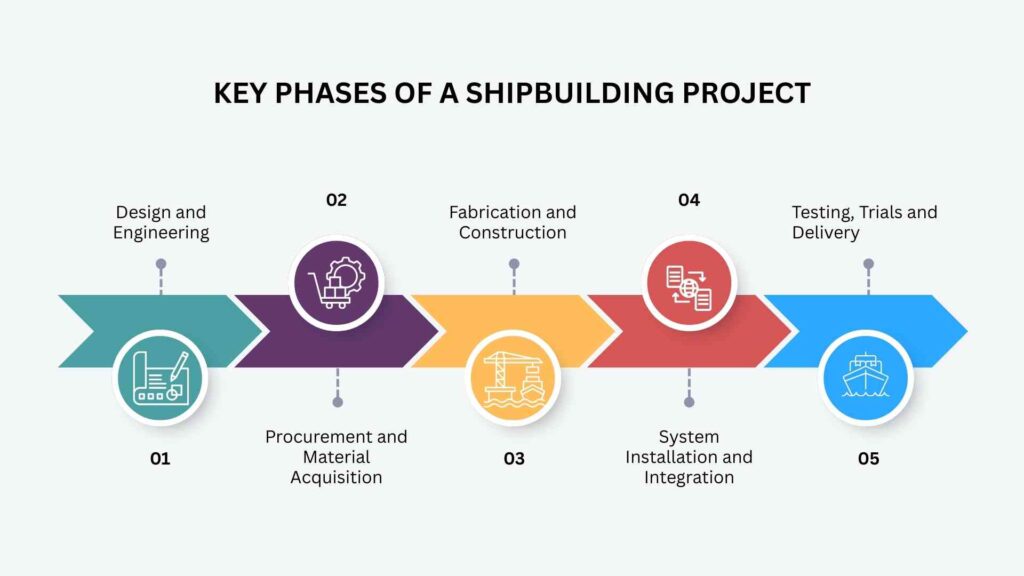
The Phases of a Shipbuilding Project and Their Cost Implications

Every shipbuilding project generally flows through several major phases. Each stage carries its own cost profile and risk dynamics:

Design and Engineering

This is the conceptual and planning stage. Detailed naval architecture, systems integration planning, regulatory compliance assessment, and prototype modeling all happen here.

Cost Drivers:

  • Complexity of design (e.g., specialized naval systems vs. standard commercial hulls)
  • Engineering hours and technical expertise
  • Changes due to later alterations or discovery of feasibility gaps

Impact on Budget: A poorly scoped design increases rework costs downstream and magnifies risk across every subsequent activity.

Procurement and Material Acquisition

Once plans are finalized, critical materials and components are sourced, which involves sourcing everything from steel plates and propulsion systems to electronics and interior fittings. Material costs alone can account for a substantial portion of the total budget, and procurement timing significantly impacts cash flow management.

Cost Drivers:

  • Material market pricing (steel, electronics, exotic alloys)
  • Logistics and import duties
  • Supplier reliability and lead times

Impact on Budget: Delays in procurement or price spikes in key commodities directly affect cash flow and schedule fidelity.

Fabrication and Construction

This represents the most visible phase, where hull sections are fabricated, assembled, and outfitted with machinery, piping, electrical systems, and accommodations. Labor costs peak during this phase, and production efficiency directly impacts the bottom line.

Cost Drivers:

  • Labor costs and productivity
  • Shop infrastructure and equipment utilization
  • Waste and rework due to poor planning or errors

Impact on Budget: This phase often consumes the majority of the budget and schedule. Inefficiencies here cascade into delays and cost growth.

System Installation and Integration

System installation is where mechanical, electrical, propulsion, navigation, communication, and automation systems come together into a single operational vessel. While each subsystem may be completed independently, the real challenge lies in ensuring they function seamlessly as one integrated environment.

Cost Drivers:

  • Complexity of electrical/hydraulic systems
  • Integration challenges between subsystems
  • Testing and commissioning requirements

Impact on Budget: Integration issues often surface late and trigger expensive fixes if they were not anticipated.

Testing, Trials and Delivery

This phase ensures the vessel meets all specifications and regulatory requirements through sea trials, system testing, and final adjustments before handover to the owner.

Cost Drivers:

  • Trial duration and resource allocation
  • Corrections from trial feedback
  • Compliance certification costs

Impact on Budget: Unexpected performance shortfalls can push costs dramatically higher at a point where budgets are already tight.

Major Cost Drivers That Can Impact a Shipbuilding Project

Cost Driver Description
Steel and Raw Materials Raw materials form the bedrock of shipbuilding expenses. Steel prices fluctuate based on global market conditions, and a large commercial vessel can require thousands of tons. Beyond steel, modern ships incorporate aluminum for superstructures, specialized alloys for critical components, and composite materials for weight-sensitive applications.

Exchange rate variations can significantly impact material costs when sourcing internationally, creating budgetary uncertainty that extends throughout the project timeline.

Labor Skilled labor represents one of the most significant and least predictable cost factors. Shipbuilding requires diverse expertise, welders, pipefitters, electricians, painters, and specialized tradespeople. Labor costs vary dramatically by geographic location, and skilled worker shortages can drive up wages or extend schedules.

Productivity rates directly influence labor costs, with experienced teams delivering substantially better cost performance than those learning new vessel types or technologies.

System Integration Complexity Modern vessels are floating networks of interconnected systems that must operate reliably in harsh marine environments. The integration of mechanical, electrical, hydraulic, and electronic systems creates coordination challenges that can significantly impact costs.

When systems from different vendors must interface, compatibility issues often emerge during installation, requiring engineering time, custom adapters, or even equipment replacement. The complexity multiplies with vessel sophistication, specialized vessels like research ships or cruise liners involve far more intricate system integration than basic cargo carriers.

Design Changes and Engineering Revisions Every change order during construction triggers a cascade of costs. A seemingly minor design modification might require reworking already-fabricated components, revising documentation, reordering materials, and disrupting the production schedule.

Late-stage changes prove particularly expensive, as they can necessitate cutting out completed work and affect multiple interconnected systems.

Equipment and Propulsion Systems Main engines, generators, propulsion equipment, and navigational systems represent major capital expenditures. These items often have long lead times, and delays in delivery can idle construction teams and extend the project timeline.

The choice between standard equipment and customized solutions significantly impacts both initial costs and long-term maintenance expenses.

Regulatory Compliance and Classification Meeting international maritime regulations, classification society requirements, and flag state standards adds layers of cost through specialized inspections, testing, documentation, and potentially more expensive materials or construction methods.

Environmental regulations particularly drive costs upward through requirements for emissions control systems, ballast water treatment, and fuel efficiency measures.

Schedule Overruns Time is money in shipbuilding, and schedule delays multiply costs exponentially. Extended construction periods increase labor costs, facility overhead, financing charges, and opportunity costs. Weather disruptions, supply chain problems, workforce issues, or technical challenges can push completion dates back by months, devastating project profitability.

How Cost Overruns Devastate the Bottom line

The financial impact of poor cost control extends far beyond simple budget exceedances. For shipyards, cost overruns on fixed-price contracts can transform profitable projects into money-losing ventures. When actual costs exceed estimates by even moderate percentages, profit margins evaporate entirely.

Cash flow suffers as unexpected expenses accelerate, potentially creating liquidity problems that affect other projects or operations. Reputation damage from cost and schedule overruns makes winning future contracts more difficult and may force yards to accept lower margins to remain competitive.

For vessel owners, construction cost increases may necessitate additional financing, reducing return on investment and potentially making the vessel economically unviable for its intended service. In competitive shipping markets, even small cost disadvantages can mean the difference between profitable operations and financial struggle.

Streamlining Cost Through Technology and Process Optimization

A successful shipbuilding project begins with realistic, comprehensive cost estimates that account for all major variables and include appropriate contingencies for uncertainty. Accurate projection enables better decision-making at every stage, from initial bidding through construction planning and change order evaluation.

Modern cost estimation moves beyond simple percentage markups on material and labor to incorporate historical data analysis, risk assessment, and scenario modeling. This approach identifies potential problem areas before they impact the schedule or budget, allowing proactive mitigation strategies.

Forward-thinking shipyards increasingly leverage technology to improve cost performance. Digital design tools reduce engineering hours and minimize errors that lead to costly rework. Production planning software optimizes material usage and construction sequencing, reducing waste and improving labor productivity.

Supply chain management systems provide visibility into material costs and delivery schedules, enabling better procurement decisions and reducing inventory carrying costs. Real-time project tracking allows managers to identify cost variances early when corrective action is most effective and least expensive.

How YARDOS Estimation Streamlines Cost Management

YARDOS Estimation App addresses the fundamental challenges shipbuilders face in cost estimation and project bidding through purpose-built tools designed for maritime construction complexity.

Comprehensive Cost Libraries within YARDOS Estimation App provide detailed breakdowns of labor, materials, and equipment costs specific to shipbuilding activities. Rather than starting from scratch or relying on outdated spreadsheets, estimators access current, validated cost data that reflects real-world conditions across all phases—from initial design through system integration and commissioning.

Parametric Estimation Capabilities allow rapid cost modeling based on vessel characteristics like size, type, complexity, and intended service. This enables quick feasibility assessments and “what-if” analyses that help teams understand cost implications of design alternatives before committing to detailed engineering.

Historical Data Integration leverages past project performance to improve future estimates. YARDOS Estimation App helps organizations capture lessons learned and actual cost data from completed projects, creating increasingly accurate estimates as the database grows. This is particularly valuable for the system installation and integration phase, where historical productivity data can reveal how long it actually takes to install and connect complex machinery and electrical systems.

Phase-Specific Cost Tracking allows project managers to monitor expenditures against budgets for each phase of the shipbuilding lifecycle. By understanding where costs accumulate during conceptual design, engineering, procurement, construction, system installation, and commissioning, teams can intervene early when variances emerge rather than discovering overruns at project completion.

System Integration Cost Modeling helps estimators account for the unique challenges of the installation and integration phase. YARDOS Estimation App can track labor requirements for different system types, coordination costs between trades, and the time required for testing and troubleshooting integrated systems, factors that are often underestimated in traditional estimation approaches.

Streamlined Bid Preparation transforms the traditionally labor-intensive proposal process. Rather than spending weeks compiling estimates from multiple sources and formats, teams use YARDOS Estimation App to generate comprehensive, professional bid packages in significantly less time. This efficiency allows estimators to focus on accuracy and competitiveness rather than mechanical data assembly.

Collaboration Features ensure all stakeholders work from a single source of truth. Engineering, procurement, production, and finance teams access the same cost data and assumptions, eliminating the miscommunications that often lead to budget problems. During system installation, when electricians, pipefitters, HVAC technicians, and automation specialists must coordinate closely, this shared visibility becomes even more critical.

Scenario Analysis Tools let estimators quickly model different construction approaches, material choices, or schedule options, identifying the most cost-effective path forward before committing resources. For example, teams can evaluate whether to install systems modularly before hull sections are joined or to install them after assembly—each approach carries different cost and schedule implications.

In shipbuilding, costs are everywhere, but unmanaged costs are avoidable. Understanding the major cost drivers in each project phase and adopting tools that bring visibility, consistency, and collaboration can transform risk into predictability.

What is Parametric Estimation for Complex Project

Parametric estimation offers a data-driven approach to forecasting costs in complex projects, making it invaluable for industries like aerospace engineering, shipbuilding, MRO (maintenance, repair, and overhaul), and defense, where traditional methods often fall short.

Key Challenges in Cost Control

Complex projects in these sectors face unpredictable variables such as fluctuating material prices, regulatory compliance demands, supply chain disruptions, and evolving design specifications. Labor variability, driven by specialized certifications and multi-phase execution, further complicates accurate budgeting, often leading to overruns, bid rejections, or eroded profit margins.

Fragmented data across spreadsheets and emails exacerbates issues like poor traceability, version control errors, and reliance on subjective expertise, hindering repeatability and audit readiness.

What is Parametric Estimation?

Parametric estimation leverages statistical relationships, known as Cost Estimating Relationships (CERs), between key project parameters, like weight, thrust, or hull dimensions, and historical costs to generate quick, scalable predictions.

Unlike bottom-up methods that detail every component, it excels in early-stage planning by using validated models derived from past data, providing a “reasonableness check” for more granular estimates. This top-down technique shines in low-design-maturity phases, enabling rapid iterations for proposals while improving defensibility through data traceability.

Parametric vs Bottom-up Estimation

Parametric estimation uses statistical models based on historical data and key parameters (e.g., aircraft weight or ship displacement) for rapid, high-level forecasts, ideal for early project stages with limited design details. Bottom-up estimating, by contrast, aggregates detailed costs from individual components, labor hours, and materials, offering precision but requiring full design maturity and extensive time. Parametric provides speed and scalability for initial bids, while bottom-up serves validation; hybrid approaches combine both for optimal accuracy across project phases.

Benefits for Aerospace, Shipbuilding, Maritime MRO, and Defense

In aerospace and defense, parametric models integrate engineering drivers like speed or power to forecast production costs early, supporting compliant bids amid strict audits. Shipbuilding benefits from CERs tied to naval program data, accelerating pricing for tenders and change orders while balancing realism and speed. For MRO, it handles unique scopes, like hidden damage post-teardown, by automating variable-based calculations for labor, parts, and multi-period phasing, reducing guesswork in aviation or maritime repairs.

The Challenges of Cost Control in Complex Engineering Projects

Projects in aerospace, defense, shipbuilding, and MRO environments share common complexity dynamics:

  1. Multi-Dimensional Cost Drivers: Engineering projects involve hundreds of interdependent variables, from labor hours and material requirements to compliance testing, interoperability specifications, and configuration management. Each of these can significantly influence cost. Relying on static cost models or rule-of-thumb percentages often fails to capture these interactions.
  2. Data Fragmentation: Large organizations frequently struggle with siloed systems. Costing teams may rely on disparate spreadsheets, disparate project repositories, or legacy enterprise systems that do not talk to each other. This makes it hard to extract clean, comparable historical data that’s needed for accurate forecasting.
  3. Schedule and Scope Volatility: Requirements often evolve as design matures, testing reveals new issues, or operational priorities shift. Without a dynamic cost model that updates in real time, decision-makers are forced to choose between inefficient manual re-estimation or operating with outdated forecasts.
  4. Contract and Compliance Risk: Many engagements in defense or aerospace involve fixed-price or incentive-based contracts. Inaccurate estimation not only erodes margins, it exposes firms to performance penalties, strained client relationships, and compliance concerns.

Best Practices for Parametric Estimation

To maximize the value of parametric cost models, organizations should adhere to proven practices:

  • Collect High-Quality Data: Parametric accuracy depends on the data feeding the model. Ensure historical project datasets are clean, relevant, and sufficiently granular. Where possible, normalize data to remove anomalies.
  • Select Meaningful Parameters: Not all variables are equally predictive. Invest time in identifying the parameters that truly correlate with cost, whether performance metrics, physical characteristics, or risk indicators.
  • Validate and Calibrate Models: Models should be tested against known outcomes to evaluate performance. Regular calibration ensures that estimates remain aligned with evolving technology and market conditions.
  • Integrate Across Functions: Cost estimation is not a standalone exercise. Integrate models with engineering, supply chain, and project financial systems to update forecasts as changes occur.
  • Document Assumptions and Limitations: Transparency builds trust. Maintain clear documentation of model assumptions, confidence levels, and scenarios where the model may not apply.

How Parametric Estimation Improves Cost Control

When implemented effectively, parametric estimation supports organizations by:

  • Delivering faster, data-backed cost forecasts early in the program lifecycle
  • Reducing reliance on manual rework when scope or requirements change
  • Enhancing scenario planning and risk quantification
  • Enabling consistent benchmarking across programs and divisions
  • Supporting compliance with defense acquisition cost reporting requirements

How YARDOS Estimation Helps

YARDOS Estimation streamlines parametric estimation with a centralized platform for reusable calculators, historical data libraries, and real-time collaboration tailored to MRO and complex bids. It supports variable-driven models, multi-period tracking, and role-based access, enabling faster, defensible proposals that capture institutional knowledge and minimize errors. 


In 2016, we started building a shipyard software company alongside our consulting practice.

When our founder, Jonathan Malanche, launched Oxalis in 2016, we were a technology consultancy drawn to hard problems, regulated industries, and organizations everyone else found too difficult to serve. We didn’t have a vertical focus and a predetermined market. We had a belief that if we showed up with real rigor and stayed close to the work, we could figure out almost anything.

A maritime practice emerged, and we kept running into the same problem. The processes that drive a Navy availability, condition-found reports, change orders, test and inspection plans, ran on paper and institutional knowledge. It was slow, error-prone, and invisible to leadership until something went wrong. We ran a build-versus-buy analysis. Nothing compliant existed. So we built OSRS, the Oxalis Ship Repair System.

We built it on a server that gave us an enterprise-grade workflow engine without building one from scratch. It was not elegant, but it was effective. Shipyards started asking for it.

We kept building, and our presence in the yards deepened. We learned ship repair by walking the yard, sitting in the contractor-customer meetings, and watching how information moves, and stops moving, across a yard in the middle of an availability. The terminology, the standards, NAVSEA requirements, the way the commercial estimating cycle runs, none of it maps cleanly to generic software.

Out of that work came OAE, Oxalis Advanced Estimation. Estimating was still broken. A yard’s bid either reflected reality or it found out at execution what it should have known at proposal. We built OAE because nothing purpose-built existed. It went into production and has been running availabilities ever since. Yards still run it today.

What we learned from OAE, and from years of running OSRS, is that the real problem in ship repair is not any one part of the lifecycle. It is the handoffs between parts. Estimation runs in one system, execution in another. The data that should inform the next bid, what you found when you opened the hull, the actual labor hours, what changed, gets lost between project close and the next award. Every yard re-learning lessons it already paid to learn.

That is the problem YARDOS was built to solve.

YARDOS is the product that OSRS and OAE were pointing toward. A unified platform for the full lifecycle of ship building and repair, including estimation, proposal, execution, warranty, sustainment. A system that captures intent and decisions at every stage, not just outputs. AI embedded in the workflows where it actually helps with safety agents monitoring against NAVSEA standards, leadership agents translating plan-of-the-day data into role-specific visibility, research agents surfacing lessons from past availabilities before you need them. Mobile-first, because the people who need this system are not sitting at desks.

We are launching YARDOS in 2026.

The maritime industrial base is under pressure it has not seen in decades. The Navy needs ships sustained faster. Yards are running the same workforce across new build and repair, under tighter schedules and evolving compliance. The organizations that come through it well are the ones that stop losing institutional knowledge at every project boundary.

We have been building toward this for ten years. This year, that work becomes YARDOS. It starts with YARDOS Estimation: the OAE yards already run, enhanced and carried into YARDOS.

If you bid availabilities, run estimating for a yard, or are tired of losing institutional knowledge between proposal and execution, start with YARDOS Estimation.

Going Private: What Atlassian Isolated Cloud Means for Security-First Enterprises

At a Glance: What Atlassian Isolated Cloud Means for Secure Cloud Adoption

Atlassian Isolated Cloud is a single-tenant cloud deployment model built for organizations with elevated security, compliance, and data sovereignty needs. Launching in 2026, it offers complete tenant isolation, dedicated resources, and advanced governance—combining the control of Data Center with the agility of Atlassian Cloud. In this blog, Oxalis breaks down how Isolated Cloud compares to Government Cloud and Data Center, who it’s built for, and how highly regulated enterprises can modernize with confidence.

For highly regulated organizations, cloud adoption is no longer a question of if—it’s a question of how to do it securely, confidently, and without sacrificing control.

At Team ’25, Atlassian introduced a powerful new option to meet that challenge: Atlassian Isolated Cloud.

Set to launch in 2026, Isolated Cloud is designed for enterprises and public sector agencies that need all the innovation of Atlassian Cloud—but with the added assurance of complete tenant isolation, advanced customization, and increased governance.

At Oxalis, we’ve helped clients in defense, government, and critical infrastructure navigate the complexities of cloud modernization. Here’s what you need to know about Isolated Cloud, how it compares to other deployment models like Government Cloud and Data Center, and how to decide what’s right for your organization.

What is Atlassian Isolated Cloud?

Atlassian Isolated Cloud is a single-tenant cloud environment fully managed by Atlassian, designed for customers with heightened security, compliance, or data residency needs.

Key Features:

  • Complete tenant isolation: Your infrastructure is physically and logically separate from all other Atlassian customers.
  • Dedicated compute and storage resources: Eliminates shared resource concerns and reduces potential exposure risk.
  • Support for custom compliance requirements: Designed to accommodate industry-specific and national regulations not addressed by shared SaaS environments.
  • Advanced governance: More granular control over access, data handling, and system configurations.
  • Managed by Atlassian: You get the benefits of cloud—scalability, performance, uptime—without needing to manage the infrastructure yourself.

This model offers a compelling middle ground: the control of a private instance with the convenience of a cloud-native platform.

How Is Isolated Cloud Different from Government Cloud?

Both solutions are built with security and compliance in mind—but they serve different use cases.

Feature Government Cloud Isolated Cloud
Hosting Environment U.S.-based, multi-tenant Single-tenant, fully isolated
Compliance Level FedRAMP Moderate (available); High & IL5 (planned) Supports advanced/custom compliance (including global needs)
Deployment Timeline Early Access now Launching in 2026
Best For U.S. federal agencies and contractors Any enterprise requiring strict data sovereignty, full tenant isolation, or custom regulatory adherence
https://oxalis.io/why-atlassian-government-cloud-is-the-future-for-public-sector-teams/

In Short:

  • Government Cloud is ideal for U.S. federal agencies.
  • Isolated Cloud is broader—it supports private sectordefense contractorsinternational agencies, and any organization with global compliance or segregation requirements.

How Is It Different from Data Center?

Atlassian Data Center has long been the go-to solution for customers requiring control, custom hosting, or on-prem deployments. So where does Isolated Cloud fit?

Feature Data Center Isolated Cloud
Hosting Model Self-hosted or partner-hosted Fully managed by Atlassian
Maintenance Responsibility Customer or third party Atlassian
Scalability Manual Elastic (cloud-native)
Innovation Access Slower Immediate
Security Controls Full control, but self-managed Strong controls with cloud oversight
Use Case Organizations with strict on-prem mandates or no cloud access Organizations ready for cloud, but needing high isolation and control

Why Atlassian Isolated Cloud It Matters:

Isolated Cloud is ideal for organizations that want to modernize securely—moving away from legacy infrastructure while preserving strict control over their environment.

It also aligns with Atlassian’s long-term direction: as support for Data Center products winds down, Isolated Cloud offers a forward-looking, compliant cloud path.

Who Is Isolated Cloud For?

Isolated Cloud is designed for organizations where data sensitivity, sovereignty, or compliance is non-negotiable:

  • Defense and National Security Agencies
  • Aerospace and Maritime Contractors
  • Global Financial Institutions
  • Healthcare and Life Sciences
  • Critical Infrastructure Providers
  • SLED Agencies with State-Specific Hosting Requirements

If your teams are working in environments where “good enough” isn’t secure enough, Isolated Cloud offers the confidence and control you need—without losing the velocity of cloud innovation.

How Oxalis Can Help

At Oxalis, we specialize in helping complex, highly regulated organizations make smart transitions to the cloud.

Whether you’re considering Government Cloud, Isolated Cloud, or modernizing away from Data Center, we can support you every step of the way:

  • Cloud strategy and roadmap development
  • Security and compliance advisory
  • Migration planning and execution
  • Governance frameworks and access models
  • Change management and user adoption enablement

We’ve done this for organizations at every level—from state health departments to national defense contractors—and we’re ready to help you move forward with confidence.

Let’s Talk About What’s Right for You

Atlassian Isolated Cloud represents a major leap forward for cloud security and compliance—and we’re excited to help our clients explore what it makes possible.

Want to learn more or start planning your move?
Schedule a Discovery Session and let’s explore which Atlassian cloud option best fits your organization’s mission, risk profile, and goals.


Atlassian Cloud Pricing Changes: What Oxalis Customers Need to Know

Prepare for upcoming adjustments to Atlassian Cloud pricing and packaging, effective October 16, 2024.

Adjustments to Atlassian Cloud pricing will affect various products and plans, including Jira, Confluence, Jira Service Management, Opsgenie, Bitbucket, Atlassian Guard, and Compass.

Why is Atlassian Making These Changes?

Atlassian is committed to continuous innovation and improvement. These pricing adjustments reflect their ongoing investment in enhancing their suite of products and solutions, ensuring they remain the best—and still the most cost-effective—tools for empowering teams and businesses to work better and more productively.

What You Need to Know:

  • List price increases: Atlassian will increase list prices for several products, ranging from 5% to 20%, depending on the product and plan.
  • Jira Service Management packaging changes:
    • Atlassian will move advanced incident, problem, and change management features exclusively to Premium and Enterprise plans. This includes features such as incident conference calls, chat tools, major incidents, Post-Incident Reviews, change management functionalities, automated risk assessments, CI/CD integrations, and problem management capabilities.
    • Atlassian will introduce consumption-based pricing for Assets objects and Virtual Service Agent assisted conversations in Premium and Enterprise plans. Premium and Enterprise customers will receive 50,000 Assets objects and 1,000 Virtual Service Agent assisted conversations per month at no additional cost. Usage beyond these limits will incur charges of $0.05 USD per object per month and $0.30 USD per assisted conversation per month, respectively, with volume discounts available.

Atlassian Cloud Pricing Grace Periods and Transition Plans:

  • Jira Service Management Standard customers:
    • If you haven’t used the advanced features moving to Premium in the past six (6) months, you will not be offered a grace period.
    • If you are actively using these features, you will receive a 12-month grace period upon your next renewal on or after October 16, 2024. After this period, you will need to upgrade to Premium or Enterprise to continue using these features.
  • Jira Service Management Premium and Enterprise customers: You will receive a 12-month grace period upon your next renewal on or after October 16, 2024, for the consumption-based pricing. After the grace period, you have the option of a three (3)-year advantaged plan to gradually transition to full limit pricing.

How Will the Changes to Atlassian Cloud Pricing Affect You?

Talk to Us

Oxalis firmly believes that Atlassian’s solutions are best-in-class and offer unparalleled opportunities to enhance organizational efficiency and productivity. While we acknowledge that these tools represent a significant investment, we view them as a crucial investment in your future and the long-term success of your business.

Our goal is to ensure you’re extracting maximum value from your Atlassian investment. We specialize in process analysis and consumption rate optimization, helping you identify areas where you may be overspending or underutilizing your licenses. We can also assist in building a compelling use case and justification for continued investment, demonstrating the tangible benefits and ROI of the Atlassian platform.

Navigating the complexities of Atlassian licensing, from Premium to Enterprise and Standard plans, can be daunting. Oxalis’ expertise lies in deciphering these intricacies, ensuring you have the right licenses for your needs and optimizing your investment. Let us guide you through the process and help you achieve your goals.

Remember, you’re not alone in this.

We Understand

We recognize that news of price increases is never welcome. At Oxalis, we’re committed to working closely with each of our customers to minimize the impact of these changes. Our team of experts will help you evaluate your current usage, explore potential cost-saving strategies, and develop a plan to ensure a smooth transition. We’re here to support you every step of the way.

Don’t Get Caught Off Guard: Consult with Oxalis Today

Your dedicated Oxalis consultant will be in touch soon to schedule a conversation about these changes and how they might impact your organization. We understand that every organization has unique needs and budgetary considerations. Let’s work together to ensure you’re getting the most value out of your Atlassian investment. We’re experts at navigating the complexities of Atlassian licensing, from Premium and Enterprise to Standard plans, and we’re here to guide you every step of the way.


Your Partnership Matters

Oxalis values your partnership and are committed to your long-term success. We look forward to working with you for years to come, navigating the ever-evolving technology landscape and ensuring your Atlassian investment continues to deliver exceptional value.

Recommended blog post:

Full Steam Ahead: Propelling Shipyards into the Digital Age with ShipyardOS

The U.S. shipbuilding and repair industry is at a crossroads. We’re facing stiff competition from around the globe, and it’s clear that the old ways of doing things just aren’t cutting it anymore. We need to embrace the digital age, not just by adopting shiny new technologies, but by fundamentally transforming how we use data to run our businesses.

That’s where ShipyardOS comes in. It’s not just another software solution; it’s a vision for a smarter, more connected, and more efficient shipyard. Think of it as the operating system for your entire operation, designed to harness the power of data and propel you ahead of the competition.

From Gut Feeling to Hard Data: Making Smarter Decisions, Faster

At its core, ShipyardOS is about empowering every person in your shipyard with the data they need to excel. Imagine a world where your estimators have real-time insights into past project performance, where your production teams can track progress in real-time, and where your executives have a bird’s-eye view of the entire operation, all fueled by data.

This isn’t some far-off dream; it’s achievable today. The technologies are mature, and the potential benefits are enormous. But it requires a shift in mindset — a move away from reactive IT towards a proactive, data-driven approach.

Building Blocks for a Digital Shipyard: The Tech Stack that Powers ShipyardOS

Building ShipyardOS starts with a solid technological foundation. Think of it as laying the groundwork for a digital shipyard. This involves:

  • Strong identity management: Making sure the right people have access to the right data at the right time.
  • Seamless data exchange: Breaking down data silos so information flows freely across departments.
  • Powerful analytics: Turning raw data into actionable insights that drive decision-making.
  • Smooth integration: Making it easy to add new technologies as your shipyard evolves.
  • Smart automation: Streamlining repetitive tasks and freeing up your team for more strategic work.

Setting Sail: Your Shipyard’s Digital Transformation Roadmap

We understand that every shipyard is at a different stage in its digital transformation journey. That’s why we’ve developed a maturity model to guide you. It helps you assess where you are today and chart a course towards a fully data-driven shipyard.

Take ship maintenance and repair, for example. The journey might start with digitizing work orders and production management. Then, you could integrate data across teams and stakeholders, build a common data platform, and eventually leverage predictive maintenance and even cutting-edge technologies like AR and robotics.

Rising Tides Lift All Boats: ShipyardOS and the Future of the Maritime Industry

ShipyardOS isn’t just about individual shipyards; it’s about transforming the entire maritime industry. Imagine a world where shipyards, suppliers, and the U.S. Navy all speak the same data language, collaborating seamlessly to build and maintain the ships that keep our nation strong.

The U.S. Navy, in particular, has a huge role to play. Their standardized work patterns offer a blueprint for industry-wide best practices. By working together, we can create a more efficient, innovative, and resilient maritime ecosystem.

Don’t Miss the Boat: ShipyardOS is Your Ticket to a Smarter Shipyard

ShipyardOS is a call to action for the maritime industry. It’s time to move beyond reactive IT and embrace a data-driven future. The tools and technologies are ready; what’s needed is the vision and commitment to make it happen.

ShipyardOS isn’t just about technology; it’s about transforming your business. It’s about empowering your people, streamlining your operations, and achieving sustainable success in the digital age. The future of shipbuilding is data-driven, and ShipyardOS is your roadmap to get there.


The Power of GenAI: With Great Power Comes Great Responsibility

The froth surrounding Generative AI (GenAI) tools like ChatGPT, Gemini, and Copilot is undeniable. These powerful large language models (LLMs) can create realistic text, translate languages, and even write different kinds of creative content. But for highly regulated industries — think shipping, healthcare, or government — the excitement comes with a healthy dose of caution. 

California’s Executive Order N-12-23 provides a valuable framework for navigating this complex landscape. It acknowledges the immense potential of GenAI while emphasizing responsible use. The EO’s directives — procurement guidelines, high-risk use inventories, pilot project sandboxes, and government worker training — all point toward a measured approach. 

California’s Executive Order N-12-23: Breaking Down the Directives & Their Implications

Let’s dive deeper into how the directives in the EO can translate into concrete actions within high-compliance industries. 

Procurement Guidelines: These guidelines ensure responsible acquisition of GenAI tools. In healthcare, for instance, procurement guidelines could mandate that hospitals only acquire AI-powered medical diagnostics that are FDA-approved. This ensures adherence to patient safety regulations. Similarly, in the U.S. public sector, procurement guidelines could emphasize data security and privacy when acquiring AI for public service applications. 

High-Risk Use Inventories: These inventories help identify situations where GenAI use poses significant risks. For example, a high-risk use inventory in the shipping industry might highlight autonomous ship navigation as a high-risk area. Extensive testing in pilot project sandboxes would be mandatory before real-world implementation. Similarly, in healthcare, high-risk use inventories might highlight AI for personalized drug dosages. Careful evaluation and sandbox testing would be crucial to ensure patient safety and efficacy. 

Pilot Project Sandboxes: These sandboxes allow controlled experimentation with GenAI in low-risk environments. This allows regulated entities to test functionalities, identify potential issues, and refine their GenAI strategy. The U.S. public sector could use sandboxes to test AI-powered chatbots for citizen inquiries. This would allow for evaluation of effectiveness and identification of any potential biases before deploying the technology at scale. 

Government Worker Training: Training government workers on responsible GenAI use is critical. This training could cover topics like bias detection in AI outputs, understanding limitations of GenAI, and legal and ethical considerations. In healthcare, for instance, training would equip healthcare workers to identify patient bias in AI-driven decisions. This ensures that medical professionals maintain a human-centric approach while leveraging the power of AI. 

Challenges and Opportunities in a Regulated Landscape

Highly regulated industries share a common set of challenges when it comes to GenAI adoption. Let’s take a closer look: 

  • Safety and Security: From ensuring safe maritime routes to protecting patient health data, safety is paramount. GenAI outputs must be thoroughly vetted to mitigate bias and ensure accuracy in critical decision-making. 
  • Transparency and Explainability: Public trust is essential in government, healthcare, and other regulated sectors. GenAI models need to be transparent, allowing users to understand how they arrive at their outputs. 
  • Compliance and Governance: Existing regulations need to be considered when deploying GenAI. Frameworks like NIST’s AI RMF provide guidance, and robust governance processes ensure responsible use within legal boundaries. 

These challenges are outweighed by the immense opportunities GenAI offers: 

  • Enhanced Efficiency: GenAI can automate routine tasks, freeing up human expertise for higher-level analysis and decision-making. 
  • Improved Insights: GenAI can analyze vast amounts of data, uncovering hidden patterns and generating valuable insights across various sectors. 
  • Innovation and Personalization: GenAI unlocks new possibilities for innovation, from personalized healthcare to more efficient government services. 

By navigating the challenges and embracing the opportunities, highly regulated industries can leverage GenAI to achieve significant advancements. It’s here that leveraging a suite of solutions, like those built by Atlassian — a trusted company with guardrails in place — can help high-compliance industries adopt GenAI technology, use it to maximum advantage and, most importantly, use it responsibly and safely. 

Unlocking the Potential of Generative AI in Regulated Industries:
A Cautious and Collaborative Approach 

The opportunities presented by Generative AI (GenAI) are vast for highly regulated industries. From automating tasks to gleaning deeper insights from data, GenAI can revolutionize the way these sectors operate. However, responsible adoption is paramount; ensuring safety, transparency, and compliance requires a thoughtful and collaborative approach. 

This is where Atlassian shines. Its suite of tools fosters seamless collaboration across teams, empowering organizations to navigate the GenAI landscape effectively. Let’s delve into the ways Atlassian equips you to harness the power of GenAI while prioritizing responsible use. 

Keeping Teams Aligned: Collaboration is King

Atlassian products excel at fostering collaboration within and across teams of all sizes. This is crucial for managing GenAI effectively. Here’s how: 

  • Confluence: Your Policy and Playbook Hub 
    Create and maintain clear guidelines for GenAI use and deployment within Confluence. This central repository offers easy access to policies, procedures, and playbooks, with version control ensuring everyone stays on the same page, even as best practices evolve. 
  • Inventorying Use Cases with Jira Service Management 
    Leverage Jira Service Management’s asset management capabilities to track GenAI use cases. Score use cases based on pre-defined criteria using custom fields. Create tickets for follow-up and evaluation, ensuring each use case is thoroughly assessed. 
  • Learning from the Field 
    Atlassian understands the importance of capturing insights from all stakeholders. The Jira Service Management customer portal allows you to collect usage data and feedback directly from those interacting with GenAI tools. 

Pilot Projects & Sandboxes: Learning from Controlled Environments 

Effective pilot projects and sandboxes require enterprise-wide visibility. Atlassian provides the tools to achieve this: 

  • Atlas: Sharing Across Teams 
    Use Atlas for horizontal information sharing across departments. Disseminate pilot project goals, approaches, and outcomes, ensuring lessons learned translate into improved GenAI adoption. 
  • Connecting Strategy to Execution  
    Align individual project goals with top-level strategic objectives using Jira Align. This fosters a unified approach to GenAI implementation across the organization. 
  • Confluence: Capturing Knowledge, Sharing Success  
    Leverage Confluence to document pilot project learnings and disseminate final reports and outcomes. This centralized knowledge base helps future projects build upon past successes. 

The Power of Built-In AI

Atlassian products themselves leverage AI, offering a familiar and trusted environment for GenAI exploration. The benefit? Built-in guardrails ensure responsible use. 

From smart suggestions in Jira to AI-powered summaries in Confluence, Atlassian provides a range of AI features designed to augment human expertise. These tools operate within a framework of trust and safety, fostering responsible innovation. 

Effective GenAI implementation goes beyond tools. Consider these additional elements: 

  • Incident Management: Things will go wrong. Leverage Atlassian tools for incident management. JSM tickets, Confluence documentation, and Jira Align can be used to collaboratively develop incident response plans and track resolutions. 
  • Prompt Repositories: Prompt development is crucial for GenAI success. Capture and store prompts in Confluence or Bitbucket, ensuring consistency and knowledge sharing across teams. 
  • Governance & Risk Management: The California EO mandates leveraging frameworks like NIST’s AI RMF. JSM Assets helps manage risks, ensuring alignment with chosen frameworks and facilitating regular reviews with robust reporting. 

The Future of GenAI: Responsibility is Key 

GenAI presents a generational opportunity, but responsible adoption is key. Atlassian, alongside partners like Oxalis, can help you navigate this exciting landscape. Whether you require specific tools, a comprehensive governance framework, or assistance with change management, Oxalis can guide you from strategy to implementation. Following frameworks like California’s EO and leveraging solutions like Atlassian’s suite of products, as well as the experience and guidance of Oxalis, will enable responsible adoption, maximizing the potential of GenAI while safeguarding public trust. 

Remember, the “gates are open,” but let’s walk through them thoughtfully, together. 

Charting Your Course: Expert Tips for Migrating from Cherwell to JSM

With Ivanti’s announcement in October 2023 that they would “End of Life” Cherwell Service Management in 2026, Cherwell users are asking themselves the question, “Now what?” There has been much uncertainty and concern about Cherwell’s future since it was acquired by Ivanti in 2021 and now, with those fears realized, these users must evaluate alternative solutions. Cherwell End of Life (EOL) won’t be reached for another two years, but large-scale ITSM migrations are complex and time-consuming; the time to move to a new solution is now.

Jira Service Management (JSM) — named a leader in the 2023 Forrester Wave™ for Enterprise Service Management and the Gartner Magic Quadrant™ for IT Service Management (ITSM) — is a flexible, powerful, cost-effective solution that is built for high-velocity teams. Unlike Ivanti’s Cherwell, which has an outdated user interface and a hard-to-navigate platform, Jira has a modern user interface, a built-in reporting engine, a large customer base and app ecosystem, end-to-end ITSM capabilities, and seamless, automatic upgrades. 

With the support of an industry-leading firm like Oxalis — an Atlassian Platinum Solutions Partner — Jira Service Management makes the transition from Cherwell seamless and simple and gives those cast adrift by Cherwell just what they need: a home.

What Cherwell’s End of Life (EOL) means for customers.

Cherwell was acquired by Ivanti in 2021, and since then, Ivanti has focused on integrating its capabilities into their broader portfolio, fueling speculation about Cherwell’s future. Now, they will sunset the platform, forcing their customers to make a choice: move to Ivanti’s proprietary solution or migrate to something new.

Though Ivanti will continue to offer support, licenses, and minor updates, it’s important for Cherwell users to recognize that the version of the product they have now is the version they will have until EOL — there will be no new features or upgrades. Other platforms, on the other hand, will keep evolving. They’ll deliver new features and capabilities to keep up with the expanding needs of their customers. To continue delivering the best IT service, support, and management, businesses need something better. Transitioning to new ITSM software is no easy task. It requires planning, careful execution, change management, training and transition management, ongoing review, and more. Organizations should bear several things in mind as they plan for Cherwell’s End of Life and consider alternative IT Service Management platforms. 

Transitioning from Cherwell: Best practices for migration.

When Oxalis helps clients migrate from another platform to Jira Service Management — our ITSM solution of choice — we advocate several best practices:

Assemble a transition team. 

A cross-functional team should include relevant decision makers, specialists, and business leadership. This team will plan, manage, and lead the transition, so it’s imperative that you have all the right roles and delegate responsibilities clearly. 

Consult with advisors. 

The right experts can help with planning, guidance, hands-on support, and migration. Migrations like these are not simple A-to-B transitions. They are not risk-free — and they can be complex and challenging — so it is best to choose a solution provider, like Oxalis, who has deep expertise in ITSM solution design, migrations, and transition, so making the switch is easy.

Evaluate and choose an ITSM platform. 

There are quite a few ITSM solutions available, each with their own pros and cons. Jira Service Management is Oxalis’ ITSM platform of choice. It is robust, it is flexible, and infinitely scalable. And it’s also — relative to other offerings — affordable. Put simply, we think it is the best Cherwell alternative and it provides the easiest transition for Cherwell users. 

Make a plan. 

Moving from one ITSM tool to another might seem like an apples-to-apples switch that should be an easy swap, but even the simplest transitions can take many months to be done right. Without the proper execution and guidance, they can be challenging and error prone. Starting early is critical to avoiding unforeseen obstacles and the occasional, inevitable speed bumps that will arise along the way. 

Involve ALL stakeholders.

Changing systems impacts almost everyone — not just the IT support team. Many categories of supported users, system owners, senior management, business intelligence groups, security, and more will be affected by the transition; representatives from each group should be involved in the planning and decision-making process.

Take advantage of the opportunity.

Don’t copy bad habits. Migrations such as these aren’t simply a matter of moving data and workflows from one platform to another — you also need to avoid replicating mistakes and bad habits in the new platform. Don’t simply make a 1:1 switch; look to improve your overall execution. Let’s say you weren’t using Asset Management. Use the change as an opportunity to improve your information technology infrastructure library (ITIL) maturity. Consultancies, such as Oxalis, can help evaluate and plan your roadmap and perform extensive analyses to ensure mistakes are not duplicated in the new implementation.

Test, test, test. 

Imagine flipping the switch on your entire IT service operation — exciting, right? But before the celebratory high fives, there’s a critical step: thorough testing and quality assurance (QA). Just like a test flight ensures a smooth landing, migrating to a new ITSM platform requires rigorous testing to iron out any wrinkles. This isn’t just about avoiding early hiccups — it’s about safeguarding the user experience, guaranteeing data integrity, and ensuring your team can seamlessly transition without disrupting critical workflows. By investing in robust testing and QA, you’ll land your migration smoothly and be ready to soar with your new platform’s full potential.

Why change management makes migration magic.

A successful ITSM migration isn’t just about flawless data transfer; it’s about winning over your team. Imagine a shiny new platform landing with a thud because your users feel lost in navigation or struggle to complete familiar tasks. Change management and comprehensive training bridge this gap. By actively communicating the “why” and “how” of the move, addressing concerns, and providing thorough training tailored to different user roles, you’ll empower your team to embrace the new platform. This not only fosters user adoption but also ensures a smooth transition, minimizing disruptions and maximizing the positive impact of your migration. A well-trained and engaged team is the secret weapon to unlocking the full potential of your new ITSM platform, leading to a more efficient and ultimately, a happier workforce.

The power of iteration.

Migrating to a new ITSM platform is a marathon, not a sprint. The finish line isn’t the cutover — it’s the ongoing optimization you achieve through continuous learning and iteration. Don’t get us wrong, a smooth transition is crucial, but the real magic happens afterward. By embracing an iterative approach, you can analyze user feedback, identify areas for improvement, and fine-tune your workflows to unlock the platform’s full potential. Think of it as building a muscle — the initial migration lays the foundation, but ongoing use and refinement make it truly powerful. This iterative mindset ensures your ITSM platform grows alongside your organization’s needs, keeping you ahead of the curve and delivering a consistently exceptional service experience.

Why Jira Service Management?

Jira Service Management Logo

The answer to “why Jira Service Management?” can be distilled down to three words: Modern. Complete. Flexible. JSM boasts a user-friendly interface, which means your development, IT, and business teams can finally collaborate seamlessly. Plus, JSM’s flexibility lets you customize workflows to fit your specific needs. The result? Smoother service delivery at high velocity — a win for both your teams and your customers.

Modern.

Jira Service Management (JSM) stands out as a modern platform designed for the evolving needs of today’s organizations. Leveraging the power of the cloud, JSM offers a reliable, all-in-one solution that scales seamlessly alongside your business. Gone are the days of cumbersome installations and outdated features; JSM boasts a user-friendly interface that fosters intuitive navigation, minimizing the learning curve for your team. Furthermore, automatic updates ensure you always have access to the latest features and AI-powered functionalities, keeping your service desk at the forefront of innovation. Atlassian’s commitment to continuous improvement empowers JSM to deliver an exceptional user experience while optimizing your service delivery processes.

Complete.

Jira Service Management (JSM) isn’t just a ticketing system — it’s a complete ITSM powerhouse. Need to track and manage your IT assets? JSM has you covered. Worried about knowledge silos? JSM’s built-in knowledge base empowers you to create a central hub for self-service solutions. And when incidents arise, JSM’s robust incident management features keep your team on top of things. But JSM doesn’t stop there. From the help desk technicians tackling everyday requests to C-Suite executives monitoring performance through data-rich dashboards, JSM caters to all stakeholders, ensuring everyone has the tools they need for success.

Flexible.

Effortlessly scalable, Jira Service Management empowers HR, finance, legal, marketing, facilities, and beyond with its flexible service management approach; its user-friendly interface makes it easy for any team to jump in. And it works for more than just ITSM. Jira Service Management is a powerful tool for managing plants, property, and equipment (PP&E) and Enterprise Service Management (ESM), too. Plus, with customizable templates and a massive marketplace — integrations include Atlassian products, such as Confluence, Bitbucket, and Trello, as well as third-party applications such as Slack, GitHub, and Zendesk — overflowing with add-ons, you can tailor JSM to your specific needs. Whether it’s building a custom service desk from scratch or integrating existing tools, JSM empowers every team to streamline their processes and deliver exceptional service.

Planning for a post-Cherwell era.

Oxalis is an experienced, expert provider of Jira migrations and implementations, as well as ITSM and ITIL service design, offering premium consulting and custom solutions for industries that address real-world challenges. We are an Atlassian Platinum Solutions Partner and have deep knowledge of their suite of products and solutions. We have a proven track record of successful, large-scale Jira migrations — always delivered on time and on budget.

Oxalis are not just your advisors; we are your partners, guides, and technical support staff. Our team of experts can help guide your migration and ensure a smooth transition to your new ITSM platform, so you can take full advantage of the benefits Jira Service Management has to offer. Don’t wait. Contact Oxalis today to start planning your transition from Cherwell. Oxalis will listen. We will take the time to learn about and understand your needs, and we will guide you every step of the way. Don’t get left behind by Cherwell; make a new home with Oxalis and Jira Service Management.