Break Free from Legacy ITSM: A Smarter Approach with Atlassian’s System of Work

How AI, Collaboration, and Knowledge Sharing are Transforming ITSM

Today’s service management landscape looks very different from even a few years ago. IT teams are no longer simply “keeping the lights on”—they are expected to deliver seamless experiences, power business agility, and drive innovation across the organization.

Yet many service teams are still trapped by outdated, siloed systems that slow down progress and create friction between teams.

Atlassian’s System of Work offers a new path forward. By connecting people, processes, and technology through a unified platform, organizations can transform IT Service Management (ITSM) into a strategic advantage.

Today, we’ll explore how the System of Work reimagines service management—and why it’s time to modernize.

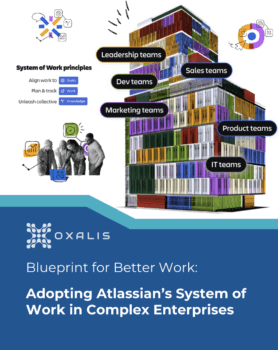
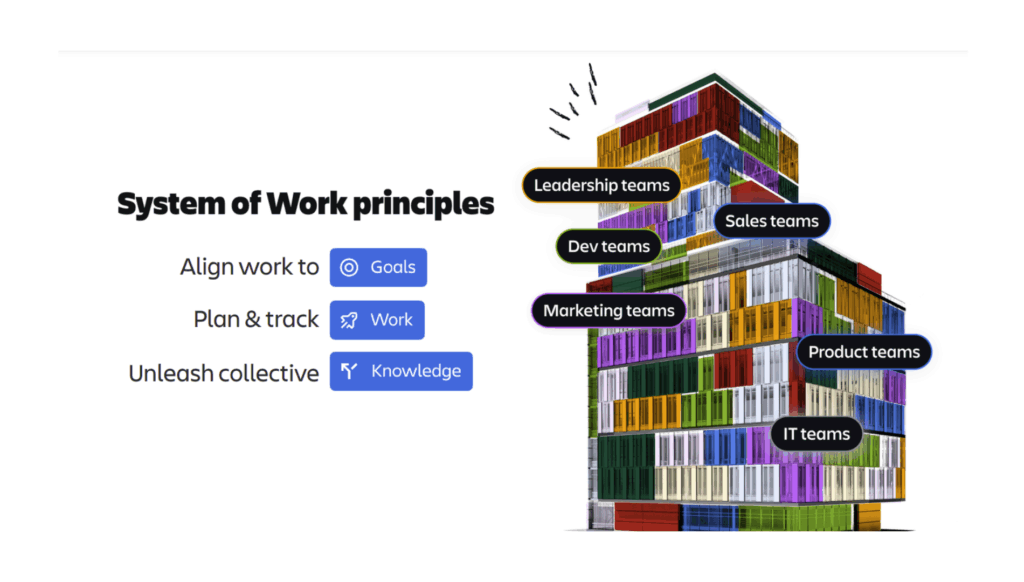
Atlassian System of Work

Why Traditional ITSM Models Are Falling Short

Legacy ITSM systems were designed for a different era—one where IT operated behind a ticket queue, isolated from the rest of the business. In today’s environment, that model creates several major problems:

  • Slow response times due to disconnected tools and manual workflows
  • Limited visibility across teams, making collaboration difficult
  • Fragmented knowledge hidden in silos, inaccessible when needed most
  • Reactive operations rather than proactive, value-driven service

Organizations that want to deliver high-velocity service—and stay competitive—need a better system.

How the Atlassian System of Work Modernizes ITSM

Atlassian’s System of Work is a connected philosophy powered by a tightly integrated platform. It transforms service management in three critical ways:

In this white paper, you’ll discover:

  • How partners like Oxalis bring it all to life through expert implementation, cloud migration, and change enablement
  • Why legacy ITSM and project tools no longer cut it for complex organizations
  • How Atlassian’s Teamwork Graph and Rovo AI supercharge collaboration and decision-making
  • Real-world strategies to unify project management, service delivery, and strategic planning

1. AI-Driven Service Management

With the Teamwork Graph and AI capabilities like Rovo, service teams now have access to intelligent, context-aware automation:

  • Virtual agents can resolve common issues automatically by referencing connected knowledge bases.
  • Smart routing directs tickets to the right team or person based on past trends and context.
  • Real-time summaries allow support teams to respond faster, with key information surfaced instantly.

Example: A service desk agent receives an incident report. Rovo automatically pulls in recent changes from Jira, highlights potential related issues, and recommends a resolution article from Confluence—all before the agent even clicks into the ticket.

The result? Faster resolution times, higher SLA adherence, and more satisfied customers and employees.

2. Cross-Team Collaboration, Built In

Modern service management is no longer just the responsibility of IT. Facilities, HR, Finance, and Security teams are all part of the service delivery ecosystem.

Atlassian’s System of Work makes cross-team collaboration seamless:

  • Jira Service Management allows non-technical teams to manage requests without heavy configuration.
  • Shared workspaces in Confluence and Jira mean incidents, changes, and problems can be tackled together—with full visibility.
  • Linked workflows ensure that escalations between development, security, and operations happen in real time.

Example: When a cybersecurity incident occurs, the service team logs it in Jira Service Management. Linked development and security teams are automatically pulled in through integrated workflows—reducing time to resolution and keeping all stakeholders aligned.

No more disjointed email chains. No more lost handoffs. Just integrated, streamlined service delivery.

3. Knowledge-Enabled Support

Knowledge is the fuel that powers high-velocity service management. But if knowledge is scattered, outdated, or hidden, it can’t drive value.

The System of Work ensures knowledge is:

  • Centralized in Confluence, linked directly to service tickets
  • Dynamic through live updates and crowd-sourced improvements
  • Accessible through intelligent search powered by the Teamwork Graph
  • Automated with AI suggesting relevant articles to agents and customers alike

Example: An employee submitting an IT ticket about VPN access immediately receives an AI-suggested knowledge base article explaining how to troubleshoot common VPN issues—often resolving the problem without ever escalating to IT.

Knowledge sharing doesn’t just make support faster—it turns service teams into enablers of self-service and empowerment.

What This Means for IT and the Business

Modernizing service management with the Atlassian System of Work delivers tangible, organization-wide benefits:

  • Reduced operational costs through automation and faster resolutions
  • Improved employee experiences with faster, smarter support
  • Higher service team morale as routine tasks are automated
  • Greater alignment between IT and business units
  • Data-driven insights into service trends, risk areas, and opportunities for improvement

In short, service management becomes less about reacting to problems—and more about strategically enabling the business to move faster and smarter.

How Oxalis Helps You Unlock High-Velocity Service Management

At Oxalis, we specialize in helping organizations—especially those in highly regulated and complex industries—modernize ITSM with the Atlassian System of Work.

We help our customers:

  • Migrate from legacy ITSM tools like ServiceNow and Cherwell to Jira Service Management
  • Implement cross-team service management practices that scale
  • Activate AI-driven service capabilities like Rovo agents
  • Design knowledge management systems that fuel smarter support
  • Train teams and drive adoption through change enablement strategies

Whether you’re starting fresh or evolving an existing service operation, Oxalis is your partner in delivering high-velocity, connected service management.

Ready to modernize your service management approach?

Contact Oxalis today and let’s build a smarter, more connected future together.

The Evolution of IT Operations: Why Atlassian is Moving Beyond Opsgenie

Since acquiring Opsgenie in 2018, Atlassian has continuously evolved its IT operations capabilities, integrating alerting, on-call management, and incident response features into the Atlassian platform. Now, in a move to simplify and enhance collaboration between IT and development teams, Atlassian has announced the end of support for Opsgenie, effective April 5, 2027.

This transition aligns with Atlassian’s broader strategy: moving key Opsgenie capabilities into Jira Service Management (JSM) and Compass to create a modern, AI-powered IT operations platform.

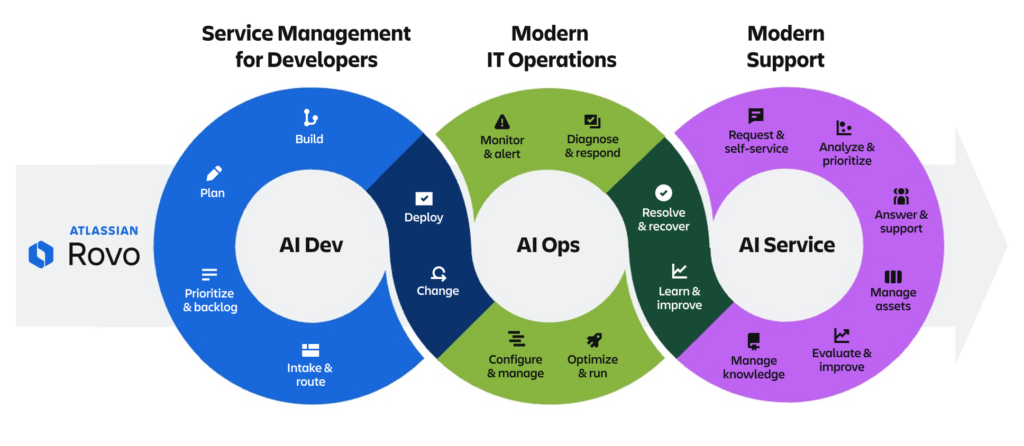
Atlassian Rovo Overview

What’s Changing?

  • Opsgenie will no longer be available for purchase after June 4, 2025 — no new instances will be sold.
  • Opsgenie will be fully retired on April 5, 2027 — all access will be shut down, and unmigrated data will be deleted.
  • Jira Service Management will now own incident, problem, and change management with enhanced alerting capabilities.
  • Compass will provide service and robust alert management, offering context-rich alerts integrated with a comprehensive internal developer platform.

Why the Shift?

Atlassian is doubling down on AI-powered IT operations and consolidating tools to streamline workflows across DevOps, ITSM, and support teams. Instead of managing multiple platforms, teams can now centralize their incident and alerting workflows within Jira Service Management and Compass.

By embedding AI-driven alert grouping, automated alert resolution, and post-incident reviews (PIRs) into this consolidated platform, teams can resolve incidents faster, prevent outages, and increase productivity.

What Should Opsgenie Users Do Next?

Atlassian is offering two migration paths, depending on your organization’s needs:

  • Move to Jira Service Management (JSM) — Ideal for teams needing a comprehensive ITSM solution with built-in incident response, problem, and change management.
  • Move to Compass — Best for DevOps teams looking for advanced alerting and on-call management alongside an intuitive software component catalog.

How Oxalis Can Help

As an Atlassian Platinum Solutions Partner specializing in ITSM and Cloud, Oxalis is here to help your organization navigate this transition smoothly. Our team has deep expertise in JSM migrations, DevOps transformations, and IT operations strategy, ensuring you get the right solution for your needs with minimal disruption.

We can help with:

  • Migration planning and execution – Ensuring a seamless transition from Opsgenie to JSM or Compass.
  • Configuration and optimization – Tailoring JSM or Compass to fit your workflows.
  • Training and enablement – Equipping your teams to get the most out of Atlassian’s modern IT Ops platform.

The clock is ticking on Opsgenie. Don’t wait until the last minute—reach out to Oxalis today to start planning your migration and ensure your IT operations remain uninterrupted.

Contact Us


Don’t Miss These Posts

The Cherwell Sunset: Your Guide to a Brighter ITSM Dawn

For businesses that have relied on Cherwell for years, the EOL news can be unsettling. The thought of migrating to a new platform may conjure images of data chaos, productivity dips, and frustrated users. But fear not! This “Cherwell sunset” doesn’t have to mark the end of efficient service delivery. Instead, it presents a golden opportunity to embrace a brighter ITSM dawn with a future-proof solution.

Enter Jira Service Management (JSM): Your Post-Cherwell Oasis

Jira Service Management, from Atlassian, emerges as a compelling successor to Cherwell. Designed for the modern service desk, JSM offers a robust feature set, intuitive interface, and seamless scalability — all while ensuring a smooth transition for Cherwell veterans.

But how does JSM stack up against Cherwell? What are the key advantages of migrating?

These are just some of the questions we answer in our comprehensive white paper: “A Guide to Jira Service Management for the Cherwell User.” Packed with valuable insights and practical considerations, this guide explores the following:

  • Understanding JSM: This section delves into JSM’s core functionalities, highlighting its similarities to Cherwell. You’ll learn how JSM’s familiar structure, combined with an intuitive interface, minimizes the learning curve for Cherwell users.
  • Beyond Cherwell: JSM’s Advantages: We unveil JSM’s true strengths, showcasing its unmatched capabilities for fostering collaboration, streamlining workflows, and integrating seamlessly with other Atlassian tools. Discover how JSM empowers your organization to break free from the limitations of legacy systems and embrace a truly agile, collaborative ITSM approach.
  • Migration Considerations: We address potential concerns about data migration and user adoption. Learn about proven strategies for minimizing disruption and ensuring your team feels comfortable and empowered in the new JSM environment.
  • The JSM Advantage: Quantifiable Benefits: Facts speak louder than words! This section delves into real-world case studies showcasing successful migrations from Cherwell to JSM. We also summarize the key findings from the Atlassian-commissioned Forrester Total Economic Impact (TEI) report, highlighting the compelling ROI and potential cost savings JSM can bring to your organization.

Why Choose JSM over Other Solutions?

While numerous ITSM platforms exist, JSM stands out for several reasons:

  • Familiar Yet Evolved: JSM’s core functionalities share similarities with Cherwell, ensuring a smooth transition for users. However, JSM goes beyond, offering greater flexibility, customization, and modern integrations, future-proofing your ITSM setup.
  • Built for Collaboration: The modern service desk thrives on seamless collaboration between IT, development, and business teams. JSM fosters a unified environment where everyone can work together efficiently, breaking down silos and accelerating problem resolution.
  • Scalability and Adaptability: Your organization doesn’t operate in a vacuum. JSM’s cloud-based architecture ensures it scales alongside your company’s growth. Whether you’re experiencing rapid expansion or anticipating future growth, JSM adapts to your needs, safeguarding your investment for years to come.

Embrace the Future of ITSM: Download the White Paper Today!

While Cherwell’s EOL may appear daunting, it’s ultimately a catalyst for positive change. By migrating to JSM, you unlock a world of ITSM possibilities:

  • Enhanced Service Delivery: Empower your team to deliver exceptional service faster and more efficiently.
  • Reduced Costs: Streamline processes, automate tasks, and unlock trapped resources, resulting in significant cost savings.
  • Improved User Experience: Cultivate a user-friendly service environment that fosters collaboration and satisfaction for both internal teams and your customers.
Cherwell to Jira Service Management Migration Services

Ready to navigate your post-Cherwell journey with confidence? 

Download your free copy of our white paper: “A Guide to Jira Service Management for the Cherwell User.” Packed with valuable insights and practical considerations, this guide equips you with the knowledge and confidence to make a smooth and successful transition to JSM.

Don’t let the Cherwell sunset dim your ITSM future. Embrace the dawn of a brighter era with JSM!

Jira Service Management vs. Cherwell: Why JSM is the Clear Winner

In today’s digital age, speed is king. Businesses need to deliver exceptional service at breakneck pace to stay competitive. Achieving this requires seamless collaboration – not just within teams, but across the entire organization. Development, IT, and business teams must work in perfect harmony to identify issues, implement solutions, and continuously improve.

That’s where IT service management (ITSM) comes in. ITSM solutions provide a central platform to streamline IT requests, track incidents, and manage the overall service lifecycle. But with so many options on the market, choosing the right ITSM solution can be a challenge. 

This blog post throws down the gauntlet between two popular contenders: Atlassian’s Jira Service Management (JSM) and Cherwell Service Management by Ivanti, which will go “End of Life” in 2026. We’ll delve into the strengths and weaknesses of each platform, ultimately revealing why, when it comes to the question of Jira Service Management vs. Cherwell, JSM emerges as the clear winner for businesses seeking high-velocity service delivery. 

Jira Service Management vs. Cherwell in a Head-to-Head Matchup

Cherwell to Jira Service Management Migration

When it comes to choosing the right ITSM solution for high-velocity service delivery, two strong contenders emerge: Jira Service Management (JSM) and Cherwell Service Management. But beneath the surface, key differences can make a significant impact on your team’s efficiency and overall success. Here’s a breakdown of how JSM pulls ahead: 

Collaboration Chokehold vs. Seamless Teamwork

Cherwell can create data silos, hindering communication and collaboration across development, IT, and business teams. JSM, on the other hand, thrives on breaking down these barriers. Its unified platform streamlines workflows, fosters transparency, and ensures everyone is on the same page. Imagine a single source of truth for all service requests, incidents, and changes — that’s the power of JSM. 

Data Migration Maze vs. Federated Freedom

Migrating existing data structures to a new system can be a nightmare. JSM understands this pain point. Its innovative federated data model allows you to keep your existing data structures intact while simultaneously providing a unified view for everyone. This eliminates the need for disruptive data migrations and empowers teams with the information they need, right at their fingertips. 

ITIL Lock-in vs. Flexible Framework

ITIL is a popular ITSM framework, but a rigid implementation can stifle your organization’s unique needs. JSM offers a refreshingly flexible approach. You can tailor ITIL to your specific processes, ensuring a perfect fit for your workflows. Cherwell, however, leans towards a more rigid implementation, potentially forcing you to adapt your well-established practices to the software. With JSM, you remain in control, customizing ITIL to work for you. 

Interface Intrigue vs. User-Friendly Finesse

A complex interface can slow down adoption and hinder user experience. JSM boasts an intuitive and user-friendly design that minimizes setup time and training for your teams. They’ll be up and running in no time, focusing their efforts on delivering exceptional service. Cherwell’s interface, on the other hand, can be more intricate, requiring a steeper learning curve for new users. JSM gets everyone on board quickly and efficiently. 

Deployment Drag vs. Streamlined Setup

Rolling out a new system shouldn’t feel like pulling teeth. JSM streamlines the implementation process, ensuring faster deployment and quicker adoption across your teams. This translates to maximized efficiency from day one. No more waiting around for clunky software to get up and running. JSM gets you started quickly, allowing your teams to focus on what matters most. 

ROI Roadblock vs. Rapid Value

Seeing a return on your investment (ROI) is of paramount importance. JSM’s intuitive design and streamlined setup ensure that your organization can start reaping the benefits of service management quickly. This translates to a faster ROI compared to Cherwell, where longer deployment cycles can delay the value you might realize from the software. JSM gets you moving ahead and seeing results faster. 

Why JSM Shines: Key Advantages and Real-World Results 

JSM and Cherwell may both be ITSM contenders, but JSM takes the lead in several crucial areas, empowering your teams to deliver service at the speed of business. Let’s delve deeper into these advantages and see how JSM stacks up against Cherwell. 

Unified Platform vs. Silos? Collaboration Makes the Dream Work

Cherwell can leave your data scattered across isolated islands, hindering communication and collaboration between development, IT, and business teams. JSM, on the other hand, fosters a collaborative environment with its unified platform. Imagine a central hub for all your service requests, incidents, and changes — that’s the power of JSM. With a single source of truth, information flows freely, teams work together seamlessly, and communication roadblocks become a thing of the past. 

Federated Data Model: Keeping Your Data Happy (and Accessible)

JSM understands that you likely have existing data structures in place. Its innovative federated data model lets you keep those structures while simultaneously providing a unified view of everything. This translates to happy data teams (no need for disruptive data migrations) and empowered teams across the organization with information at their fingertips. 

ITIL: Your Way, Not the Highway

JSM recognizes that a one-size-fits-all approach to ITIL (a popular ITSM framework) doesn’t fly in today’s dynamic business landscape. It offers a flexible approach, allowing you to tailor ITIL to your specific needs and processes. Cherwell, on the other hand, leans towards a more rigid implementation, potentially forcing you to adapt your workflows to the software. With JSM, you’re in the driver’s seat, customizing ITIL to work for you. 

Speedy Interface? Buckle Up!

JSM boasts an intuitive and user-friendly interface that’s a breeze to navigate. This translates to minimal setup time and training hassles for your teams. Cherwell’s interface, on the other hand, can be more complex, requiring a steeper learning curve. JSM gets your people up and running faster, so they can focus on what matters — delivering exceptional service. 

Implementation on Warp Speed

Rolling out a new system can be a drag. JSM cuts through the red tape with a streamlined implementation process. This means faster deployment and quicker adoption across your teams, maximizing efficiency from day one. No more waiting around for clunky software to get up and running. 

Unleash the Power of Rapid Time-to-Value

JSM understands that you want and need to see results, and fast. Its intuitive design and streamlined setup ensure that your organization can start reaping the benefits of service management quickly. This translates to a faster return on investment (ROI) compared to Cherwell, where longer deployment cycles can delay the value you see from the software. JSM gets you moving ahead, not waiting in the starting blocks. 

JSM: The Evidence is Clear 

But JSM’s advantages go beyond theory. A Total Economic Impact™ (TEI) Report conducted by the independent research firm Forrester Research provides compelling evidence of JSM’s real-world impact. Here are some key highlights from the report: 

  • Impressive ROI: JSM delivers a staggering 277% return on investment (ROI) over three years. 
  • Measurable Benefits: Organizations see significant improvements in customer satisfaction, increased service desk efficiency, and reduced costs, totaling $4.1 million in benefits over three years. 
  • Cost Savings: JSM helps organizations achieve $2.1 million in savings by retiring their previous service management solution. 
  • Improved Productivity: IT operations teams save a collective 115 hours per month, freeing them to focus on higher-value tasks. 
  • Happier Customers: JSM translates to improved service desk productivity, leading to faster resolution times and happier customers – a benefit valued at $1.4 million. 
  • Strong Net Present Value (NPV): With a net present value (NPV) of $3.08 million, JSM demonstrates a clear financial advantage for organizations. 

These real-world results from the Forrester TEI Report solidify JSM’s position as the superior ITSM solution for businesses seeking high-velocity service delivery. JSM empowers your teams to collaborate seamlessly, leverage existing data structures, and achieve a significant return on investment – all while keeping your customers happy. 

Partnering for High-Velocity Service with Oxalis 

JSM’s powerful platform is just the first step on your journey to high-velocity service delivery. To unlock its full potential and achieve maximum impact, partnering with an experienced Atlassian expert is key. 

Oxalis, a premium Atlassian Platinum Solutions Partner, brings a wealth of experience to the table. We specialize in designing, migrating, and implementing ITSM solutions for enterprise-scale organizations across diverse industries, including maritime/shipping, healthcare, U.S. public sector, and aerospace. Learn more about our Atlassian Services.

Our team of Atlassian-certified consultants understands the unique challenges faced by high-velocity, highly regulated environments. We go beyond just implementation, offering a comprehensive suite of services to maximize your JSM success: 

  • Change Management: Ensure smooth adoption of JSM within your organization. 
  • Knowledge Management: Create a centralized hub for service knowledge and best practices. 
  • Training: Empower your teams to get the most out of JSM functionalities. 

JSM: The Clear Choice for High-Velocity Service Excellence 

In today’s fast-paced business environment, seamless collaboration and high-velocity service delivery are mission-critical. For organizations seeking an ITSM solution that empowers these goals, JSM stands out as the clear champion. Its unified platform shatters data silos, fostering collaboration across development, IT, and business teams. The user-friendly interface minimizes setup time and training needs, while the adaptable ITIL approach allows you to tailor the service management framework to your unique needs. Most importantly, JSM delivers a rapid time-to-value, ensuring you see a return on investment quickly. This, coupled with the compelling evidence from the Forrester TEI Report, solidifies JSM’s position as the ideal choice for driving service excellence at the speed of business. 
How You Can Benefit from Atlassian’s New Acquisition, Halp

Atlassian software solutions work to enable the distributed workforce by providing tools that help to streamline functionality when working in a remote environment. As many companies transition to life while working from home, Atlassian continues to develop new and exciting ways to support teams with increased efficiency and transparent communication. Atlassian continues to deliver on this commitment, as shown through the acquisition of Halp, a cutting-edge virtual help desk. 

What is Halp?

Is a software as a solution service platform utilized to help streamline support between IT service providers and their clients, was born out of demand in 2019, offering support services for ticketing automation to leverage the efficiency of technical operations teams. Halp’s ticketing platform seamlessly integrates into messaging platforms, like Slack or Microsoft Teams, to develop and track support tickets within organic conversations. Halp saw a need to quickly process internal requests within native communication environments as opposed to the many steps required for email approval or formal service requests. Halp uncovered the opportunity to develop consistency, and efficiency, throughout the process by meeting people where they’re already working. Talk to our experts.

Using different classifiers like emojis or targeted phrases, Halp classifies “tickets” made within conversations for service requests, custom forms or report tickets, automating progress. These tickets are automatically delivered to external platforms, including Jira Service Desk and Confluence, to process these requests without additional communication. Halp limits the need for additional communication, such as formal requests or email chains, in order to maximize efficiency and meet clients within their native environments, on their own terms. Halp will also pre-populate answers to frequently asked questions, integrating with your knowledge base in order to streamline answers to pressing questions.

What does Atlassian’s acquisition of Halp mean for you and your teams?

Discover Atlassian Halp

Atlassian aims to provide solutions to your greatest problems, on your own terms. This mission is realized through the most recent acquisition of Halp. Halp supports teams to create and manage service and communication requisitions, on the tools you are already using. Integrating Halp into your current process helps to maximize efficiency through the use of a fully automated, monolithic service desk. Halp will not only recognize previously addressed topics but will also automatically reply to key phrases in order to provide answers as quickly as possible. Get support.

 Halp also works to streamline the ticketing process through the use of automated ticket development and tracking, while seamlessly integrating into your unique workflows. Tickets and requests created by Halp within Slack, or your current messaging system, to then transfer and sync with external platforms for processing, like Jira Service Desk or Confluence. Specifically seen within Slack, users can react to messages with a targeted emoji, which then translates as a unique qualifier to create a new ticket within your service desk platform, like Jira. This helps to create tickets within organic conversations that are automatically organized with the appropriate identifiers and user admins.

Halp supports streamlined services, no matter the scale.

Halp provides in-depth support with ease and efficiency, helping your teams prioritize progress. No matter the size of your organization or your constraints also has proven success for many diverse situations throughout the first year of operation. As Halp transitions to Atlassian, many industry learning companies have seen success through the use of Halp including Adobe, VMWare, GitHub, Slack, and many more. Halp supports these teams by managing and maintaining communication without having to transition to another platform to create work items. This frees up valuable time for your teams while also providing expedited answers and progress for your clients, on the platforms you know and love. Learn more.

This tool can provide consistency and clarity while expediting progress, for your teams and your clients. Find the support you need to deliver progress faster with unified and transparent communication, through the help of Oxalis. Oxalis is here for you and your teams to help provide clarity and stability within remote work environments and technology solutions. We understand how difficult it can be to implement new services and manage unified teams at the same time but, Oxalis has the tools and expertise to guide you through this process. To understand more about the power of Halp and what it can do for your teams, schedule a demo below.

Contact us

Oxalis Solutions Named Atlassian Rising Star in the Americas

Oxalis Solutions, a leading provider of Atlassian collaboration solutions, is proud to announce it has been awarded the prestigious Atlassian Rising Star AMER award at Atlassian’s 2019 Partner of the Year Awards. This exciting achievement recognizes Oxalis’s outstanding performance in driving new business, demonstrating thought leadership, and delivering exceptional Atlassian products and services.

“We are thrilled to recognize and honor our 2019 Partner Award recipients,” said Martin Musierowicz, Atlassian’s Head of Global Channels. “Solution Partners like Oxalis are instrumental in helping our customers succeed, and we’re proud to highlight their dedication to providing top-notch support and innovative solutions.”

“Being named a Rising Star is a tremendous honor,” said Oxalis CEO Jon Malanche. “This award validates the value our solutions bring to clients, especially when combined with our unique product methodology. We deeply value our partnership with Atlassian and look forward to continued growth and collaboration.”

Oxalis Solutions was named Atlassian Rising Star AMER (Rising Star for the Americas) 2019

Learn more about Atlassian and their Partner of the Year Awards for 2019:

About Oxalis Solutions

Oxalis Solutions specializes in delivering secure, compliant, and user-friendly Atlassian solutions tailored to the needs of government, defense, and highly regulated industries. With offices across the United States, Oxalis’ deep understanding of both Atlassian products and the unique challenges faced by their clients enables them to provide comprehensive support and drive successful implementations.

To explore how Oxalis can help your organization leverage the power of Atlassian tools, learn more about our Atlassian Services.

Recommended blog posts

Using Jira for Non-Software Projects: Yes, Your Non-Software Team Should Use It!

As organizations across various industries transition to agile development, you may be wondering—should you follow suit? While created for software development, the agile approach’s focus on self-organizing, cross-functional teams who use adaptive planning, early delivery, and continual improvement can be applied in other areas too. In fact, agile has even been applied to family life.

Once you decide to go agile, you need a good tool to implement it with. Jira’s success with agile development teams (and service desk organizations) obscures the fact that it’s well-suited for a wide variety of business processes. Teams have used it for purposes as different as handling document review with approvals, tracking the inspection of power lines—even managing the repair of US Navy ships.

Wait, what is Jira?

Jira Software is an Atlassian software platform for work tracking and project management. For agile work, it offers both Kanban projects for ongoing work management, as well as Scrum projects for iterative, delivery cycle-based work management. The two fundamental elements Jira offers to organize work are: the project, which can be a classic project with a defined endpoint or a bucket for a team’s ongoing work; and the issue, which is a unique document that holds almost any data you want, comes with a workflow that can be adapted to fit whatever business process you need, and stores all user communication about the document via comments.

Notable Jira features include: highly-customizable workflows for issue tracking, a flexible and granular user permissions model, notification schemes and in-issue communication with @mentions, robust reporting and dashboards—and for agile teams, epics, sprints, stories, releases, versions, boards, and roadmaps. Jira allows users throughout the entire organization the visibility and control needed to track projects in real-time with complete transparency.

Realistically reflect your unique processes.

Each team is unique, and you need a work management tool that adapts to your team rather than forcing you to adapt to it. In addition to Jira’s built-in flexibility, a marketplace full of thousands of add-ons helps you make Jira work for you. You can even create your own add-ons using the extensive API. If you need a custom field that pulls from a custom database, Jira can do that. If you need to push data to another application when a process completes, Jira can do that. If your workflow spans five different teams and requires custom notifications at multiple points, Jira can do that. Whatever the nature of your team’s work, Jira can help you do it more collaboratively and more efficiently.

Embrace change and prepare for the future.

The reality is, however, that while you can define your workflows and business processes to reflect how you work at a a given point in time, most organizations make frequent changes to those flows and processes in order to achieve objectives and adapt to changing markets. Well, change is central to agile thinking. The same flexibility and customization Jira provides you to meet today’s needs will help you meet next month’s, next year’s, and next decade’s needs. Say you take on a large new customer who requires some special handling in your workflow. Rather than changing the workflow for all your customers, or creating a separate workflow for the new customer that’s mostly the same as your regular workflow, you can add a hidden field that tells the workflow “only show this part to our new customer.” Or say there’s a reorganization of your teams, and now half your users are in different teams who report to different managers than before. Jira lets you manage users using both groups and roles, which enables you to move people around without having to touch your workflows.

Real-time reporting, tailored to your audience.

Reports can be rendered at any point within the workflow process to reflect the progress of specific projects. This can be tailored to any level or your organizational hierarchy, allowing varying degrees of visibility depending on the audience viewing the report. This allows real-time progress updates which can be rapidly produced, in order to increase communication regarding project progress.

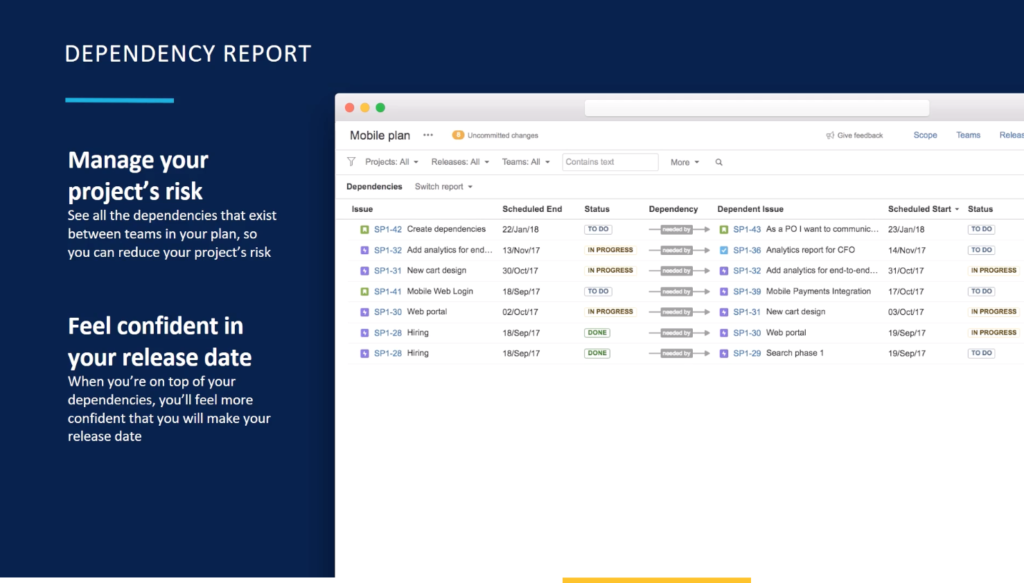
Jira: Dependency Report

Cross-department collaboration

In reality, projects are often shared between multiple departments across an organization. This can cause discontinuity within workflows when communication is not abundantly apparent between teams. Jira allows projects to be broken down into smaller boards, based on issue types. This allows users to focus on only pertinent issues to them while also protecting data irrelevant to their work within a project from being accidentally changed or lost. Users will have only relevant information to their section of the project but can still share issues across multiple boards without changing the specific issue’s progress in another. This allows multiple users to more clearly visualize and communicate the work they are doing, across different departments within an organization.


Agile development has become the new normal, not just for IT departments.

Now is the time to transition agile to elevate and progress your processes. Reflect your workflows within Jira, realistically, to help institute positive change and increase cross-team collaboration. Scale agile and Jira across your non-software team to help institute agile development at scale! Our team can help, with our Jira consulting services.


Ready to take the next step? Schedule your demo, today

5 “Do-Now” Business Cybersecurity Changes

As technology gets smarter, so do hackers. Your data could be at risk without even knowing it. Don’t wait until it is too late to institute change, we have highlighted the top 5 cybersecurity changes for your business or organization to institute today. 

1. Enable IAM MFA

The easiest way to increase the security of your data is to control how your users can access it. Single-sign on passwords is obsolete, opening doors for hackers to enter through. Creating a Multi-Factor Authentication creates more barriers to entry for hackers. It becomes more difficult to gain access to a user’s sensitive accounts when there are multiple steps before gaining the ability to accessing data. This is incredibly important to institute for Identity and Access Management Users are known as IAM users within Amazon Web Service platforms. Introducing multiple steps of authentication before allowing access is imperative for IAM users who possess greater access and increased editing capabilities within the platform, which are very lucrative to hackers. Get more information.  

Cybersecurity strategies

2. Turn on CloudTrail. Now.

CloudTrail is a very beneficial feature within Amazon Web Services. This feature creates an access history of your AWS account, allowing an ongoing record of your valuable projects. This also helps to increase the security within AWS accounts as it increases viability. CloudTrail helps you spot errors faster and smarter. CloudTrail also increases functionality such as downloading, searching, archiving or responding to account activities. Why wait? Download your free trial of CloudTrail today! 

3. Your sensitive data may not be safe, can you plug the leak? 

Hackers can often infiltrate systems without notice until it is too late. You run the risk of exposing your data to various threats, without even knowing it. Do not wait for an attack to happen, enhance your security today. Prepare for the possible outcome of the risks you face, don’t wait until it is too late. 

4. Do a quick scan

It is important to understand your security protocols from an overarching perspective. Continually checking your systems will promote familiarity and consistency, helping you better spot and limit the abilities of unwanted users accessing your sensitive information. Regularly scanning your systems quickly on a foundational level will help you maintain security with ease. Get started.

Cybersecurity strategies for your company

5. Lockdown your ACLs. Don’t be the one to make your S3 bucket public.

The AWS S3 bucket saves your data to a public cloud, allowing increased accessibility and heighten security. However, it can be easy to accidentally make sensitive information available publicly for external users. Creating and securing Access Control Lists, or ACLs, within AWS limits accidental mistakes. These lists delegate access to buckets and objects, allowing you to expressly control who gets to see what. This will also help to decrease access to fraudulent accounts that attempt to access from within internal domains or accreditations. Talk to an expert.

Time to take the Business Cybersecurity Changes

It is important to institute a cybersecurity roadmap for your business before your sensitive information is in the wrong hands. Comprehensive assessments are sometimes needed to better understand your company’s security structure. Security is no longer a “one and done” situation. Now is the time to emphasize the operational effectiveness of your data security. Learn how Oxalis can help you cover your blind spots, keeping data in your own hands. In case you need help with Atlassian, feel free to contact us.

Recommended blog post

Contact us

Why Small Agile Scrum Teams Work Better

If you rely on big systems, you’re missing the point

Agile development is consistently at the forefront of workflows across various industries. Change is centralized at the core of agile development. Possessing the ability to move quickly in response to change is imperative. This rapid response can often get lost in translation across various teams across an organization. That’s why, when considering the size of your agile teams, scrums work better for smaller-sized agile teams. In this post, we will review the advantages of scrum for small teams.

scrums for small teams

Large, establish system integrators can appear to be an efficient solution. It may feel easier to institute a technology solution instead of allowing time and effort to transition to new methods of development. Agile development is the new normal, regardless of industry or the size of the team. Don’t prolong your inevitable switch, transition to agile development today as your teams begin to grow. 

Why put a band-aid on a broken system?

Today, smaller-sized scrum teams are utilizing agile development to work faster, smarter. It can cumbersome and frustrating to work with multiple users across various departments on the same projects. Regardless of team role, breaking projects down within an agile software platform, like Jira, allows heightened visibility and increased accuracy among scrum team members.

Jira Scrum

With Portfolio for Jira, users can segregate the same issue across multiple boards. The specific issue will remain the same across all boards, allowing readers consistency when advancing projects. Separating issues based on the task of the team looking at them across various boards prevents errors from perpetuating problems across various boards. This will help to advance the most accurate solutions when developing projects within Portfolio for Jira. 

Portfolio for Jira
Jira provides clarity throughout all stages of the workflow process, optimizing efficiency for you and your users.

Understanding your teams’ perspective is essential when scaling agile development. Multiple moving parts across the various stages of projects can prevent progress in reality. Creating smaller sub-divisions of agile teams across projects can transform your workflows. The same data points are leveraged against various activities while promoting consistency and accuracy, without the added frustration of various users continually manipulating data. 

Learn how you can benefit from agile development, across your enterprise to work smarter and faster. Oxalis has a wealth of expertise leveling agile across various industries within organizations of varying team sizes. We understand what it takes to find the right framework for your agile teams. We are ready to help when you need it, so why wait? We offer Jira consulting services and a full range of technology consulting services to help you scale.

Recommended blog posts

Connect with Us!