Services Delivery. That’s the one that matters most to us.

Oxalis Solutions has been named Atlassian’s 2026 Partner of the Year for Services Delivery, Americas, announced at Atlassian Team ’26 in Anaheim in May 2026. The Services Delivery award recognizes the quality and reliability of a partner’s implementation work: whether deployments hold up in production, whether teams adopt what was built, and whether the result matches what the client was promised. Oxalis is an Atlassian Platinum Solution Partner specializing in highly regulated environments, primarily federal, state, and local government and healthcare, where implementations must meet strict compliance, security, audit, and data-residency requirements.

(more…)

Atlassian Team ’25 Europe: What the Next Era of AI-Powered Cloud Means for Regulated Industries

At-a-Glance: What the announcements from Atlassian Team ’25 Europe Mean for Regulated Industries

Atlassian Team ’25 Europe introduced a significant leap forward in secure, AI-powered cloud collaboration. From the expansion of Rovo—Atlassian’s enterprise AI layer—to new Software and Service Collections and government-grade cloud deployment models, Atlassian is redefining how regulated organizations modernize safely.

For public sector, defense, healthcare, and other compliance-driven industries, these updates mean faster cloud migration, deeper data governance, and AI capabilities built with control and transparency in mind. Oxalis helps customers navigate this evolution—architecting secure Atlassian environments, designing compliant AI workflows, and ensuring that innovation and regulation move forward together.

When Atlassian’s Team ’25 Europe opened in Barcelona this week, one message was loud and clear: AI is no longer an experiment. It’s the foundation of teamwork for the decade ahead.

From the expansion of Atlassian’s AI layer, Rovo, to the launch of new AI-native product Collections and secure cloud deployment models, this year’s announcements set the stage for organizations to modernize how they work, safely, intelligently, and at scale.

For customers in highly regulated industries, these innovations aren’t just exciting; they’re transformational. Atlassian is investing heavily in the features, governance, and compliance controls that regulated teams have been waiting for. And Oxalis is ready to help you turn these capabilities into measurable impact.

1. Cloud Isn’t Optional; Migration Is Inevitable

Atlassian officially unveiled Atlassian Ascend, a comprehensive migration program designed to make cloud transitions faster, safer, and more predictable. Ascend includes new migration tools, partner incentives, and “FastShift” automation to reduce friction and de-risk every stage of the move.

They also announced a series of enterprise-grade deployment models, including:

  • Government Cloud – FedRAMP-compliant offerings for U.S. public sector customers.
  • Isolated Cloud – Dedicated, single-tenant infrastructure for organizations with strict data separation needs (coming soon).
  • Units – Logical partitions within Cloud organizations to isolate data, permissions, and policies per business unit or domain.

Meanwhile, Atlassian confirmed the long-anticipated Data Center sunset over the next few years, signaling that now is the time to plan your move.

Why it matters

For regulated organizations, moving to the cloud has often meant balancing modernization against security, sovereignty, and compliance. With Atlassian’s expanded options, that balance is finally attainable. Teams can migrate confidently—choosing the right mix of performance, residency, and control—without sacrificing compliance posture.

How Oxalis helps

Oxalis has guided some of the most complex migrations in government, healthcare, and defense. We:

  • Architect secure cloud environments that meet regulatory frameworks like FedRAMP, CMMC, HIPAA, and DFARS.
  • Design data-segmented structures using Units to protect sensitive programs and isolate risk.
  • Pilot and validate Isolated Cloud and hybrid deployments to ensure security and compliance from day one.

2. Rovo Everywhere: AI That Knows, Connects, and Governs

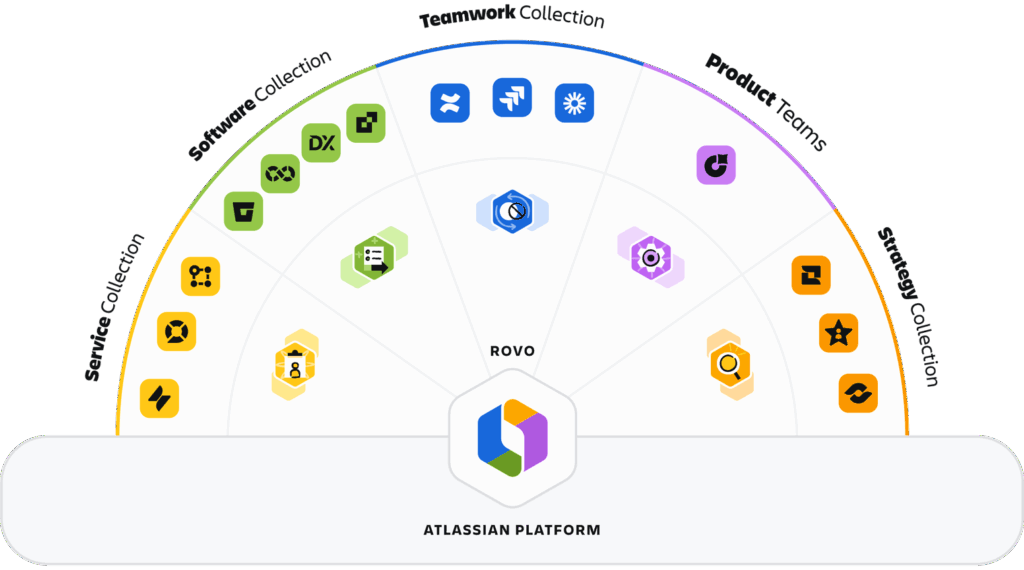
Atlassian Rovo

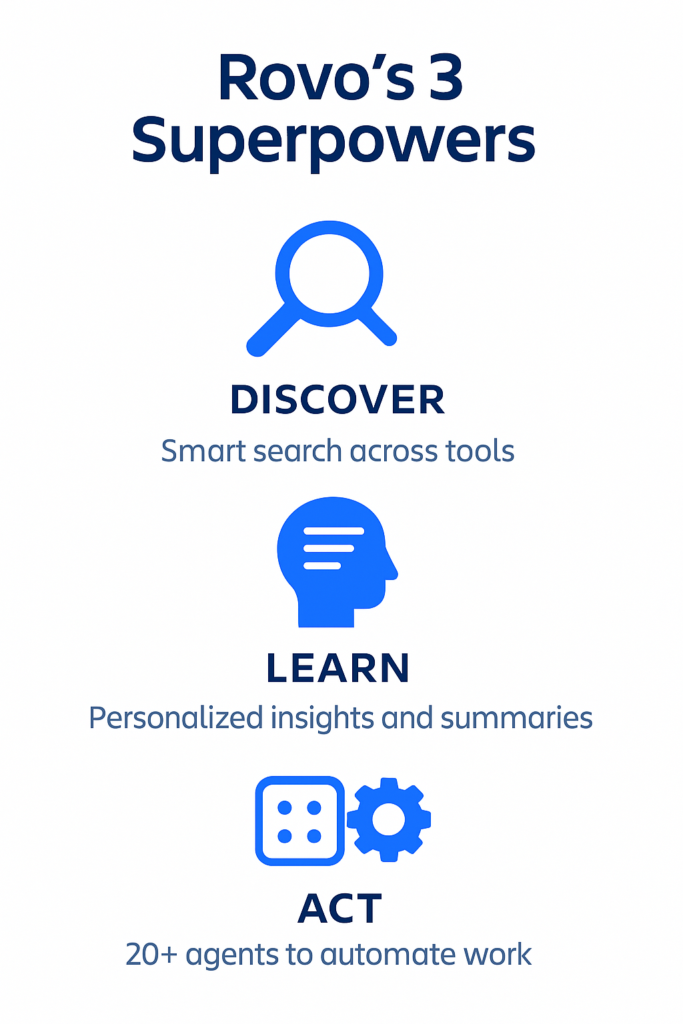
Rovo—Atlassian’s AI backbone—took center stage at Team ’25. It’s now embedded across every Atlassian surface: search, chat, automation, and agent workflows.

What’s new in Rovo

  • Rovo Search will soon become the default in Jira, bringing unified results across Atlassian tools and connected apps.
  • Rovo Chat adds memory, real-time collaboration, and “Skills” — over 100 modular capabilities built by Atlassian, partners, and customers.
  • Rovo Studio enables teams to create secure, production-ready AI agents and Forge apps directly inside Atlassian, in plain English.
  • Enhanced Governance includes usage dashboards, granular permissions, audit logs, and Atlassian-hosted LLMs — ensuring data stays within controlled boundaries.

Why it matters

For regulated customers, AI adoption has been slowed by one question: “Can we trust it?”
Rovo answers that with transparency, control, and compliance built in. It’s AI designed for enterprise governance, not as a separate experiment, but as a core part of the system of work.

How Oxalis helps

We specialize in bringing AI to regulated environments responsibly. With Rovo, that means:

  • Defining clear AI usage and data indexing policies for compliance.
  • Building custom Rovo agents that automate audits, change approvals, and workflow traceability.
  • Integrating Rovo into secure enclaves, ensuring that sensitive information never crosses defined boundaries.
  • Providing continuous monitoring and adoption support to keep AI use aligned with policy.

3. Collections: AI-Native Suites for Every Domain

Atlassian Team '25 Europe

Atlassian expanded its “Collections” model—domain-focused bundles that unify apps, data, and AI—to now include:

  • Software Collection: Rovo Dev, DX, Bitbucket Pipelines, Bitbucket SCM, and Compass for the entire software development lifecycle.
  • Service Collection: Jira Service Management, Customer Service Management, Assets, and Rovo for unified service and operations.
  • Teamwork Collection: Jira, Confluence, Loom, Rovo, and Guard Standard for collaboration and communication.
  • Strategy Collection: Focus, Talent, and Align for enterprise planning and portfolio alignment.

Why it matters

For regulated teams, Collections close the gaps between domains. Software, service, strategy, and collaboration are no longer siloed — and that’s a major compliance win.
Unified data and governance across Collections mean traceability from incident to resolution, better auditability, and fewer blind spots across the enterprise.

How Oxalis helps

Oxalis helps organizations:

  • Implement cross-collection workflows that maintain visibility and control end-to-end.
  • Create AI agents that bridge domains (e.g., automatically linking a vulnerability report to a service ticket and audit trail).
  • Quantify value through compliance KPIs: fewer manual handoffs, faster incident resolution, and reduced audit prep time.

4. Enterprise-Grade Scale and Governance

Atlassian also announced new scale and compliance enhancements across its Cloud Platform:

  • Scale: Jira now supports 100K users; Confluence will support 250K, JSM 50K.
  • Multiple Sandboxes: Safer change management environments for configuration and testing.
  • Backup & Restore: Enhanced business continuity and audit-ready data control.
  • Expanded Data Residency: Coverage now includes Rovo, Analytics, and Focus.
  • Platformization: Assets, Projects, and Units become platform apps for consistent governance.
  • Teamwork Graph Externalization: APIs let customers build secure, compliant custom apps on Atlassian’s unified data layer.

Why it matters

Regulated industries need predictability and transparency. These updates strengthen the control surface: sandboxing, restore capability, and data locality — the trifecta of enterprise assurance. They also empower organizations to innovate safely, building their own secure integrations on top of Atlassian’s trusted data foundation.

How Oxalis helps

Oxalis partners with enterprise clients to:

  • Architect governance-first Atlassian environments using sandbox segmentation and automated rollback.
  • Map data residency requirements to architecture design.
  • Build custom analytics and oversight tools on the Teamwork Graph, surfacing compliance intelligence and operational insights in real time.

5. A Practical Roadmap for Regulated Teams

Here’s how organizations can act on the Team ’25 Europe momentum right now:

  1. Assess your current state and risk profile
    Identify workloads, data types, and compliance standards that will be affected by migration or AI adoption.
  2. Plan your migration proactively
    Leverage Ascend resources and Oxalis guidance to define sequencing, risk mitigation, and post-migration validation.
  3. Establish AI governance early
    Define what data can be indexed, who can deploy agents, and how activity will be logged and audited.
  4. Pilot Rovo and Collections strategically
    Start small — one department, one workflow — measure results, and expand from there.
  5. Monitor, refine, and report
    Use Atlassian’s new usage dashboards and Oxalis’s reporting frameworks to measure adoption, compliance, and ROI.

Why Oxalis Is Your Partner for What Comes Next

At Oxalis, we live at the intersection of compliance and collaboration. We’ve implemented Atlassian solutions for defense contractors, shipyards, healthcare systems, and state agencies—each with complex data governance and security requirements.

Now, as Atlassian redefines the system of work with AI and Cloud, we’re helping our customers take the next step — responsibly, confidently, and with measurable business value.

We combine:

  • Deep Atlassian expertise across Cloud, Service Management, and Enterprise Strategy & Planning.
  • Compliance fluency across CMMC, HIPAA, DFARS, FedRAMP, and more.
  • Proven frameworks for migration, AI governance, and secure collaboration.
  • Practical experience implementing real-world solutions for teams that cannot afford risk.

Our goal is simple: help regulated organizations modernize securely and unlock the same AI-driven productivity as their commercial counterparts, without compromise.

Final Thoughts

Team ’25 Europe wasn’t just another product launch. It was a signal of where teamwork—and compliance-ready innovation—is heading.

AI is no longer a bolt-on feature. Cloud is no longer optional. Governance is no longer a constraint; it’s a differentiator.

Atlassian is building for that reality, and Oxalis is here to help you get there — safely, intelligently, and ahead of the curve.

Interested in understanding how Team ’25 updates affect your organization?
Schedule a strategy session with Oxalis to assess your migration roadmap, AI readiness, and compliance posture.


10 Ways Modern ERP Simplifies Compliance (and Saves Your Sanity)

At-a-Glance: Modern ERP systems like IFS Cloud embed compliance into daily operations—from audit trails and role-based access to automated reporting and policy-aligned workflows. This blog highlights 10 ways ERP modernization helps public sector teams reduce risk, prepare for audits, and eliminate the stress of manual oversight. For CIOs and compliance leaders, it’s not just about passing the next audit—it’s about building a system that supports every one after that.

Home » Archives for Melissa Case

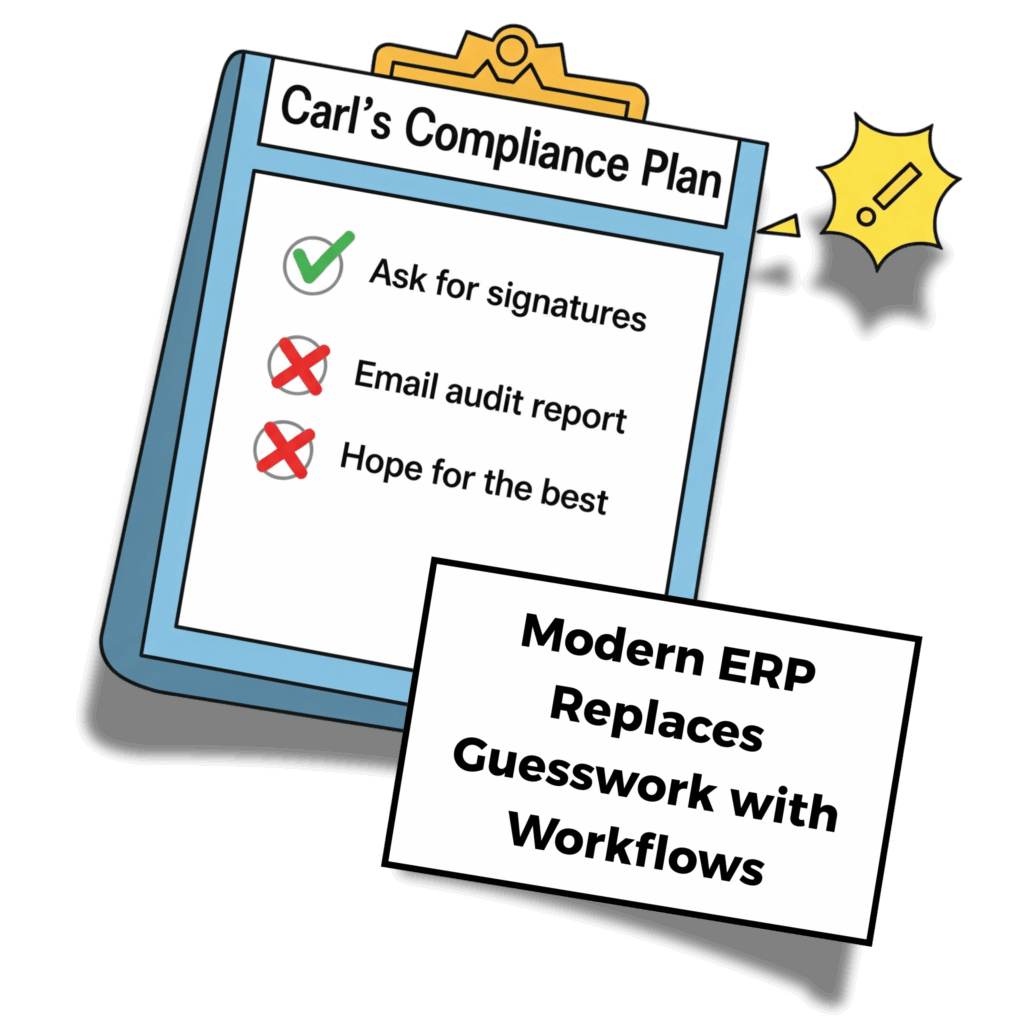
Compliance pressure is real—especially if you’re running on spreadsheets, legacy tools, or crossing your fingers before an audit. If you’ve ever lost sleep wondering if that approval was documented (or if your coworker Carl remembered to upload the inspection report), you’re not alone.

Modern ERP platforms like IFS Cloud take the drama out of compliance. Instead of treating it like an add-on, IFS builds it right into your everyday workflows—so you can stop chasing signatures and start focusing on what actually matters.

Here are 10 ways ERP modernization makes compliance easier, smarter, and (yes) sleep-worthy.

1. Real-Time Audit Trails

Everything’s tracked: approvals, edits, handoffs—complete with time stamps. You don’t have to piece it together later. It’s already there.

No more digital archeology during audit prep.

2. Role-Based Access Control

Only the right people can approve, edit, or access sensitive stuff. Built-in roles mean fewer “oops” moments and cleaner records.

Less micromanaging. More trust.

3. Policy-Aligned Workflows

Need a three-step sign-off for inspections? Done. Want purchasing to always route through finance? Easy. Your workflows, your rules.

Set it once. Let it roll.

4. Compliance Dashboards That Actually Tell You Something

You shouldn’t have to run six reports just to see what’s expiring next month. Dashboards highlight risks before they become headaches.

Red = danger. Green = good. You get the idea.

5. Auto-Generated Paper Trails (Without the Paper)

Whether it’s for grant funding, certifications, or federal audits, IFS gathers the right data and spits out what you need—when you need it.

Modern ERP automates what Carl used to manage manually

Instant receipts for the people who love paperwork.

6. Digital Signatures & Approvals

No chasing people for scribbles. Approvals happen in-system, with logs to prove it.

Carl can’t “forget” this one.

7. Training & Certification Tracking

Know who’s qualified (and who’s not). Get alerts before credentials expire and avoid the awkward “wait, they did what?” conversations.

Because qualified people doing qualified work is the goal.

8. Version Control + Change Tracking

Who changed that form? When? Why? With modern ERP, you’ll know.

Transparency without the witch hunt.

9. Built-In Security + Compliance Frameworks

IFS supports FedRAMP-ready deployments, encrypted data, and strict access controls—so your system stays secure andcompliant.

Peace of mind for your CISO *and* your inspector general.

10. No More “Tribal Knowledge” Dependencies

If your audit plan lives in someone’s head—or worse, a personal folder—you’re one PTO request away from panic. Modern ERP puts process knowledge where it belongs: in the system.

Sleep easy knowing everything’s documented (even Carl’s magic spreadsheet).

Modern ERP Makes Compliance a Feature—Not a Burden

Compliance shouldn’t be scary. With IFS Cloud, it becomes second nature—automated, trackable, and built into how your teams already work.

If your current ERP is making compliance harder than it needs to be, we can help.

10 Things Modern ERP Does That Legacy Systems Never Could

At-a-Glance: Legacy ERP systems like SAP ECC, R/3, Oracle EBS, and JD Edwards weren’t built for today’s mission-driven, asset-intensive operations. Modern ERP platforms like IFS Cloud deliver what legacy systems can’t: real-time visibility, mobile field service, compliance-first architecture, and rapid time-to-value. This blog explores 10 essential capabilities that distinguish modern ERP from its predecessors, offering public sector leaders a smarter, more resilient path to operational excellence.

Legacy ERP systems were built for a different era—one where back-office processes were relatively static, compliance was manual, and field operations were an afterthought. But in today’s mission-driven, asset-intensive world, organizations need more than just a digital ledger. They need real-time visibility, operational agility, and systems that flex with changing demands.

That’s where modern ERP platforms like IFS Cloud come in.

The reality is, many public sector and regulated organizations are still running outdated ERP systems—often from vendors like SAP (ECC, R/3, Business Suite) or Oracle (E-Business Suite, JD Edwards, PeopleSoft). These platforms were foundational at the time but weren’t built to support real-time service delivery, field operations, or modern compliance requirements. Today, they struggle under the weight of customizations, expensive upgrades, siloed data, and limited agility.

Here are 10 things modern ERP does—things legacy systems simply weren’t designed for:

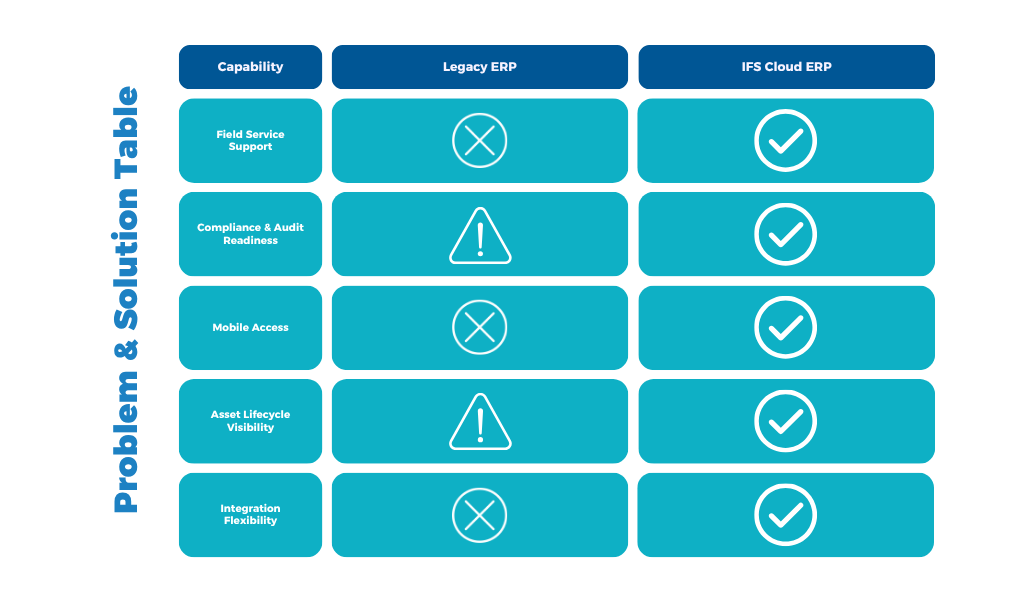
1. Connects Assets, People, and Projects in Real Time

IFS Cloud ERP isn’t just about tracking transactions. It links field teams, assets, inventory, and workflows on a single platform—accessible in real time, from anywhere.

Legacy ERP: Built for finance.
Modern ERP: Built for operations.

2. Supports Field Service and Mobile Teams Out of the Box

Mobile crews need data at their fingertips. IFS Cloud includes native Field Service Management (FSM) tools to support dispatch, maintenance, and inspections.

Legacy ERP: Desktop-bound.
Modern ERP: Mobile-enabled.

3. Adapts to New Mandates and Policies—Without Rework

Legacy ERP: Hard-coded and inflexible.
Modern ERP: Built for change.

Feature comparison between legacy ERP and modern ERP like IFS Cloud

4. Delivers Built-In Compliance and Auditability

With configurable workflows, modern ERP lets you respond to funding changes, compliance shifts, or new operational models without starting from scratch.

Need role-based access, real-time logging, or automated audit trails? IFS makes it easy. No bolt-ons. No spreadsheets. No surprises at audit time.

Legacy ERP: Add-ons and afterthoughts.
Modern ERP: Compliance-first.

5. Provides Visibility Across the Entire Asset Lifecycle

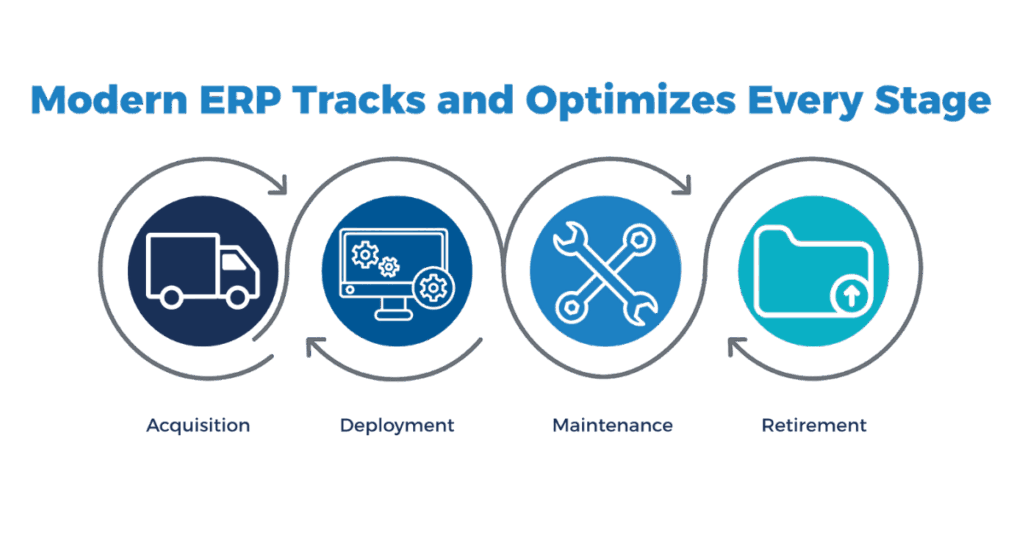
From acquisition to retirement, modern ERP helps you track, maintain, and optimize your assets—whether it’s a fleet, facility, or field equipment.

Legacy ERP: Manages assets like inventory.
Modern ERP: Manages assets like investments.

Modern ERP enables full asset lifecycle visibility and planning

6. Improves Planning with Real-Time Operational Data

Modern ERP pulls live data from across your org to support proactive decision-making, from project scheduling to resource allocation.

Legacy ERP: Reports after the fact.
Modern ERP: Informs in the moment.

7. Reduces IT Overhead with Cloud-Native Architecture

With IFS Cloud, you don’t need to manage infrastructure or worry about server maintenance. While IFS does release regular upgrades (typically twice per year), the platform handles the heavy lifting—so you stay current without managing it all in-house.

Legacy ERP: Hardware-heavy and expensive to upgrade.
Modern ERP: Scalable and streamlined.

8. Integrates Seamlessly with Tools You Already Use

Modern ERP doesn’t live in a silo. IFS integrates with Jira, Power BI, legacy finance systems, and more—so you get continuity, not disruption.

Legacy ERP: Custom integrations required.
Modern ERP: Plug-and-play flexibility.

9. Speaks the Language of Your Industry

IFS was designed for asset-intensive, service-driven sectors like defense, manufacturing, shipbuilding, and public infrastructure, not just generic business functions.

Legacy ERP: One-size-fits-none.
Modern ERP: Industry-specific by design.

10. Delivers Measurable ROI Faster

Many IFS customers see value within 6–12 months, from improved uptime and audit readiness to faster procurement cycles and lower total cost of ownership.

Legacy ERP: Long runway, slow payoff.
Modern ERP: Fast track to impact.

Oxalis is an IFS Silver Channel Partner

Ready to See the Difference?

Modern ERP isn’t just an upgrade—it’s a shift in how your organization operates. Whether you’re supporting a shipyard, managing public infrastructure, or overseeing field services, IFS Cloud helps you deliver with clarity, confidence, and control.

Let’s explore what ERP modernization could look like for your team.

True Collaboration, Real Results: Inside EDD’s Atlassian Cloud Transformation

What EDD Gained: Trust, Expertise, and a Scalable Future

The Challenge:

The California Employment Development Department (EDD) needed more than a technical solution—they needed a partner who understood the complexity of public sector operations. To realize their modernization goals, EDD sought a trusted advisor with deep Atlassian expertise, a clear roadmap for secure cloud migration, and a proven approach to change enablement.

Their goals were ambitious:

  • Improve agility and service responsiveness
  • Modernize IT project and knowledge management systems
  • Enhance collaboration and transparency across teams
  • Ensure scalability, security, and long-term sustainability

This vision marked the beginning of the EDD Atlassian Cloud transformation—a bold initiative to overhaul legacy platforms and empower workforce programs with modern, cloud-based tools.

The Oxalis Solution:

Oxalis assembled a multidisciplinary team of Atlassian-certified experts to lead EDD through every stage of the transformation. Our approach combined technical depth with a clear understanding of EDD’s business and operational needs.

  • Atlassian Cloud Migration: A secure, efficient transition to Atlassian Cloud ensured scalability and accessibility for a large, distributed workforce.
  • Jira Software and Confluence Implementation: We configured Jira Software to support agile project tracking across EDD teams and implemented Confluence as a collaborative knowledge base and documentation hub.
  • Custom Cloud-Based Solution Development: In addition to configuration, Oxalis developed a new solution built on Atlassian Cloud to meet EDD’s specific operational and reporting needs.
  • Change Management & Enablement: To support adoption, we provided strategic change enablement including user training, onboarding sessions, stakeholder communications, and scalable governance planning.
  • Ongoing Support & Optimization: Post-implementation, Oxalis continued to provide support and iterative enhancements to ensure continued alignment with EDD’s evolving priorities.

The Results:

The EDD Atlassian Cloud transformation delivered measurable results across the organization:

  • Increased efficiency and visibility in project management
  • Enhanced collaboration through centralized, shared documentation
  • Improved knowledge sharing and continuity across teams
  • Greater transparency and accountability for internal initiatives
  • A scalable foundation for future innovation


“Oxalis is not just a vendor; they are a true partner. Their commitment to client satisfaction, technical expertise, and collaborative approach makes them an invaluable asset. From planning through implementation and training, they delivered with precision, care, and a deep understanding of our needs.”
—  
Joseph Ledoux, EDDNext Project Administrator

The California Employment Development Department (EDD), one of the largest state departments in the United States, partnered with Oxalis to lead a comprehensive modernization initiative. This EDD Atlassian Cloud transformation involved migrating to Atlassian Cloud, implementing Jira Software and Confluence, and developing a custom solution tailored to enhance collaboration, transparency, and scalability across the organization.

Why It Worked

The success of the EDD Atlassian Cloud transformation wasn’t driven by tools alone—it was the result of a trusted partnership. Oxalis brought not only technical excellence but also the discipline of active listening, practical implementation, and long-term client enablement.

By aligning solutions with EDD’s real-world workflows and team structures, Oxalis delivered impact that extended far beyond go-live.

Looking Ahead

Today, EDD operates on a modern Atlassian Cloud environment that supports cross-team collaboration, improved project outcomes, and knowledge continuity. With Oxalis as a continuing partner, EDD is positioned to evolve and scale its systems with confidence.

Moving Forward with Atlassian Enterprise Transformation

Oxalis Partners with IFS to Modernize Shipbuilding and MRO for the U.S. Defense Industry

Strategic Partnership Brings Cutting-Edge ERP and IT Solutions to Shipbuilders, MRO Providers, and Defense Industry Manufacturers

Oxalis Solutions, a leader in technology solutions for highly regulated industries, is pleased to announce a strategic partnership with IFS, a global innovator in enterprise resource planning (ERP) software. This collaboration will empower shipbuilders, maintenance, repair, and overhaul (MRO) providers, and defense industry manufacturers with advanced technology solutions that improve efficiency, streamline operations, and enhance readiness for mission-critical projects.

“IFS is committed to delivering industry-leading cloud solutions that drive operational excellence for asset-intensive industries. Our partnership with Oxalis marks a significant step forward in modernizing U.S. Navy MRO operations, ensuring shipyards and defense contractors have the tools they need to enhance efficiency, readiness, and long-term sustainability,” said Vinod Chumber, Global Head of Channels at IFS.

IFS is a proven leader in enterprise software for asset-intensive industries, including aerospace, defense, and maritime. By partnering with Oxalis—known for its deep expertise in software integration, cloud solutions, and process optimization—this collaboration will provide businesses that support the U.S. Department of Defense (DoD) with state-of-the-art IT solutions to modernize operations and increase supply chain resilience.

“We are excited to partner with IFS to modernize U.S. shipbuilding, repair, and MRO operations,” said Jonathan Malanche, CEO of Oxalis Solutions. “Our combined expertise in software implementation and enterprise technology will help businesses across the defense industrial base embrace digital transformation, improve efficiency, and remain competitive in a rapidly evolving market.”

Addressing the Need for Modernization in Shipbuilding, MRO, and Defense Manufacturing

The U.S. defense industry is undergoing a critical shift toward modernization, driven by aging infrastructure, increased global competition, and the need for more efficient manufacturing and repair processes. Organizations supporting the DoD—including shipbuilders, aerospace manufacturers, and MRO providers—face growing challenges in asset management, workforce optimization, and operational efficiency.

By integrating IFS’s powerful ERP solutions with Oxalis’ expertise in IT system modernization and digital transformation, this partnership will help businesses:

  • Optimize complex supply chains and improve manufacturing processes.
  • Enhance asset management and predictive maintenance capabilities.
  • Increase operational efficiency and reduce downtime in MRO operations.
  • Ensure compliance with DoD and industry-specific security and regulatory requirements.
  • Improve collaboration across shipyards, aerospace firms, and other defense contractors.

A Future-Ready Solution for Defense Industry Leaders

IFS is trusted by leading defense contractors, shipyards, and aerospace organizations for its advanced ERP, enterprise asset management (EAM), and field service management (FSM) solutions. Oxalis Solutions brings deep experience in cloud-based IT modernization, process automation, and large-scale enterprise software deployments across industries that support the U.S. military and defense sector.

Together, Oxalis and IFS will provide the next generation of digital tools that enable organizations to increase agility, optimize production, and improve readiness across shipbuilding, MRO, and defense supply chains.

About IFS
IFS is the world’s leading provider of Industrial AI and enterprise software for hardcore businesses that make, service, and power our planet. Our technology enables businesses which manufacture goods, maintain complex assets, and manage service-focused operations to unlock the transformative power of Industrial AI™ to enhance productivity, efficiency, and sustainability.

IFS Cloud is a fully composable AI-powered platform, designed for ultimate flexibility and adaptability to our customers’ specific requirements and business evolution. It spans the needs of Enterprise Resource Planning (ERP), Enterprise Asset Management (EAM), Supply Chain Management (SCM), Information Technology Service Management (ITSM), and Field Service Management (FSM). IFS technology leverages AI, machine learning, real-time data and analytics to empower our customers to make informed strategic decisions and excel at their Moment of Service™.

IFS was founded in 1983 by five university friends who pitched a tent outside our first customer’s site to ensure they would be available 24/7 and the needs of the customer would come first. Since then, IFS has grown into a global leader with over 7,000 employees in 80 countries. Driven by those foundational values of agility, customer-centricity, and trust, IFS is recognized worldwide for delivering value and supporting strategic transformations. We are the most recommended supplier in our sector. Visit ifs.com to learn why.

About Oxalis Solutions

Oxalis Solutions is a technology consultancy specializing in IT modernization for highly regulated industries, including maritime, aerospace, defense, and manufacturing. As an Atlassian Platinum Solution Partner, Oxalis provides cloud services, ITSM solutions, and enterprise software integrations to help organizations streamline operations and improve business performance.

Don’t miss these posts: 

From Silos to Systems: Inside the Big Announcements from Atlassian Team ’25

Discover how Atlassian is connecting teams, amplifying productivity, and bringing AI to the center of modern work.

Atlassian’s Team ’25 event in Anaheim set the tone for where modern work is headed—and the future is collaborative, connected, and powered by AI.

With a clear focus on helping organizations break down silos, amplify team productivity, and streamline strategic execution, Atlassian introduced a sweeping set of updates across its platform. From powerful AI capabilities and new product bundles to enhancements in cloud flexibility and customer service, this year’s announcements speak directly to the evolving needs of enterprises across industries.

Here’s a detailed look at what was announced—and what it means for your team.

Rovo: AI That Works Alongside Your Team

The biggest story from Team ’25 was the formal rollout of Atlassian Intelligence, now called Rovo—a smart AI teammate embedded directly into Jira, Confluence, and beyond.

Rovo is designed to help teams find information faster, automate manual work, and make more informed decisions using the context of your organization’s actual data. It includes:

  • Rovo Search & Chat: A conversational AI that can understand natural language and retrieve relevant information across Atlassian tools and over 50 third-party platforms (like Google Drive, Slack, Notion, and more). Think of it as a personal research assistant that always knows where your work lives—and how to get to it.
  • AI Agents: Prebuilt and customizable agents that can tackle specific tasks, such as:
    • Code Reviewer Agent for analyzing Bitbucket pull requests against requirements written in Jira.
    • Root Cause Analysis Agent that identifies the source of incidents using data from across your DevOps stack.
    • Workflow Builder Agent that creates complex Jira workflows from a simple prompt.
  • Rovo Studio: A low-code/no-code environment for creating your own AI agents, automations, dashboards, and custom data objects—essentially allowing you to build tailored AI workflows specific to your team’s unique needs.

And perhaps most impressively, Rovo is now included at no extra cost for customers on Premium and Enterprise Cloud plans, with Standard plan access to follow soon. That means world-class AI support—without a hefty price tag.

Teamwork Collection: Your Collaboration Hub, Reimagined

To further unify work across functions, Atlassian introduced the Teamwork Collection—a bundle of core Atlassian tools built to support seamless cross-functional collaboration:

  • Jira for managing tasks, projects, and initiatives.
  • Confluence for capturing knowledge and collaborative documentation.
  • Loom for async video communication and quick context-sharing.
  • Rovo AI Agents to tie it all together and reduce manual coordination.

The Teamwork Collection isn’t just a software bundle—it’s an intentional, integrated experience. With shared navigation, deep integrations, and AI features that cut across tools, teams can collaborate more effectively, whether they’re in marketing, engineering, operations, or support.

Need to spin up a new team? The collection makes it simple to create a dedicated Jira project, a Confluence space, a Loom channel, and Slack integration—all in one click. And with Rovo helping connect dots behind the scenes, silos start to disappear.

Strategy Collection: From Vision to Execution

While the Teamwork Collection empowers collaboration at the team level, the Strategy Collection is built for executive leadership and enterprise portfolio planning.

This new solution brings together:

  • Focus: A strategic planning hub where executives define goals, set OKRs, and track progress in real-time. Work from Jira or Jira Align rolls up automatically, creating a live view of how strategy translates into action.
  • Talent (Early Access): A new workforce planning tool that allows leaders to model roles, skills, and team capacity across initiatives. Talent helps identify resourcing gaps early—so you’re never understaffed on your most important priorities.
  • Jira Align: A powerful enterprise agile planning tool that connects strategy to delivery across large, complex teams. It ensures alignment from top-level initiatives down to sprint-level tasks.

Together, these tools offer something many leadership teams struggle to achieve: clear visibility into goals, work, people, and progress—all in one place.

Customer Service Management: AI-Powered Support That’s Actually Connected

Customer-facing support teams often sit far from the product and engineering teams they rely on to resolve issues. Atlassian’s new Customer Service Management (CSM) app, now in beta, is built to close that gap.

The CSM app:

  • Connects support tickets to the broader Atlassian platform—pulling in relevant Jira issues, Confluence articles, incidents, change logs, and more.
  • Features an AI support agent that can resolve common issues, summarize requests, and even suggest draft replies for support reps.
  • Provides a unified view of context: related deployments, known issues, and affected services are surfaced automatically.

By integrating support into the same system as development and IT, teams resolve issues faster, reduce handoff delays, and keep customers informed every step of the way.

New Cloud Deployment Options: Flexibility for Regulated Teams

One of the most important announcements for regulated industries came in the form of two new deployment options:

  • Atlassian Government Cloud: Now in Early Access, this U.S.-based environment is FedRAMP Moderate authorized, allowing federal agencies and contractors to use Atlassian Cloud products in a compliant and secure way. Support for FedRAMP High and DoD IL5 is on the roadmap.
  • Atlassian Isolated Cloud: Launching in 2026, this will offer a single-tenant, Atlassian-managed cloud environment for customers with the highest levels of security and data separation requirements—such as finance, defense, and healthcare organizations.

These offerings provide the flexibility enterprises need to move confidently to the cloud—without compromising on control, security, or compliance.

Enhanced User Experience Across the Platform

Alongside the major launches, Atlassian also introduced thoughtful enhancements that improve the day-to-day experience of every user:

  • Refreshed Navigation & Design: A consistent, modern UI across Jira, Confluence, and more makes it easier to navigate, collaborate, and focus—especially for users working across multiple Atlassian tools.
  • Trello Updates: Trello is getting smarter and more streamlined for personal productivity. New features make it easier to capture tasks on the go (via Slack, email, mobile), manage workloads, and automate recurring steps—transforming Trello into a true daily work dashboard.
  • Expanded Integrations: Atlassian deepened its integrations with Slack, Microsoft Teams, Google Workspace, and others, helping users work where they’re most comfortable while keeping all data connected and accessible.
  • Custom Domains: Available for Jira and Confluence Cloud, this long-awaited feature lets organizations host their Atlassian instances at their own branded domain—for example, jira.mycompany.com—enhancing both security and user trust.

What does this mean for Oxalis customers and our broader community?

Atlassian’s vision is becoming increasingly clear: one connected platform for all teams—augmented by AI, tailored for enterprise, and flexible enough to meet the needs of the most complex organizations.

  • AI isn’t a future concept—it’s here today, embedded where your teams work, and designed to eliminate the friction of searching, documenting, coding, and responding.
  • Collaboration is simpler and more seamless—whether you’re a DevOps engineer, a product owner, or a program manager leading multi-team initiatives.
  • Strategic planning is no longer locked in slide decks—it’s dynamic, actionable, and connected to real-time execution data.
  • Support and service teams are empowered, not siloed—thanks to a smarter, more connected approach to resolving customer issues.
  • You don’t need to choose between compliance and innovation—you can have both, with deployment options that meet your regulatory needs without holding back your teams.
 

At Oxalis, we’re excited about what these updates unlock for our customers across government, healthcare, maritime, and beyond. If you’re curious about how to put these new tools to work—or need a partner to help chart your path—we’re always here to help.

https://oxalis.io/beyond-tools-introducing-the-atlassian-system-of-work-for-enterprise-transformation/

Strategy, Meet Execution: Oxalis Earns Atlassian Enterprise Strategy & Planning Specialization

We’re thrilled to share some exciting news from the floor of Atlassian Team ’25: Oxalis has officially earned the Enterprise Strategy & Planning specialization (formerly known as Agile-at-Scale). This distinction recognizes our deep expertise in guiding complex organizations through large-scale Agile transformations—and we’re honored to be among the select partners entrusted with this designation.

We’re incredibly grateful to the Atlassian team for their partnership, trust, and continued investment in the Solutions Partner ecosystem. Being part of this community means more than just delivering solutions—it means helping customers unlock real, lasting change.

What the Specialization Means

To earn this specialization, partners must demonstrate real-world experience and proven outcomes in helping organizations scale agile practices using frameworks like SAFe, LeSS, Disciplined Agile, and more. It reflects not only our technical proficiency with tools like Jira Align and Jira Software, but also our broader capabilities in:

  • Advising on agile architecture and enterprise tooling
  • Aligning teams, leadership, and organizational goals
  • Accelerating delivery and improving predictability
  • Driving cultural change and agile adoption across the enterprise

This specialization is about more than process. It’s about strategy, leadership, and transformation.

Our Approach: Practical, People-Centered, and Proven

At Oxalis, we understand that no two organizations are alike. That’s why we don’t take a one-size-fits-all approach to agile at scale. We help our clients design and evolve the right framework for their unique context—whether that’s SAFe with Jira Align, a custom hybrid, or something in between. Our work is grounded in practical experience and guided by measurable outcomes.

From the California Department of Health Care Services (DHCS) to ARPA-H and the Gates Foundation, we’ve helped large, complex teams move from siloed efforts to enterprise-wide visibility and agility. We build long-term partnerships, provide coaching and training, and guide our clients every step of the way—from initial roadmap to steady-state optimization.

A Shared Vision with Atlassian

This milestone reflects the synergy between Oxalis and Atlassian’s vision for the future of work. As teams navigate increasing complexity, tighter timelines, and higher expectations, we believe enterprise agility is no longer optional—it’s essential. Atlassian’s suite of tools, including Jira Align, provides the foundation. Oxalis helps make it real.

We’re proud to stand alongside Atlassian at Team ’25, celebrating the innovation, passion, and momentum that this community brings to every challenge.

To our clients, our partners, and the Atlassian team—thank you. We’re just getting started.

Let’s continue building better ways of working, together.

Ready to achieve your Agile at Scale transformation?

Atlassian Government Cloud is Now FedRAMP Moderate Authorized

We have exciting news for public sector organizations: As of March 14, 2025, Atlassian Government Cloud has officially achieved FedRAMP Moderate Authorization! This milestone marks a significant step forward in enabling government agencies to modernize operations, enhance collaboration, and drive mission success—all within a secure and compliant cloud environment.

What This Means for Government Teams

For U.S. government agencies and contractors, FedRAMP Moderate Authorization ensures that Atlassian Government Cloud meets stringent federal security standards for handling Controlled Unclassified Information (CUI) and other sensitive data. With this authorization, agencies can now confidently leverage Jira Software, Jira Service Management (JSM), and Confluence in a secure, fully managed cloud environment.

Why FedRAMP Matters

The Federal Risk and Authorization Management Program (FedRAMP) is the gold standard for cloud security in the U.S. government. It provides a standardized approach to security assessment, authorization, and continuous monitoring for cloud products and services. Achieving FedRAMP Moderate Authorization means that Atlassian Government Cloud has undergone a rigorous evaluation to ensure compliance with over 300 security controls, safeguarding government data and reducing risk.

Atlassian Government Cloud: A Platform Built for the Public Sector

With FedRAMP Moderate Authorization, agencies now have access to a secure, scalable, and fully managed cloud solution designed to support their unique needs.

Key Benefits of Atlassian Government Cloud:

  • Secure & Compliant – Meets federal security standards for handling sensitive government data.
  • Always Up-to-Date – Automatic updates ensure access to the latest security patches, features, and performance enhancements.
  • Cost-Effective – Reduces IT overhead by eliminating the need for on-premises infrastructure.
  • Scalable & Flexible – Easily scales to meet the needs of government teams, regardless of size.
  • Seamless Collaboration – Enables secure, cloud-native collaboration between teams and agencies.

How Atlassian Government Cloud Supports Mission-Critical Work

Atlassian Government Cloud is purpose-built to accelerate digital transformation and enhance operational efficiency in government. With Jira, JSM, and Confluence, agencies can:

  • Improve IT Service Management (ITSM) with Jira Service Management, streamlining service requests and asset management.
  • Enhance project management and collaboration using Jira Software for agile workflows.
  • Centralize documentation and knowledge sharing with Confluence, ensuring mission-critical information is accessible and secure.

What’s Next? Planning for the Future

The FedRAMP Moderate Authorization of Atlassian Government Cloud is just the beginning. Atlassian is actively pursuing FedRAMP High and DoD IL5 compliance, further strengthening its commitment to supporting the needs of federal agencies, defense organizations, and highly regulated industries.

How Oxalis Can Help You Migrate to Atlassian Government Cloud

As an Atlassian Platinum Solutions Partner with deep expertise in FedRAMP-compliant cloud migrations, Oxalis is here to help your agency seamlessly transition to Atlassian Government Cloud. Our team of experts will ensure a secure, efficient migration tailored to your agency’s needs—minimizing risk, reducing complexity, and optimizing your cloud environment for mission success.