Enterprise Service Management (ESM) – The Natural Extension of ITSM

In this blog post we’ll look at Enterprise Service Management (ESM) and its relationship to ITSM, as well as how IT processes apply to and can benefit business teams. We’ll review examples of how these teams are using tools and principles such as knowledge management, service request, change management, and more, to address challenges and apply solutions across ALL enterprise teams. We will discover how ESM, when implemented with Jira Service Management, captures invaluable data about the service your business teams are providing each other.

What is Enterprise Service Management? How Does it Compare to ITSM?

Enterprise Service Management (ESM) strategically expands the proven principles and practices of IT Service Management (ITSM) to encompass the entire organization. This approach optimizes service delivery across departments like HR, Finance, Legal, and beyond.

Key Differences Between ESM and ITSM

  • Scope: ITSM focuses specifically on managing IT services, while ESM encompasses the service needs of all business units.
  • Reach: ITSM typically serves internal IT customers, whereas ESM aims to improve service experiences for both internal and external stakeholders.

Core Components of ESM

As Forrester outlines, ESM typically involves these essential elements:

  1. Adapting ITSM Practices: Proven ITSM processes like incident management, change management, and knowledge management are tailored for use across various business functions.
  2. Unified Platform: A centralized platform, often based on existing ITSM tools, offers a single service portal and catalog for all teams within the organization.
  3. Low-Code Automation: Low-code solutions streamline workflows and accelerate service delivery innovation, breaking down service barriers and empowering teams.

Beyond Bug Tracking: Understanding Jira’s Evolution and the Rise of ESM

Jira has come a long way from its humble beginnings as a bug-tracking tool. Atlassian wisely recognized its potential and expanded Jira’s capabilities to serve a whole range of teams.

The Power of Adaptability

In 2013, Atlassian saw a fascinating trend: 40% of users were already bending Jira to manage service requests! In response, Jira Service Desk was born, later evolving into Jira Service Management (JSM) in 2020 to fully embrace ITSM principles.
Read more about the origin of the name Jira.

But the story doesn’t end there. Organizations boldly (and successfully!) used Jira even beyond its original design. This showed that the service desk concept isn’t just for IT – it benefits HR, legal, facilities, literally any team that deals with requests. This realization paved the way for Enterprise Service Management. Atlassian itself uses a whopping 130 internal service desks – proof of ESM’s power!

The Core Idea

It’s simple: every team gets requests and needs to fulfill them. HR handles time-off, facilities tackles maintenance issues – the service desk model streamlines this process for everyone. ESM makes this ‘unofficial’ use case official, allowing JSM’s strengths to benefit the entire organization.

Enterprise Service Management (ESM) empowers your entire organization by creating a seamless and predictable help experience. Each team benefits from a standardized help portal where users can find self-service knowledge articles and easily submit and track service requests. This consistent approach boosts efficiency by eliminating confusion and streamlining workflows across all departments.

How do ITSM processes apply to non-IT teams?

Let’s go over some examples of the practices that Enterprise Service Management with Atlassian includes.

Knowledge Management

The Challenge

Most organizations can benefit from improving how they organize and manage their documents and information. A survey of 2,000 hybrid and remote office workers found that the average respondent needs to search for documents or other information seven times each day. In addition, respondents spent 13 minutes searching on their own before asking for help. Do the math: 13 minutes of searching, seven times a day, five days a week… that’s 455 minutes, about 7.6 hours. Almost a full workday every week lost to searching for information they need to do their job – per person.

Every team manages – whether intentionally organized or not – a body of institutional knowledge that people they serve will need to know at some point.  But how many teams, aside from IT, have systems and procedures in place to ensure that stakeholders get the right information, in the proper format, at the right level, and at the correct time, according to their access level and other relevant policies? 

The Solution

The practice of knowledge management is built around the knowledge base, a self-serve online library of information about a product, service, department, or topic, all easily accessible by a robust search engine.  By putting the organization’s information in one organized, access-controlled place like Confluence, where employees can search for what they need, you can go a long way toward minimizing time wasted.

And it does double duty, because it benefits both team members and those they serve; the latter use the knowledge base through the service portal.

Service Request Management

The Challenge

Every team’s work can be usefully described in terms of the services they provide to those outside the team.Users typically access those services haphazardly, whether it’s in Slack asking for payroll information, or by email reporting an urgent maintenance need, or as a walk-in wondering how to replace a security access card.  When teams must then track their work in multiple places, inevitably errors, oversights, and delays will creep in.

The Solution

Service Request Management is what ITSM is perhaps best known for.It begins with the concept of the Service Catalog: an organized, managed collection of repeatable, defined services within a group, including such information as description, ownership, dependencies, and escalation.

When employees start to submit a request in a service portal, recommended articles from the knowledge base appear with helpful information through a tool like Jira Service Management, getting employees the answers they need quickly while deflecting requests from busy teams. Requests submitted are all organized in one central place, saving time, hassle, and mistakes.

The growing body of fulfilled requests also becomes a time-saving resource for teams, by looking up the resolution of previous similar requests.

Change Management

The Challenge

The services that business teams provide usually follow defined procedures, and once employees understand those procedures, altering them can cause confusion, frustration, and wasted time if not implemented properly. Do all the stakeholders get a chance to provide feedback during planning? Are all potential users notified of the change and its timeline?

While business teams may not have the sort of mission-critical infrastructure – requiring 99.9% or 99.99% uptime – that IT teams support, they do provide important services that can be time-sensitive.  For instance, prompt coordination between HR and IR is vital for a behind-schedule project that needs an emergency contractor up and running ASAP.

Furthermore, every team’s ability to adapt its processes smoothly to new business needs matters to a growing organization.

The Solution

Modifications to the procedures business teams follow should be made thoughtfully, and in a controlled fashion that allows for review by stakeholders and ensures adequate communication.  Change Management practices enable this by breaking down silos, providing context and transparency, avoiding bottlenecks, and minimizing risk. They can also help meet regulatory standards.

Change Management with JSM helps accomplish change in the following ways: 

  • Establishing a framework to manage the change process 
  • Prioritizing necessary changes to properly allocate resources 
  • Incorporating relevant information for smarter decision making 
  • Involving necessary stakeholders from dev and IT for approvals 
  • Incorporating testing of changes, to avoid incidents
  • Streamlining and improving the flow of changes to deliver value more quickly

Problem Management

The Challenge

As with change management, when problems occur in the defined procedures that enable theservices business teams provide, confusion, frustration, and wasted time can result – like when an employee loses an afternoon dealing with a Payroll mistake.

And no team wants that to happen. It’s easy to ask “what caused that incident?” But uncovering the surface, immediate cause isn’t good enough when you aim to provide quality customer service. You need to dig into the underlying causes, the factors and conditions that led up to the incident. Why? A service-disrupting incident is an opportunity for improvement, because it reveals an inefficiency or a bottleneck or a miscommunication that can be identified and fixed IF you take the time to find out what’s really going on. The team’s service will improve.

The Solution

Problem management enables business teams to continually investigate, learn from incidents, and improve their procedures. It uses the same service portal as Service Request Management, so employees have a centralized, seamless service experience, and team members who work the problem reports benefit from all the features of JSM.

The smoother a team’s procedures work, the more time the team and the people it serves have to do the work the organization needs them to do. Effective problem management also builds inter-team cohesion across the organization by minimizing points of friction – when employees are always complaining about, say, how hard it is to get what they need from HR, the whole organization suffers.

Problem Management relies on basic steps like these:

  1. Proactive problem detection 
  2. Track and assess known problems
  3. Investigation and diagnosis
  4. Create a known error record
  5. Create a workaround, if necessary
  6. Resolve and close the problem

Workflow Automation

The Challenge

Every team faces repetitive, mundane tasks that waste employee time.  How many people do you really want to pay to track down a signature for a piece of paper? How much time should employees spend trying to figure out who to escalate a request to, or who has to approve?

You want every employee to devote as much time as possible to the work the organization needs them for.

The Solution:

Automation uses digital workflows to route requests properly, gather the information needed to work the request, apply SLAs, obtain approvals, escalate, notify, and much more.

In Jira Service Management, Automation is a per-project feature for building simple if-then workflows called “rules” that fire off whenever the defined trigger event occurs. You can configure your own by choosing what event(s) trigger the rule (like “Rule is run when an issue is created”), what additional conditions have to be true (like “Request Type equals Promotion”), then what happens – or you can use built-in templates like “Resolve issues due to inactivity” or “When an incident is created, create a post-mortem page in Confluence.”

Because JSM’s Automations are just a list of rules that can easily be individually configured and enabled/disabled, they’re fairly easy to work with. All Jira versions also come with customizable workflows that, while they require admin setup, provide a much more powerful form of automation that works across any projects you want.

Continuous Improvement with JSM

Each of the above Enterprise Service Management practices, when implemented with Jira Service Management, captures invaluable data about the service your business teams are providing each other. The combination of Jira’s native search/filter capability, its builtin reporting, and powerful reporting plugins available in Atlassian Marketplace, you can harness that data to analyze and understand, for instance:

  • What employees are actually requesting from different teams, which can provide insight into the reality of employee work experience and help identify pain points to resolve.
  • Where interdepartmental bottlenecks are occurring, so you can improve service efficiency.
  • Where bottlenecks are occurring within teams, such as with approvals, which also enables improving service efficiency.
  • What the best practices are for your organization to manage process changes, both within and between teams.

Think of this as continually tuning up the performance of the engine that is your organization. To build a car that wins the Indy 500, you have to measure performance, analyze it, and make adjustments, then repeat the process – constantly.

“The pace of business today demands that teams move at higher velocity. Technology is moving fast, from super quantum computing to artificial intelligence to self-driving cars. Enterprises across every industry – from traditional banks to pizza delivery – are undergoing massive digital transformation.”


Resource: The Atlassian Approach to ESM Whitepaper.

Oxalis has practiced Enterprise Service Management since our inception, using Jira and Confluence for all our teams – most recently including Marketing. Stop struggling to share information and visualize work across departments. Seamlessly connect ALL teams. Get the conversation started with Oxalis and get started with ESM today.

Contact Us

Elevate your entire IT service ecosystem with Oxalis. From strategy to implementation and ongoing optimization, we’re your end-to-end Atlassian ITSM partner.
 

Oxalis becomes an Official Atlassian Specialized Partner in Cloud

Oxalis Solutions, LLC is proud to announce that it has achieved the prestigious Atlassian Cloud Specialization designation. This recognition underscores Oxalis’s deep expertise, proven track record, and unwavering commitment to delivering exceptional cloud solutions for Atlassian customers.

Since the program’s inception in May 2021, Oxalis has consistently demonstrated a mastery of the Atlassian Cloud platform. The company has successfully migrated complex operations and supported enterprise-level use cases across the platform, earning high praise from its clients for its customer-centric approach and technical proficiency.

“We are honored to be recognized by Atlassian for our specialized cloud practice. This achievement is a testament to the tireless dedication of our team, our partners, and the trust our customers place in us. We are excited to continue leveraging our expertise to help organizations unlock the full potential of the Atlassian Cloud.”

— Jonathan Malanche, CEO, Oxalis

About the Atlassian Cloud Specialization Program

The Atlassian Cloud Specialization program is a rigorous assessment that recognizes partners who have demonstrated the highest levels of expertise in cloud migration, implementation, and ongoing support. This designation serves as a valuable indicator for customers seeking reliable and experienced partners to guide their cloud journey.

“Atlassian congratulates Oxalis on their specialized solution practice and their proven success in migrating operations and supporting enterprise-level use cases across the Atlassian Cloud Platform. Their commitment to delivering consistent, high-quality services exemplifies the values we seek in our partners.”

— Ko Mistry, Head of Global Channel, Atlassian

About Oxalis Solutions

Oxalis Solutions is a leading provider of Atlassian consulting and implementation services. With a team of certified experts and a proven track record of success, Oxalis empowers organizations to streamline workflows, enhance collaboration, and achieve their business goals through the power of Atlassian’s cloud-based tools.

A Commitment to Customer Success

Oxalis remains committed to delivering exceptional customer experiences and results. This recognition further solidifies Oxalis’s position as a trusted advisor and partner for organizations seeking to maximize the value of their Atlassian investment.

Contact Us

To learn more about how Oxalis Solutions can help your organization thrive in the Atlassian Cloud, contact our experts today!


Elevate Your Business with Expert Atlassian Cloud Migration

Oxalis, your trusted Atlassian partner, brings deep expertise and proven methodologies to seamlessly transition your Atlassian tools to the cloud. We understand the unique challenges and opportunities each industry presents, tailoring our approach to optimize your migration for improved collaboration and adoption.

Our Comprehensive Cloud Migration Solutions

  • Expert Planning & Execution: Our experienced consultants meticulously plan and execute your migration,ensuring a smooth and efficient process.
  • Enhanced Collaboration & Adoption: We prioritize improving team collaboration and user adoption during and after your migration, maximizing the value of your Atlassian investment.
  • Holistic Governance: Our robust Atlassian Governance Services establish clear policies and procedures, ensuring a secure and compliant cloud environment.
  • Enterprise-Level Support: Our Atlassian Enterprise Services cater to large organizations, offering scalable solutions and ongoing support.

Unlock the Full Potential of the Cloud

Experience increased agility, scalability, and cost-efficiency with Oxalis’s expert Atlassian Cloud Migration. Explore our comprehensive professional services and discover how we can empower your business to thrive in the cloud.

Take the First Step

Contact Oxalis today to discuss your Atlassian Cloud migration needs. Let us show you how our proven expertise and personalized approach can transform your business operations.

Recommended blog posts

How Oxalis Propelled Starfish Space’s Mission for Off-World Expansion

The Challenge

Starfish Space, a visionary aerospace startup, is pioneering autonomous satellite servicing to unlock a boundless off-world economy. Their mission faced several challenges:

  • Disconnected DevOps teams: Collaboration was essential for rapid innovation.
  • Rapid scaling: Their growth required adaptable technology solutions.
  • ITAR compliance: Strict regulations mandated secure hosting.
  • Unreliable software environment: Stability was crucial for mission-critical work.

Our Approach

Oxalis, specialists in secure DevOps solutions, partnered with Starfish Space to implement a transformative ITAR-compliant environment:

  • Deep Analysis: We meticulously analyzed existing security, tools, and processes.
  • AWS GovCloud: Ideal for Starfish Space’s needs, ensuring compliance and scalability.
  • Atlassian Suite: Tailored Jira Software, Confluence, and GitLab for secure collaboration and code management.
  • Ongoing Support: Training, security monitoring, maintenance, operations, and data management ensured peak performance.

What Starfish Space says about Oxalis

“When we sought out a trusted partner for DevOps platforms and hosting under heavy compliance for Aerospace, we found Oxalis. During our most uncertain times as a space startup, Oxalis’s commitment to us and ultimate belief in our business never wavered and has been demonstrated countless times.

We have now realized our product vision and are rapidly expanding, and Oxalis was there for the entire journey. I can recommend this company without hesitation and look forward to working with them on future technology projects.”

The Outcome

  • ITAR-compliant Success: Secure, robust Atlassian Data Center and GitLab in AWS GovCloud.
  • Scalability Achieved: Environment handled a 100%+ user increase with ease.
  • Mission-Critical Reliability: Regular maintenance windows keep systems up-to-date and protected.
  • True Partnership: Deep collaboration on security, DevSecOps, data, and knowledge management fuels Starfish Space’s growth.

Services Provided

  • ITAR-compliant Jira Software, Confluence, and GitLab in AWS
  • Security, maintenance, and data management advisory
  • Secure, expandable, unified environment
  • Enterprise-level service management

About Starfish Space

Starfish Space is a pioneering aerospace company at the forefront of cutting-edge space exploration. Their mission is to redefine the boundaries of human reach, utilizing innovative technologies and strategic collaborations to unlock new frontiers.

Let’s Discuss

If your mission, like Starfish Space’s, aims to redefine what’s possible, contact Oxalis. We specialize in crafting secure, tailored solutions to fuel ambitious projects.

Contact Us

Looking for similar results to Starfish Space? Get started with the expert team at Oxalis today.

Understanding Microsoft Cloud Compliance

Confused about Commercial vs. Government vs. GCC vs. GCC High Terminology?

Microsoft cloud compliance offerings for 365 and Azure can be confusing if you need to comply with data protection requirements.

  • Why are there two 365 Government levels?
  • Why does 365 Government (GCC) use Azure Commercial?

We’re here to break down Microsoft cloud compliance offerings for Microsoft 365 and Azure, clarify the important distinctions, and explain how each offering affects the compliance types most important to our customers.

Let’s get some terminology and acronyms out of the way first.

Microsoft Cloud Compliance Terminology

Being clear on these acronyms and terms will help for the following discussion.

Officially means Non-Federal Information Systems, which includes more than commercial organizations.

GCC – means Government Community Cloud.

CONUS – stands for Continental United States.

OCONUS – stands for Outside the Continental United States.

Data Enclave, in this context, refers to a segregated environment, with servers residing in regional Azure data centers.

Data residency means the hosted data is stored entirely on servers in the U.S.

Data sovereignty builds on data residency by specifying that the data will be handled and supported only by US persons, and accessed via a US-only network and directory.

  • Sovereignty includes controls for restricting sensitive data access to only screened US persons with data processing.
  • It also specifies technical support provided 24×7 by screened US Persons in a US Location, but note that this only applies to the customer service personnel you contact to open and update support tickets. A support engineer you escalate to may be anywhere in the world, and it’s up to you to watch what you share. You can request that your support ticket be restricted to screened US Persons in a US Location only, but be aware that the response time and mitigation level may suffer.

Overview of Microsoft Cloud Compliance offerings

Microsoft cloud compliance offerings

This table packs in a lot of distinctions; let’s unpack them.

Microsoft Cloud: Microsoft 365 vs. Azure

  • Microsoft 365 is a family of software products and online services, with three levels: “Commercial,” GCC, and GCC High. Despite the names, GCC and GCC High are fundamentally different since they use different Azure offerings.
  • Azure is a cloud computing platform, like AWS, with two levels: “Commercial,” and Government.  GCC is only a 365 offering, and has nothing to do with Azure.

Each 365 level pairs with an Azure level, but not in a 1:1 way, since 365 “Commercial” and GCC both pair with Azure Commercial.

Microsoft Cloud: MS 365 Commercial vs. MS 365 Government (GCC)

  • Commercial is open to all customers. All datacenters, customer support, and network/directory are global. It meets the fewest compliance requirements.
  • Government (GCC) is restricted to certain customers. All datacenters are in CONUS, and more compliance requirements are met.  It does NOT include any specifications about where customer support personnel are located, or the network and directory used.

Microsoft Cloud: GCC vs. GCC High

As noted, the language is a bit confusing: GCC and GCC High are not variants of each other. The only element they share is compliance with a few low-level requirements.

GCC

MS 365 Government (GCC) is a CONUS data enclave of Microsoft 365 Commercial, so it inherits all shared services from Commercial. These shared services may have data processing OCONUS, and they leverage a global follow-the-sun support model. Most notably, this includes a global network and a global directory. For example, Azure Active Directory (AAD) in Commercial is shared with GCC. AAD is supported globally and may have data processing occur OCONUS along with service management by global support personnel. For the primary Office 365 workloads (as opposed to Azure services), GCC has a commitment to ensure data residency and data processing is in CONUS. In addition, only screened US Persons in datacenters are authorized for restricted customer data. However, Microsoft 365 Government (GCC) customer support is provided under the same terms and conditions offered to Microsoft 365 Commercial, without assurances for agent physical location or citizenship – so you have to ensure that your own internal data sharing controls, policies, and procedures are followed when engaging with Microsoft customer support. Will GCC meet your needs? Since there are many CUI categories, we can only offer guidelines here. Several categories may not require data sovereignty, such as Privacy, Legal, etc. GCC does not support export-controlled data, such as ITAR and EAR natively. If you’re absolutely clear on which CUI categories you deal with, and what level of compliance they require, GCC may work for you. If you’re not sure, or if the categories or compliance level change over time, or if you don’t want to have to worry whether you’ve got it right, then GCC High is for you.

GCC High

Like GCC, all datacenters are all in CONUS and only certain customers are eligible. Unlike GCC, the network is sovereign and constrained to CONUS. The GCC High directory services with AAD are provided by Azure Government and are sovereign to the US. It meets all listed compliance requirements. Customer support is provided 24×7 by screened US Persons in a US Location, but MS customer support relies on support engineers in other countries for their expertise in certain topics. If you require your support ticket be restricted to “screened US Persons in a US Location” only, be aware that the response time and mitigation level may suffer. As a result of the above, GCC High is suitable for any level of compliance you need.

Microsoft Cloud: Azure Commercial vs. Azure Government

For clarity, Microsoft’s own official distinction is between Azure and Azure Government, but we use “Azure Commercial” to minimize confusion.

  • Azure Commercial is supported with a global follow-the-sun support model, with a global network and a global directory.
  • Azure Government contains every aspect of the data and its handling to CONUS.  The network is sovereign and constrained to CONUS.  Directory services with Azure AD are provided by Azure Government and are sovereign to the US, to holistically safeguard all categories of CUI.

Note that because all services must meet all the applicable compliance requirements, adding them to Azure Government often takes longer or may come with limitations, so be sure to check Microsoft’s documentation for the latest service offerings.


Compliance: CMMC 2.0 Level 1 vs. Levels 2-3

The goal of the Cybersecurity Maturity Model Certification (CMMC, which we’ve blogged about before) is to increase the trust in measures of compliance to a variety of NIST standards.

Level 1

This level applies to FCI – information that is not intended for public release, but does not require safeguarding like CUI does. It relies on self-assessment. GCC provides compliance with CMMC 2.0 Level 1 for protection of FCI, but not for absolute protection of CUI. Level 1 may may meet your need if you have CUI that does not require explicit commitments to protect CUI Specified and ITAR export-controlled data. Or if you add additional compensating controls, such as FIPS 140-2 validated end-to-end encryption to protect ITAR export-controlled data. If you’re absolutely clear on which CUI categories you deal with, and what level of compliance they require, GCC may work for you. If you’re not sure, or if the categories or compliance level change, or if you don’t want to have to worry whether you’ve got it right, GCC High is for you.

Levels 2-3

These levels aim to safeguard CUI/CDI, which is a safeguarding system for unclassified information (CDI is the DoD’s almost interchangeable term for CUI). Although this type of information is not considered “classified,” it is still sensitive, important, and requires protection. They involve many more practices and objectives that protect your information. Level 2 requires a mix of third-party assessments and self-assessments, while Level 3 requires government-led assessments. You may demonstrate compliance with all maturity levels of CMMC with Azure Government, so as with GCC, if you’re not sure whether Level 1 meets your needs, or if your the categories of your CUI change, or if you don’t want to have to worry whether you’ve got it right, Levels 2-3 are for you.

Compliance: ITAR/EAR

ITAR and EAR regulate export controls of certain items, and compliance with both necessitates screened US Persons and data residency/sovereignty in CONUS.

  • ITAR (International Traffic in Arms Regulations) regulates the export of items, both physical objects and technical data, that are built for defense and military use. It dictates that information and material pertaining to these technologies may only be shared with US Persons (where “person” does not mean “citizen”, but includes some permanent resident non-citizens, legal entities incorporated in the US, and federal government bureaus, departments, offices, etc.) unless authorization from the Department of State is received to export the material or information to a foreign person.

The Department of State interprets and enforces ITAR.

  • EAR (Export Administration Regulations) regulates the export of items, both physical objects and technical data, that may have defense/military use in addition to commercial use. This necessarily means that EAR covers a much wider range of items than ITAR – for example, radar systems have broad use in commercial enterprises, but because they can also be a component in missiles, their export is regulated by EAR.

EAR contains a list of 10 General Prohibitions that restrict export-related activity for the regulated items, and require that you receive either a license or a license exception from the Bureau of Industry and Security, an agency in the Commerce Department.

The Commerce Department interprets and enforces EAR.

Using ITAR-compliant and EAR-compliant systems ensures that foreign persons won’t accidentally gain access to your data without the federal government’s authorization – as can happen, for instance, if a data center or customer service center is OCONUS.


There’s More to Microsoft Cloud Compliance

As we said at the beginning, this article focuses on the compliance types most important to our customers, but there are plenty more, including DFARS, FedRAMP, StateRAMP, SRG, and NIST SP-800.

You can find more in-depth information at this article, Understanding Compliance Between Commercial, Government and DoD Offerings – written by Richard Wakeman, Published Mar 17 2022, Source: Techcommunity.microsoft.com.

We can help you sort through which Microsoft cloud offerings best meet your compliance needs.


Oxalis Is Here to Help

As experts in Microsoft cloud compliance, we provide consultancy services to better enable businesses to be more productive while maximizing the ROI of their tools. Get in touch with an Oxalis expert and get secure today.

Oxalis Ship Repair Mobile Application Updates

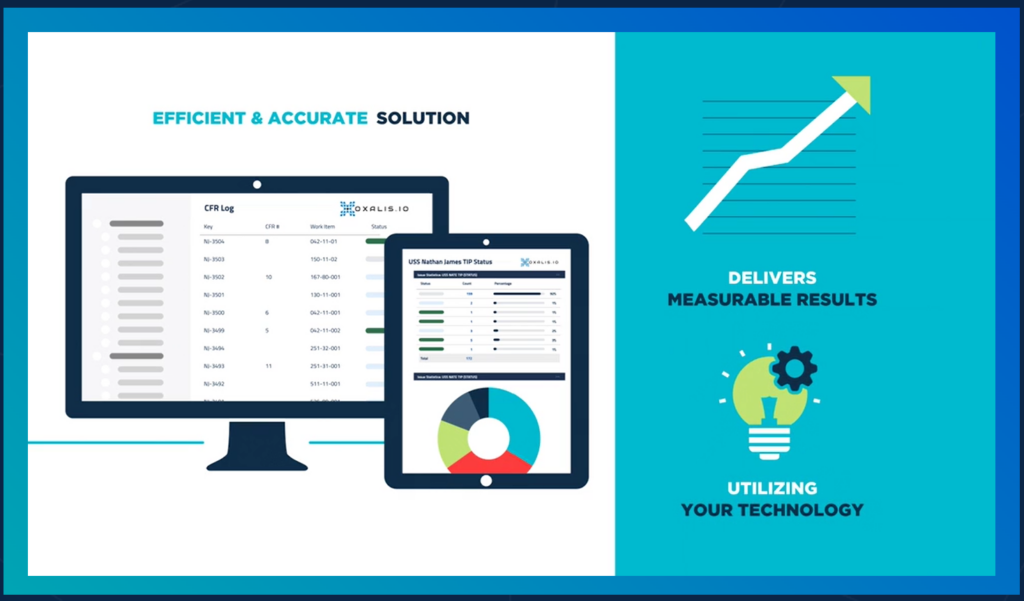
We’re thrilled to announce the Oxalis team has been working on an NSRP Rapid Adoption Project (RAP), in partnership with the Navy and Fincantieri Marine Repair (FMR), to expand the capabilities of the Oxalis Ship Repair Mobile Application. This new functionality will support the digital capture of records, including Condition Founds Reports, improving efficiency and decreasing the cycle time to submit various records.

Key Mobile App Capability Updates

  • Support new record capture in the Oxalis Ship Repair System, including Condition Found Reports
  • Mobile record creation is built for scale and expansion, with the ability to support any type of record, such as Hot Work Permits
  • Leverages existing functionality of the mobile app including offline capabilities

A Quick Recap:  

In 2022, Oxalis completed a pilot of the first release of the Oxalis Ship Repair Mobile Application in partnership with FMR. Oxalis developed a secure, offline-capable mobile solution for digitally executing checkpoints, including capturing signatures. This led to a number of benefits for shipyards and their customers, including:

  • Reduced cycle time for checkpoint result submission to Navy Maintenance Database (NMD)
  • Elimination of paper forms and the need for contractors to manually transcribe checkpoint results
  • High-quality digital OQE to simplify audits and availability certifications
  • Support Contractor and Navy goal of achieving digital workflow and increasing the efficiency of data flow

Following the success of the pilot with FMR and the rollout of the mobile app to multiple shipyards, Oxalis was awarded an NSRP RAP to expand the capabilities of the mobile application to support Condition Found Report capture. The Oxalis Ship Repair Mobile App is an integral part of the larger Oxalis Ship Repair System, which acts as a central hub for coordinating and managing work and document flows throughout the repair process.   


NSRP Rapid Adoption Project (RAP)   

Why RAP? The Rapid Adoption Project model enables a collaborative framework for the development, delivery, and pilot of new technologies and processes to improve efficiencies across the U.S. shipyard industrial base. Through the program, Oxalis is able to quickly develop, iterate, implement, train, and pilot the solution with Fincantieri Marine Repair in less than 6 months.

The Rapid Adoption Project encompassed two critical aspects:  

  1. Training and field testing. While the project was not primarily aimed at proving the technology itself, we acknowledge that mobile technologies’ benefits to distributed workforces have long been established. Instead, we focused on refining our system and ensuring seamless integration within various Maritime operations. By investing in extensive training programs and rigorous field testing, we have fine-tuned the Oxalis Ship Repair System to meet the specific needs of the industry.  
  1. Meeting Tactical Needs: Condition Found Reporting (CFR): Within the comprehensive Oxalis Ship Repair System, one particular area where we have addressed a pressing need is condition found reporting. Recognizing the importance of timely and accurate submission of CFRs, our team at Oxalis has been working diligently on creating digital solutions to enable efficient CFR submission and approvals.

Project Timeline 

As of June 2023, we anticipate development and pilot testing with FMR to be complete by August 2023. The next steps are to execute the first pilot availability using the updated Oxalis Ship Repair Mobile App.

The Rapid Adoption Project is not about proving technology. We’ve proven technology, mobile technologies through OSRS.  The benefits of this system aid an underserved and distributed workforce. Its software capabilities for Shipyards and Maritime companies are unlike anything on the market today.

– Micah Waldstein – Director of Product Management

Takeaways: 

  • The Oxalis Ship Repair Mobile Application is an integral part of a larger system OSRS that coordinates and manages work, process flows, and information from various stakeholders involved in the repair process.
  • The results of our first pilot using the mobile application for checkpoint execution are described in our “TIP Mobile Application Pilot Results” whitepaper. If you’d like to request a copy of the report, please do so using the form at the bottom of this page. 
  • The Oxalis Ship Repair Mobile Application is an offline-capable mobile app integrating with the Oxalis Ship Repair System that supports the digital execution of checkpoint results and the submission of new records, such as Condition Found Reports.  
  • Oxalis developed a roadmap and framework for introducing new digital technologies across the U.S. shipyard industrial base. 

The implementation of the Oxalis Ship Repair System has demonstrated significant improvements in Maritime and Shipyard processes. Our commitment to continuous improvement, extensive training, and thorough field testing ensures that our solution meets the specific needs of these industries.  

We are expecting to conduct a webinar demo later this year and are excited to continue to share updates with you. 

Learn More

Count on Oxalis, for experienced maritime technology solutions and get the results you deserve. We believe that our work on our NSRP app could be of great interest to you to scale your operations.