Four questions shipyards kept asking, and the tension underneath all of them.
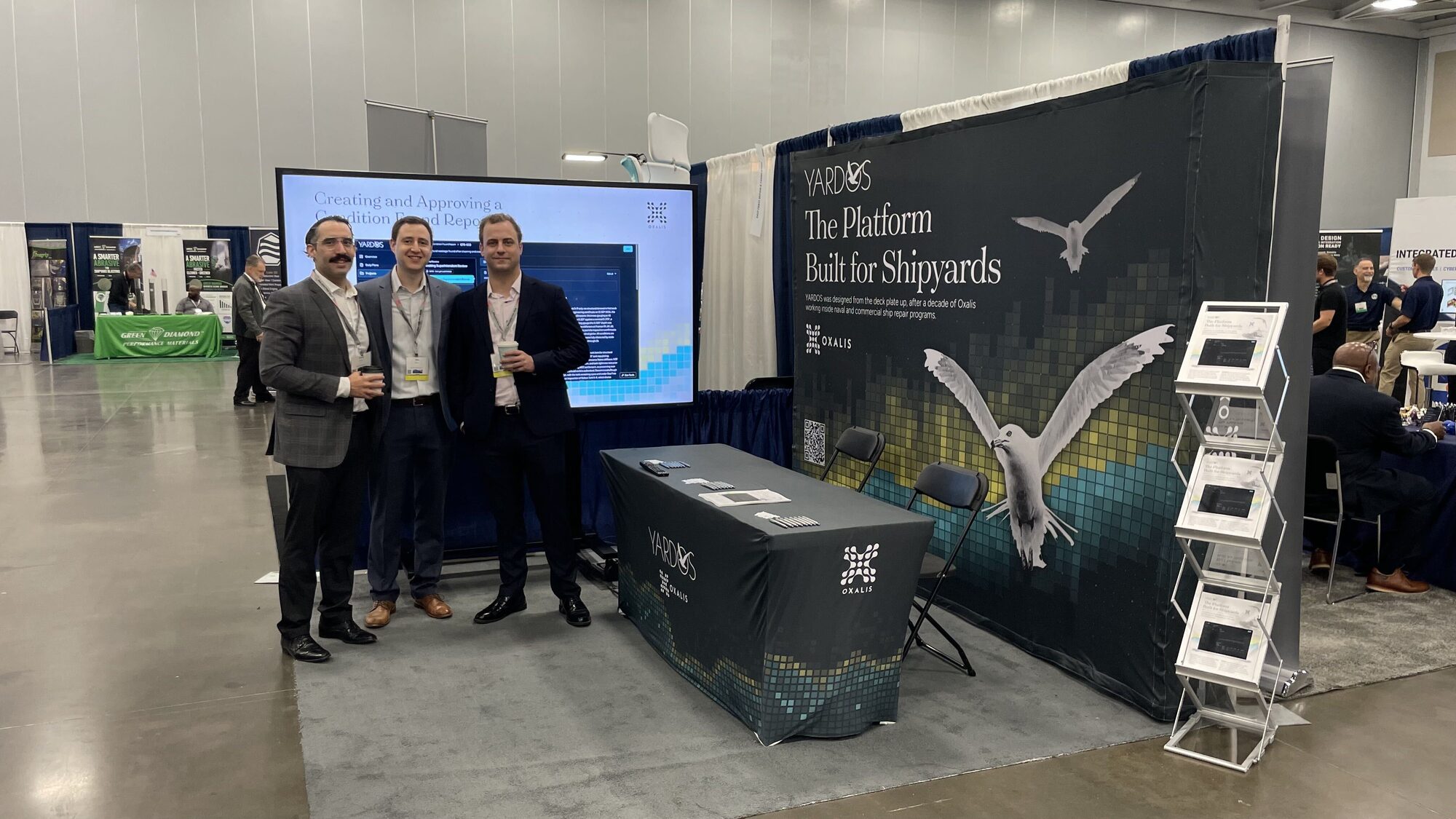
At a glance. Oxalis spent three days at FMMS 2026 in Virginia Beach showing YARDOS and listening to the people who run availabilities. The same questions kept coming back, and together they describe an industry that needs to modernize without ripping out its systems of record. Here is what we heard, and what we are doing with it.
FMMS 2026 filled the Virginia Beach Convention Center with the people who keep the surface fleet running. Navy and Regional Maintenance Center stakeholders walked the floor. Prime shipyards staffed booths a few steps from their subcontractors and suppliers.
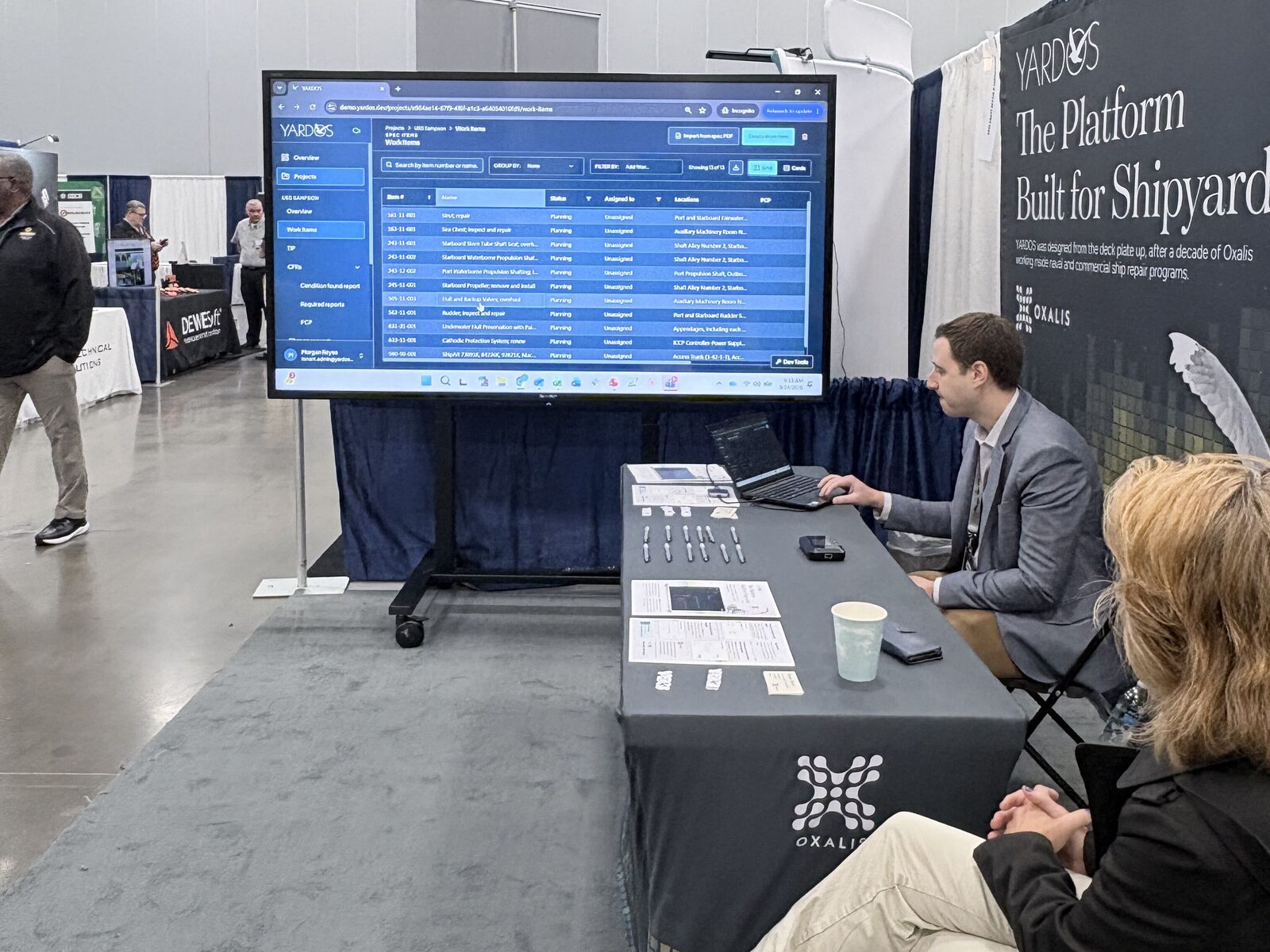
We showed YARDOS, the maintenance, repair and overhaul (MRO) platform for maritime, built by people who speak the language.
The four questions shipyards kept asking
Across primes, suppliers, and Navy visitors, these repeated all week.
- What does the integration with the Navy Maintenance Database (NMD) cover?
- Does YARDOS connect to the scheduling and ERP tools we already run?
- How is change management handled for an availability in production?
- How does Oxalis, the IFS Specialized Partner, relate to Oxalis, the service-first firm behind YARDOS?
Three of the four were about fit. People were thrilled with what they saw, from estimates to CFRs to TIPs, and wanted to know if it would work with NMD, their ERP, and the way change documents move through an availability.
That caution is earned. Maritime has been burned by generic tools, and people wanted to know we understand the deck plate.
The tension underneath those questions
The Navy is stretched thin, and the demand to get more done inside shorter availabilities is real.
Commercial fleet owners feel the same squeeze. Cost of capital is increasing and each availability is a moving puzzle of subcontractors, materials, and inspections, all under schedule pressure.
Everyone in the room is held accountable for delivering on time and on budget.
The systems underneath that work are another matter. GAO’s latest assessment of the Navy’s shipyard infrastructure program, covered by The Maritime Executive this month, puts the realistic cost of rebuilding the four public yards at $200 billion, with completion in 2080. The program was scoped at $21 billion over 20 years when it launched in 2018.
On the commercial side, even before interest rates began rising again, many owners were already gun-shy about touching outdated systems with which they struggle but depend on.
Thread these tensions together, and you find yards staring down two options. Rip out what works well enough today with capital they do not have, or wait years for a replacement to arrive.
The third option is YARDOS
Most yards don’t know they have a third option. YARDOS brings the estimate, condition found reports, test and inspection plans, and executed work into one record by layering on top of their MRO systems, then syncs seamlessly with NMD. Keep your ERP. Keep your scheduler. The people on the job see what needs action next.
Yards get most of the value now with breathing room to make the bigger upgrades down the line.
What we are doing with what we heard
Software only works if people use it, and a tool that slows down the repair gets traded back for paper and Excel within a week.
Oxalis is a forward-deployed partner first. After ten years inside naval and commercial yards, we speak maritime, not just AI, Data, or ERP. We designed YARDOS around how each yard runs, purpose-built to remove friction and stand with the crews until the new ways of working hold. Integration, training, and change management are planned from the start and built around the workflows that set each yard apart.
That is why value shows up quickly. One yard at FMMS told us they see an easy 10% return the moment work moves off paper.
We bring the same approach to IFS, keeping IFS Cloud working for the yards and defense suppliers that can’t afford a bad go-live. For those already on IFS, that means one partner for the ERP and the deck plate.
Where this goes next
We also heard a longer-term worry. Experienced people are retiring, and much of what they know leaves with them.
That is where adoption pays off a second time. When crews use YARDOS to do the work, every estimate, change, and close-out stays in the yard’s own record.
Take estimating, for example. Specialist AI draws on that record to draft the next estimate, so each new bid starts from what the last one learned. It does the math no one has time for, while the estimator still makes the final call.
Across every role, keeping what people know in the yard means less time rebuilding it and more time on the work itself. That is the goal that unified everyone at FMMS, more repairs in a shorter window so vessels are back in service sooner.
We’ll pick up the conversation at WorkBoat in New Orleans, December 2 to 4, booth 3660. If you run a yard, an availability, or the systems underneath either one, bring us your questions or see YARDOS for yourself.
Yard tested. Yard trusted.