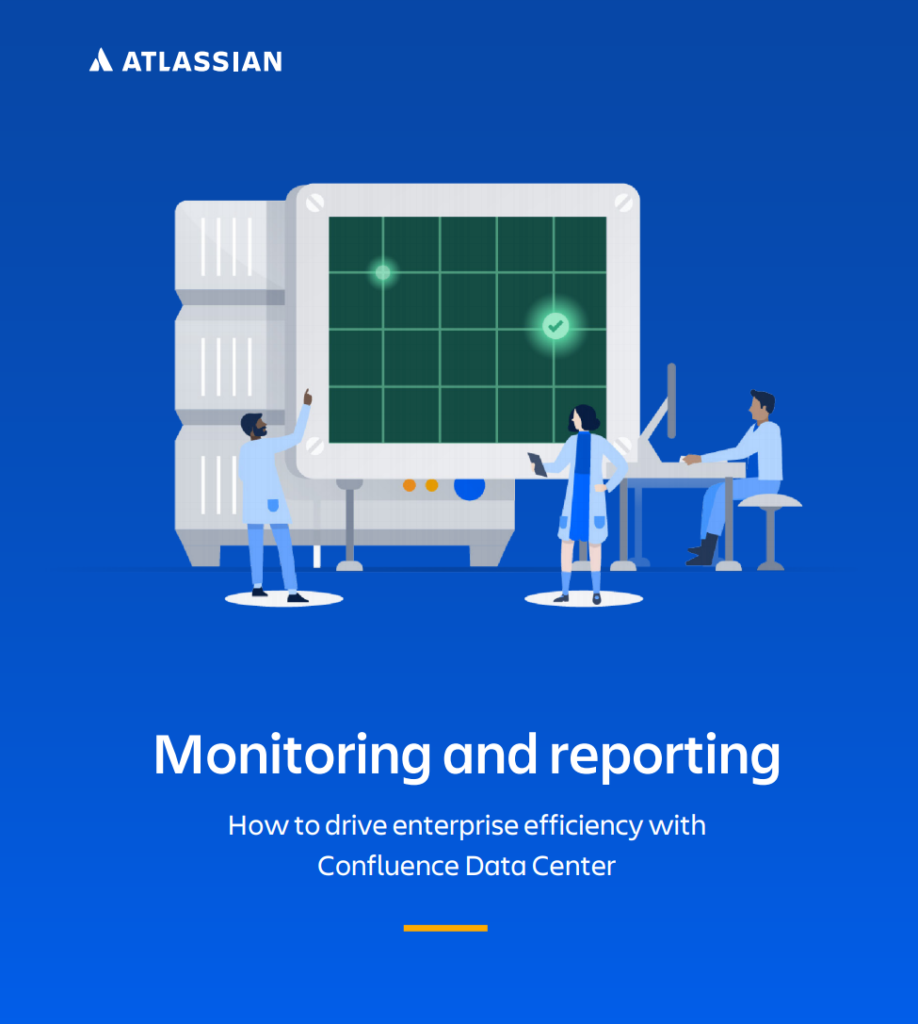
Monitoring and reporting : How to drive enterprise efficiency with Confluence Data Center
how to drive efficiency with Confluence Data Center | Whitepaper

What’s inside:

In this whitepaper, you’ll know how to drive efficiency with Confluence Data Center, including:

  • 5 ways to become more efficient with advanced auditing capabilities.
  • Confluence use cases.
  • Monitoring and reporting best practices.

Find out how to drive enterprise efficiency with Confluence Data Center. When it comes to driving efficiency and effectiveness in your organization, monitoring and reporting capabilities are your best friends.

Being an admin of a self-managed environment means that you are responsible for the management of your entire instance. This includes data retention, scale, performance, and end-user activity just to name a few things. On top of this, you also have to deliver on aggressive business objects, break down organizational silos, and establish consistent ways of working across the enterprise, that’s a whole lot to manage when you can’t understand what’s actually happening in your instance. That’s why having the right software that enables you to take action is so important. Start to drive enterprise efficiency with Confluence Data Center.

Data Center, Atlassian’s self-managed enterprise edition, has advanced auditing capabilities, which allow you to create a digital record of what’s happening in your instance. You can choose one of four different coverage levels (off, base, full, advanced) to log different types of events, depending on the unique needs and insight that your organization requires. Interested in driving enterprise-level efficiency with your teams? Contact us to learn more about Confluence Data Center.

If the software that your organization relies on can’t help you answer questions on performance and security, then it’s not contributing to efficiency and effectiveness within your enterprise. Contact us if you need help getting the most out of Confluence Data Center.
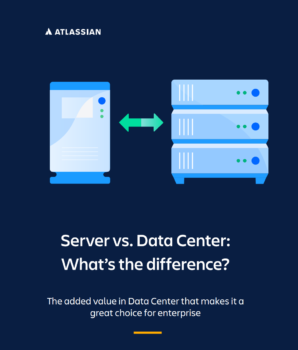
Server vs. Data Center: Which Atlassian Option is Right for You?

Server vs. Data center: What's the difference | Whitepaper

What’s inside:

  • Principal differences between Atlassian Server and Data Center.
  • Main group of benefits with Data Center.

If you have a Jira implementation—either Jira Software or Jira Service Management—you’ll need a license for either Server or Data Center. But what are the differences? Which is right for your business? Data Center offers the same functionality as Server, but with even more features and capabilities to better serve enterprises.

Simply put, Data Center is built for enterprises. High performance and availability, scalability, seamless user management, flexible deployment options, and solid security are just some of the ways in which Data Center meets the needs of organizations operating at scale. And, as of February 2021, apps like Team Calendars for Confluence and Advanced Roadmaps for Jira that were once add-ons will now be included in Data Center products.

While Data Center has several features, there are three main groups of benefits for your organization to enable you to deliver products quickly, reliably, and at scale:

  1. Agile & DevOps
  2. IT Service Management (ITSM)
  3. Work Management

As an enterprise, you’re likely dealing with large, complex, growing, and/or geographically distributed teams. And if those teams need Atlassian products to get their work done, any performance or availability issues can mean a huge loss in productivity. All Data Center products have features that help improve performance. In Jira Software and Jira Service Desk, you can archive both projects and issues to clear up space, clean up your instance, and make your products more performant.

To better understand the differences between Server and Data Center, take a look at the Data Center roadmap to learn about all the additional features that are currently available or coming soon. Still not sure? Reach our to our experts and they’ll be happy to help.

Updated: Please note that Atlassian Server reached its End of Life (EOL) on February 15, 2024 and is no longer supported.

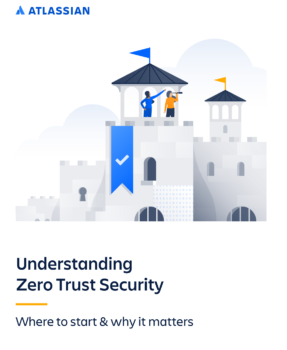
Understanding Zero Trust security: Where to start & why it matters.

Undertanding zero trust security | Whitepaper

What’s inside:

In this paper, we will review the current state of workplace security, the basic principles of this model, and how you can begin your journey towards a Zero Trust-secure workplace environment.

Zero trust security model is perfect for you if you want to improve your safety. For decades, enterprise security controls were built to protect a large, single perimeter around a corporation. Often described as castle-and-moat security, this approach is based on the principle that the perimeter (or moat) should protect everything within its bounds, and everything inside the network is trusted by default.

In this paper, we will review the current state of workplace security, the basic principles of the Zero Trust security model, and how you can begin your journey toward a Zero Trust-secure workplace environment. What makes the Zero Trust approach unique is that in order to minimize the ‘perimeter’ of any given individual and isolate the risk associated with that user, the Zero Trust approach supports the idea that an employee should only be given the minimum access and permissions needed for that employee to do their job.

By limiting access in this way, the risk is minimized. Should an attacker gain access to the credentials of a user in marketing, for example, that perpetrator is ‘laterally’ limited in that they cannot gain access to any of the tools, assets, or information outside that user’s specific role.

The corporate technology space has changed dramatically since the days of castle-and-moat. That change brought the need for a new approach to workplace security. Enter Zero Trust – the new security model industry experts have turned to that addresses the growing security challenges in the modern workplace. This model worked for environments in which applications are hosted on-premise. But castle-and-moat doesn’t stand up to the security threats posed by the proliferation of cloud applications, devices, and logins.

It has become increasingly difficult to secure the critical systems, data, and employees that allow companies to successfully operate. Several converging trends in the IT space are to blame. In case you need help with Atlassian or Jira feel free to contact us.

What is IT Service Management: How IT teams manage the end-to-end delivery of IT services to customers.

What's IT serivce management | Whitepaper

What’s inside:

  • The importance of ITSM.
  • ITSM processes.
  • ITSM software and tools.
  • And more.

IT service management — often referred to as ITSM — is simply how IT teams manage the end-to-end delivery of IT services to customers. This includes all the processes and activities to design, create, deliver, and support IT services.

The core concept of ITSM is the belief that IT should be delivered as a service. A typical ITSM scenario could involve asking for new hardware like a laptop. You would submit your request through a portal, fill out a ticket with all relevant information, and kick off a repeatable workflow. Then, the ticket would land in the IT team’s queue, where incoming requests are sorted and addressed
according to importance.

ITSM stands at the center of modernizing organizations. As the rise of software powered service accelerates, IT service teams are enabling employees and teams across organizations to deliver value more quickly. The role of the IT team has transformed from supporting the business to differentiating the business. It’s time to move towards approaches to ITSM that emphasize collaboration, ease of use, and faster value delivery. Transform your service desk with the Atlassian approach to IT Service Management.

Due to their day-to-day interactions with IT service management, people often misconstrue ITSM as basic IT support. On the contrary, ITSM teams oversee all kinds of workplace technology, ranging from laptops to servers, to business-critical software applications.

There is a common line of thinking in the IT industry that posits that a proper approach to ITSM should follow three steps in this order: 1) Build and implement IT technology. 2) Bring in and enforce the right process. 3) People can learn the technology and abide by the process. Atlassian flips that paradigm.

For Atlassian, the team comes first. IT teams should be continually learning and improving. They must feel valued and empowered to make a difference in the organization. In case you need some help feel with your Atlassian status, free to contact us.

DevOps with Atlassian: A guide to cloud features

DevOps with Atlassian | Whitepaper

What’s inside:

Atlassian unifies all of DevOps work and reduces collaboration overload. In this whitepaper you’ll touch base on the following topics:

  • Find out how Atlassian tools help developers get more productive.
  • How to plan and track projects.
  • How to mitigate alert fatigue and resolve incidents faster.
  • DevOps best practices.

Atlassian’s new features, automations and integrations for DevOps help developers take back their time and ship code faster. Teams benefit from less context switching, fewer meetings, and fewer pings from IT about security incidents.

Increased collaboration can come at a cost to developers. Instead of coding and building innovative solutions, developers can end up spending a big chunk of their day integrating multiple tools, updating work status, and sharing it with other teams. According to the recent DevOps Trends Survey conducted by Atlassian, more than 80% of developers state that disconnected tools, manual
processes, and constantly changing collaboration processes are getting in the way.

We’re helping developers focus on their code as we uniquely connect development, IT operations, and business teams with automation
that spans our products and third-party tools. Atlassian’s new features, automation, and integrations for DevOps help developers take back their time and ship code faster. Teams benefit from less context switching, fewer meetings, and fewer pings from IT about security incidents. Successful DevOps implementation doesn’t end at connecting the tools. Most DevOps practitioners agree—citing people and culture as the top factor in successfully implementing. Inside this whitepaper, you’ll learn more about every stage such as: Plan, building, CI/CD, operating & monitor, Communication & collaboration.

In case you need help with DevOps with Atlassian, Atlassian confluence, or other products, feel free to contact us

5 reasons to move to the cloud

5 reasons to move to the cloud | Whitepaper

What’s inside:

In this whitepaper, you’ll learn:

  • 5 reasons to move to the cloud.
  • 5 case studies.
  • What it takes to get to the cloud.
  • How to trial the cloud for free.

More and more organizations are moving to the cloud. Experts predict that up to 83% of enterprise workloads will be on the cloud by the end of 2021.

If you’re not in the cloud yet…it’s time. The highest-performing teams are 24 times more likely to use the cloud than underperformers. So, when we say staying on-premise is holding you back, we mean it. A move to the cloud isn’t a button you can push to instantly increase profits, speed, productivity, scalability, and future readiness. But the time and cost it takes to make the move pay off big in the long term. No matter your team size or growth phase, Atlassian has flexible plans and the tools you need in the cloud to not just keep up, but stay ahead.

Atlassian offers their most popular products completely free for teams of 10 or less to help unleash the potential of teams from startup to enterprise. Atlassian Cloud Premium gives teams the confidence to scale reliably with advanced features, plus a 99.9% uptime SLA, unlimited storage, and Premium Support. Not to mention that enterprise companies benefit from large team discounts when they sign up with 101+ users.

Cloud services are more secure, sustainable, agile, and cost-effective than ever before, and companies are finding fewer reasons to stay on-premise (also known as ‘on-prem’). In fact, 9 out of 10 new Atlassian customers choose cloud over on-premise—and even die-hard traditionalists are starting to make the move. So, what’s driving this mass move to the cloud? Why do experts think companies that haven’t made the switch are already falling behind? Learn more by downloading the white paper below, and contact us if you need help deciding if the cloud is right for your organization.

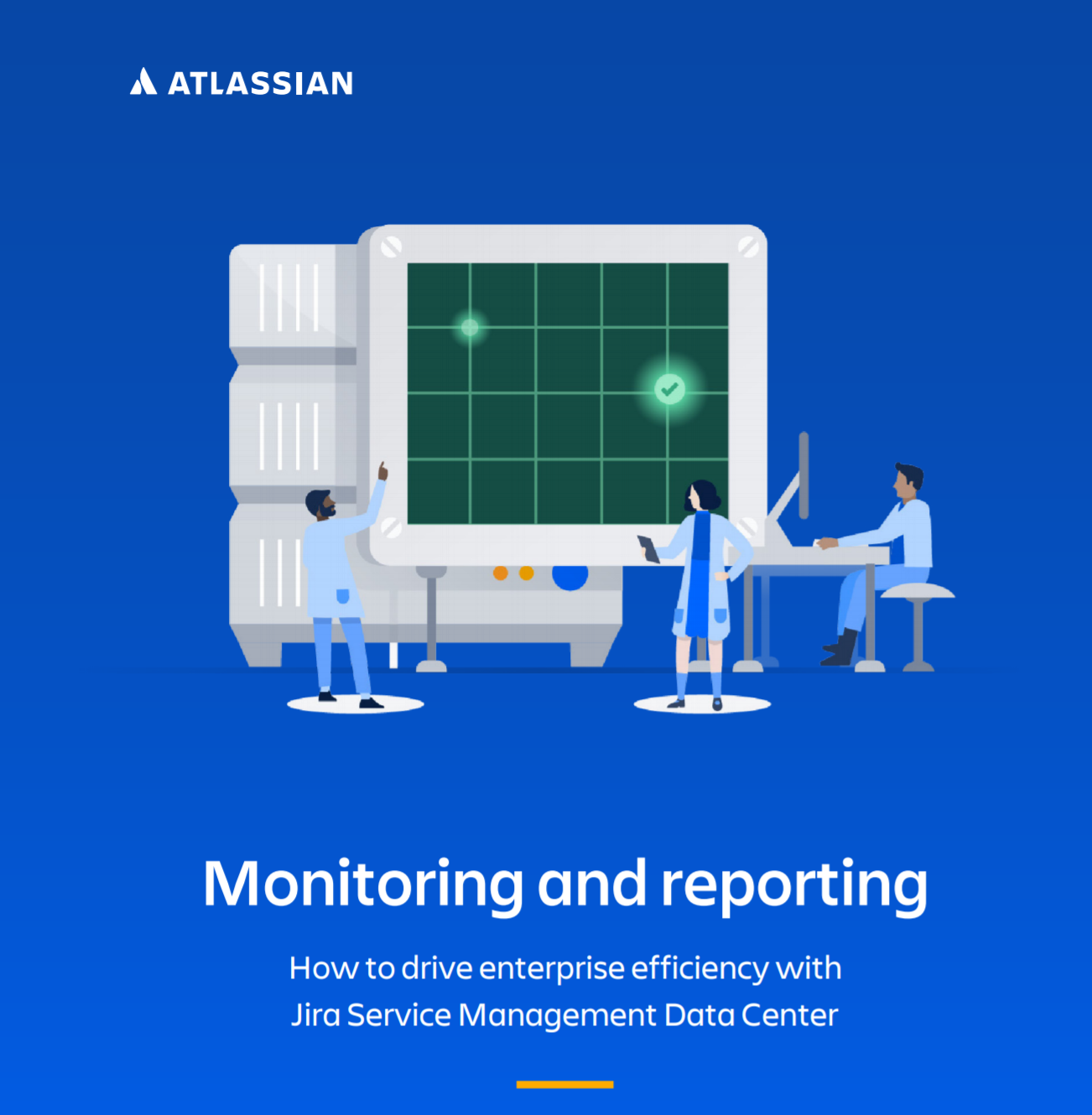
Monitoring and reporting: How to drive enterprise efficiency with Jira Service Management Data Center

How to drive enterprise efficiency with Jira Service Management Data Center | Whitepaper

What’s inside

  • Discover how to drive enterprise efficiency with Jira Service Management Data Center
  • 5 ways to become more efficient with advanced auditing.
  • Jira service management use case.
  • And more.

Drive enterprise efficiency with Jira Service Management Data Center, when it comes to driving efficiency and effectiveness in your organization, monitoring and reporting capabilities are your best friends. These capabilities are what allow you to gain insight into how your teams are using their software.

Being an admin of a self-managed environment means that you are responsible for the management of your entire instance. This includes data retention, scale, performance, and end-user activity just to name a few things. On top of this, you also have to deliver on aggressive business objects, break down organizational silos, and establish consistent ways of working across the enterprise, that’s a
whole lot to manage when you can’t understand what’s actually happening in your instance. That’s why having the right software that enables you to take action is so important.

You can choose one of four different coverage levels (off, base, full, advanced) to log different types of events, depending on the unique needs and insight that your organization requires. Advanced auditing is built with file externalization capabilities, which means that you can integrate your Data Center products with third-party monitoring tools, such as Splunk, Elastic Stack, Sumo Logic, or CloudWatch. By leveraging file externalization, you can even use key features provided by your monitoring tools to gain even more insight into your events.

Data Center, Atlassian’s self-managed enterprise edition, has advanced auditing capabilities, which allow you to create a digital record of what’s happening in your instance. In case you need some advice about how to use jira or other Atlassian products, feel free to contact us.

Proven Drivers for unlocking high-velocity ITSM

PROVEN DRIVERS FOT UNLOCKING HIGH VELOCITY ITSM

What’s inside

  • Principal challenges for I&O Organizations
  • Key drivers evaluation
  • High performers metrics

The proven drivers for unlocking high-velocity ITSM has an obsession with a culture of collaborative, cross-functional product teams and practices that prioritize autonomy, speed, and flexible integrated technology. With the global outbreak of the COVID-19 pandemic, uncertainty has become the new normal for many organizations. As a result, I&O organizations have been tasked with navigating and adapting to these uncertain times. And if organizations want to survive and thrive, they’ll need to start responding with higher velocity in a manner that is both faster and more sustainable. Leading I&O organizations must become nimbler and more flexible in their support and partnership with development, embracing the DevOps culture of collaborative teams, practices, and technology.

Atlassian commissioned Forrester Consulting to evaluate the key drivers at play during uncertain times for high performing I&O organizations. Forrester conducted an online survey with 649 respondents who have responsibility for IT service management (ITSM) initiatives in their organization to explore this topic. The survey was fielded during the COVID-19 pandemic, and it found that those high-velocity organizations which embrace more agile and integrated teams lead their industry in terms of performance, positive outcomes, and readiness to change. Organizations can thrive in today’s market by focusing on collective (rather than siloed) effectiveness when it comes to people, practices, and technology. Check out this study Forrester Consulting and Atlassian has for you and find the proven drivers for unlocking high-velocity ITSM. If you need some help feel free to contact us.

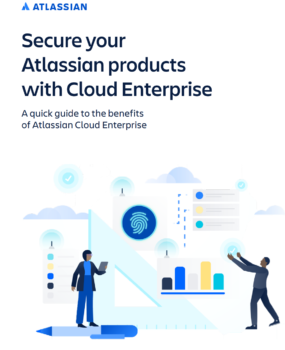
Secure your Atlassian Products with Cloud Enterprise: A quick guide to the benefits of Atlassian Cloud Enterprise

Benefits of Atlassian cloud enterprise | Whitepaper

What’s inside:

Start with your improvement today. With Atlassian safeguarding your data, your IT team is free to focus on projects and initiatives important to your company

  • Principal benefits of Atlassian Cloud Enterprise

Benefits of Atlassian Cloud are there to start improving your business process. The idea of handing the security of your data over to another company may be intimidating. But when it comes to protecting data, most enterprises prefer cloud over on-premise setups. In fact, 94 percent of companies reported improvement in security once they moved to the cloud.

Maintaining compliance with regional or industry standards is non-negotiable, especially for companies whose customers are entrusting them with sensitive information. With on-prem setups, that compliance is on you. You’re in charge of bringing in auditors, building out compliance roadmaps, and executing on your plan.

A CSP can take care of the heavy lifting involved in achieving compliance certifications and offer technology that helps you stay compliant with local regulations. According to RapidScale, 91 percent of companies say cloud solutions make it easier to stay compliant. This is because any changes to compliance standards from a technology perspective are also handled by CSPs on behalf of their customers.

Cloud service providers (CSPs) like Atlassian work to help you stay compliant, offer dedicated teams charged with keeping your data safe, and leverage secure remote-ready practices that help your teams get work done. With Atlassian Cloud, you don’t have to worry about whether your Atlassian products are compliant—they are.

If you need help with Atlassian support feel free to contact us.