What it takes to price an aviation MRO job accurately
Understanding aviation Maintenance, Repair, and Overhaul (MRO) goes beyond the technical basics. It requires a deep grasp of the financial complexities that drive every project bid and budget. With rising cost pressures and increasingly complex estimation challenges, MRO contractors need advanced tools to create accurate forecasts, control expenses, and stay competitive in a demanding market.
What is aviation MRO?
In aviation, Maintenance, Repair, and Overhaul (MRO) covers all the work needed to keep aircraft safe, reliable, and airworthy. This includes routine inspections and checks (A/B/C/D checks), troubleshooting and repairing faults, and even fully disassembling and rebuilding engines or structures to OEM standards. MRO keeps planes flying safely, extends an aircraft’s life, and ensures passenger safety.
Most MRO work must be performed by certified facilities or mechanics (FAA-certified repair stations), adhering to strict regulatory standards. Airlines, airframe manufacturers, and dedicated MRO providers all rely on these services to meet regulations and avoid costly flight disruptions.
What are the top cost drivers in aviation MRO?
In project management, costs are generally classified as fixed, variable, direct, indirect, and sunk. Direct costs are expenses tied to specific work, like labor and materials. Indirect costs are overhead and support. Fixed costs don’t vary with work volume, like equipment rentals or fees. Variable costs change with scope, like fuel or consumables. Sunk costs are past expenditures, not usually included in new estimates. We’ll organize the top MRO cost drivers under these categories.
Direct costs are those you can directly link to the aircraft service itself. Skilled labor, such as mechanics, avionics technicians, and inspectors, has its time logged against the job. Parts and materials include engines, avionics, and critical spares. Equipment and tooling covers engine stands or scaffolding rentals used during repairs. Subcontracted services include outsourcing non-destructive testing or composite repairs.
Indirect costs support the project but aren’t tied to a specific line item. Administrative overhead covers project management, quality control, and compliance reviewers. Transportation and logistics cover the handling, shipping, or special transport of aircraft or components. These costs aren’t directly billed, but they’re essential to the project’s success.
Fixed costs remain the same regardless of the project’s scale or duration. In aircraft MRO, two stand out. The hangar or bay rental is often a flat rate per day or per slot. The aircraft downtime cost is the revenue an airline forfeits when a plane can’t fly because it’s in heavy maintenance.
Variable costs fluctuate with the amount of work completed. Consumables and expendables, such as lubricants, sealants, fasteners, and cleaning supplies, escalate with more tasks. Contingency for unforeseen repairs is budgeted for surprise findings once maintenance begins.
Sunk costs are costs that have already been spent and shouldn’t influence a current estimate. These might include prior surveys, initial inspections, or preparatory work. They’re important historical expenditures, but irrelevant when building the next bid.
Administrative overhead (project management, compliance, quality control); transportation & logistics (aircraft or parts movement, customs, handling fees)
Fixed costs
Hangar or bay rental fees; aircraft downtime cost (loss of revenue during maintenance)
Variable costs
Consumables and expendables (lubricants, sealants, fasteners); contingency for unforeseen repairs or scope changes
Sunk costs
Previous inspections, prior surveys, or preparatory work already expended
What challenges do MRO contractors face in estimating a bid?
Building an accurate MRO bid is difficult. First, scope uncertainty is significant. Many issues only become apparent once work begins. Old airframes often conceal corrosion or fatigue that becomes apparent during disassembly, and estimators must guess at contingency work without grossly overpricing.
Second, supply chain volatility throws wrenches into plans. Parts shortages or long lead times can derail schedules and inflate labor costs if crews sit idle. Material price spikes add another wrinkle.
Third, regulatory complexity adds hidden tasks. MRO work in the U.S. must meet FAA/EASA certification rules, and may involve special environmental or safety procedures, like engine run-ups, waste handling, or inspection reports. Failing a compliance step can mean fines or rework, so these costs must be anticipated. Marine MRO faces the same pattern under IMO/SOLAS rules.
Finally, outdated tools and processes hamper accuracy. Too many shops still use spreadsheets, emails, and siloed rate cards to create quotes. This unstructured approach makes it easy to omit labor hours or markups and hard to reuse knowledge. When veteran estimators leave, their know-how often goes with them, leaving gaps that can cause costly mistakes down the line.
How does YARDOS Estimation help with aviation MRO estimating?
OAE is now YARDOS Estimation. YARDOS Estimation‘s cloud-based platform is purpose-built to solve these problems. It lets senior estimators capture their hard-won knowledge in templates and libraries, so that best-practice rates, labor breakdowns, and workflows are stored consistently across all projects and teams.
Newer team members can use these libraries to build bids quickly without missing details. YARDOS Estimation is designed for complex, multi-year projects, common in heavy maintenance, and adapts as change orders come in. Access is permission-based, so outside shops can enter their pieces of the estimate without exposure to the full price book.
Frequently asked questions about aviation MRO cost estimating
What is aviation MRO? Aviation MRO covers the inspections, repairs, and overhauls that keep aircraft safe, reliable, and airworthy, usually performed at FAA-certified repair stations.
What are the biggest cost drivers in aviation MRO? Direct labor and parts, hangar or bay rental, aircraft downtime, and contingency for unforeseen repairs are the categories that show up most in an MRO bid.
Why is aviation MRO estimating so difficult? Scope uncertainty, supply chain volatility, regulatory complexity, and outdated estimating tools all make an accurate MRO bid harder to build.
What a multi-level BOM is and does
A multi-level Bill of Materials (BOM) is a hierarchical structure that details the components, subassemblies, and assemblies needed for the final product. It organizes parts in a tree-like format where the top level represents the finished product, and each lower level delineates increasingly detailed subassemblies and individual parts. This structure helps visualize relationships and dependencies, such as which components must be assembled before others.
In complex industries like aviation and maritime, multi-level BOMs are essential for managing the intricate assemblies and parts involved. However, building and maintaining multi-level BOMs presents challenges such as managing vast amounts of detailed data, ensuring up-to-date version control amid frequent product revisions, and integrating BOM data accurately with ERP and MRP systems to avoid errors and miscommunication.
What is a multi-level bill of materials (BOM)?
A multi-level Bill of Materials (BOM) is a hierarchical representation of all components, subassemblies, and raw materials required to manufacture a final product. Unlike single-level BOMs that simply list components in a flat structure, multi-level BOMs capture the actual assembly relationships, showing not just what parts are needed, but how those parts fit together and which components depend on others.
The structure resembles a family tree, with the finished product at the top (Level 0), major assemblies or subassemblies at Level 1, and progressively smaller components at subsequent levels. For example, in aerospace manufacturing.
This hierarchical approach provides comprehensive visibility into the supply chain, enabling accurate inventory management, cost estimation, and demand forecasting. Each level details all components that are directly or indirectly used in the production of a parent item, creating a clear roadmap of dependencies and relationships.
Why does a multi-level BOM matter for cost management?
Here are some of the ways a well-constructed multi-level BOM supports better cost management.
Component-level cost visibility. Because each part or subassembly is represented and valued, you can roll up the cost from the lowest level, raw materials and purchased components, through subassemblies to the top. This shows which subsystems or parts contribute most to cost, and where cost optimization efforts should focus.
Accurate estimates and quoting. A hierarchical BOM makes it possible to produce more precise cost estimates for new projects or variants by summing detailed costs, rather than relying on “ballpark plus buffer” guesswork.
Change impact analysis and engineering change control. In complex systems, design changes in one subassembly can cascade costs elsewhere. A multi-level BOM makes it easier to trace dependencies and simulate the impact of a change before implementing it, which avoids costly surprises mid-project.
Better resource and inventory planning. Purchasing, stocking, and lead times can be planned for each component in the hierarchy. Knowing where bottlenecks or long-lead parts lie means procurement can be staged or mitigated ahead of time, and intermediate components are less likely to be overstocked or understocked.
Traceability, audit, and compliance. In regulated sectors like aerospace or maritime, traceability of parts, serial numbers, lot numbers, is critical. A multi-level BOM, integrated with quality systems, gives a documented lineage of every part from raw material through assemblies. That documentation supports certification, audits, recalls, or root-cause analysis on a defect.
Cost control and variance analysis. During project execution, actual costs can be compared against baseline BOM-based estimates at each level. Deviations, like a subassembly costing more than planned, can be flagged early enough for corrective action.
Support for variant and configuration management. Many aerospace or maritime systems have variant options, optional modules, different subsystems. A hierarchical BOM makes it possible to manage these variants cleanly, reusing shared subassemblies while tracking the differences between them.
What are the challenges in building and maintaining multi-level BOMs?
While the advantages are compelling, building and maintaining multi-level BOMs in complex industries is a non-trivial task. Some of the key challenges include the following.
Challenge
Explanation and risks
Data complexity and volume
The number of parts and subassemblies can become enormous, with thousands or even tens of thousands of nodes. Managing that many relationships, versions, and interdependencies is inherently complex.
Consistency and duplicate definitions
A part or subassembly may appear in multiple places. Ensuring that its specification, revision, cost, and other attributes remain consistent is difficult.
Frequent engineering changes
In industries like aerospace, designs evolve continuously. Ensuring that changes propagate correctly, and that old BOM versions are retained for traceability, is a challenge.
Revision control and configuration management
Multiple BOM versions must be maintained, for different revisions, configurations, or model years, while preventing incorrect mixes of parts.
Cross-discipline coordination
Engineering, manufacturing, procurement, quality, and service teams all rely on the BOM but often have different data requirements and priorities. Maintaining alignment across departments is challenging, and poor coordination can lead to inconsistent data, procurement delays, production errors, and rework.
Integration with other systems
The BOM must link with ERP, PLM, purchasing, quality, and costing systems. Ensuring data integrity and a single source of truth is difficult.
Rolling up costs and allocations
Aggregating costs upward across levels, especially when different cost models or allocations (labor, overhead, waste) are used, can be complex.
Performance and scalability
As BOMs grow to include thousands of components, multiple revisions, and deeply nested assemblies, system performance can degrade if the underlying architecture is not optimized. Slow searches, delayed updates, and lengthy report generation can reduce productivity and hinder decision-making.
Some of these challenges are particularly acute in aviation and maritime.
The regulatory demand for traceability, certification, and change control is stringent.
Many parts are specialty, long-lead, or custom, so procurement risk is high.
Projects tend to be long (years), so version control over time is more demanding.
Supply chains are global and tiered (suppliers of suppliers).
How does YARDOS Estimation support multi-level BOM management?
YARDOS Estimation‘s estimation capabilities are built to address the challenges of multi-level BOM management in complex industries.
It supports variable-based estimation models that accommodate the hierarchical nature of multi-level BOMs. Estimators can configure multiple rate cards, labor roles, and material costs across different assembly levels, for pricing that reflects real-world project conditions.
Projects spanning multiple years are supported through YARDOS Estimation’s period-based functionality. Periods can be created for a project that spans multiple years, so work items, rate cards, and reporting can be assigned globally or to a specific period. That’s essential for long-term aviation and maritime projects, where component costs, labor rates, and regulatory requirements can change over time.
The platform reduces version control headaches through multi-user collaboration in a secure, permission-based environment. Estimators, project managers, and subcontractors can contribute and update estimates in real time, keeping teams synchronized and data consistent.
OAE is now YARDOS Estimation. It supports multiple rate cards per effort, with default structures or customizable configurations for different pricing approaches per effort, material, or labor role. That flexibility helps estimation teams optimize margin calculations across different levels of the BOM hierarchy.
Multi-level BOMs are more than component lists. They function as a financial map of how a product’s cost accumulates from raw material to finished assembly. In complex industries like aviation and maritime, where products involve highly detailed and custom BOMs with multiple levels of subassemblies and components, effective multi-level BOM management is critical for maintaining a competitive edge.
Frequently asked questions about multi-level BOMs
What is a multi-level bill of materials (BOM)? A multi-level BOM is a hierarchical breakdown of every component, subassembly, and raw material needed to build a final product, showing how the parts fit together, not just what’s needed.
Why does a multi-level BOM matter for cost management? It lets cost be rolled up from raw materials through subassemblies to the finished product, showing which parts actually drive cost and where to focus optimization.
What are the biggest challenges in managing a multi-level BOM? Data volume, version control across frequent engineering changes, and keeping engineering, procurement, and quality teams aligned on the same BOM are the challenges that show up most often.
What it takes to manage a multi-year bid
Winning large, multi-year bids can propel a contractor into a new tier of professionalism and profitability, but managing them is genuinely hard. It takes meticulous planning, technical precision, and unwavering attention to detail. Contractors often face stiff challenges, from navigating compliance requirements to ensuring margin stability over extended timelines.
This guide explores the pitfalls of managing multi-year bids and how smarter tools, like YARDOS Estimation, can help contractors overcome these challenges.
The challenge of managing multi-year bids
Why are multi-year bids so complex to manage?
Multi-year projects often mean extended timelines, intricate details, and greater risks. Unlike simpler, short-term bids, these projects require thorough breakdowns of labor, materials, cost escalations, and external factors like economic shifts. Here’s what contractors deal with when managing complex bids.
Extensive compliance standards. Large government and enterprise bids are often bound by stringent compliance requirements. Omissions, errors, or inconsistencies can lead to disqualification or penalties.
Manual data management risks. Relying on spreadsheets for such complex projects results in data silos, inefficiencies, and increased chances of errors, leading to costly mistakes.
Margin and costing volatility. Multi-year bids often span years of fluctuating labor costs, materials pricing, and economic conditions. Forecasting these with precision while maintaining an acceptable profit margin is no small task.
Lack of knowledge retention. Senior estimators hold significant institutional knowledge, but traditional tools fail to capture this expertise for future use. This creates gaps when key personnel leave.
Collaboration bottlenecks. Real-time collaboration is almost impossible with static tools, leading to version control issues, project delays, and outdated estimates.
With so many variables to manage, multi-year bids can become a painstaking, resource-draining process. Better tooling changes that trajectory.
What are the four steps in the bidding process?
At its core, managing a successful multi-year bid involves four key steps.
Scope definition and planning. Clearly define the project requirements, milestones, labor, and material needs. Identify key risk areas early.
Cost estimation. Project labor and material costs over the entire timeframe, accounting for planned adjustments due to inflation, material shortages, or other market shifts.
Compliance and proposal drafting. Draft a fully compliant, detailed, and clear proposal that minimizes the chances of disqualification or oversight.
Execution monitoring. Develop a process for regularly tracking resource allocation, cost performance, and work progress to ensure smooth execution.
Each step demands meticulous attention to detail and several tools working in tandem. That’s where advanced estimation software like YARDOS Estimation comes into play.
How does YARDOS Estimation simplify multi-year bid management?
OAE is now YARDOS Estimation and delivers precision where contractors need it most, from initial costing to execution monitoring. Designed specifically for industries handling highly regulated and complex bids, YARDOS Estimation helps contractors tackle some of the most common pain points.
Key features and benefits of YARDOS Estimation
Multi-year estimation capabilities. Multi-year functionality in YARDOS Estimation lets teams define global or period-specific elements of a project. Switching between rate cards, forecasting pricing escalation, and reporting accurately over extended timelines are all handled in one place.
Real-time collaboration and data transparency. YARDOS Estimation supports live, multi-user collaboration, so estimators, project managers, and subcontractors work from the same up-to-date project data instead of a version-controlled patchwork. Built-in audit trails track every change.
Knowledge capture for future growth. With YARDOS Estimation, contractors can build a centralized repository of calculators, bid templates, and estimation best practices that reflect the institutional knowledge of expert estimators. That record helps preserve continuity when experienced professionals retire or leave.
Predictive analytics and scenario modeling. YARDOS Estimation’s scenario modeling helps manage margin pressure. Testing “what-if” scenarios shows how different variables affect project budgets, timelines, and profitability.
Automation that reduces manual effort. Automating time-intensive tasks like compliance checks, labor breakdowns, and material forecasting lets contractors submit bids with less manual effort and fewer chances for error.
Scenario modeling and margin control. Estimators can try different inputs, like higher material costs or alternate subcontractor rates, to see how margin responds, then choose the strategy that protects profitability.
Industries YARDOS Estimation supports
YARDOS Estimation is built for contractors operating in complex sectors.
Maritime. Addresses labor and material complexity for shipyard overhauls or repairs.
Construction. Streamlines multi-trade projects and capital infrastructure bids.
Energy, oil, and gas. Handles engineering, procurement, commissioning, and complex instrumentation projects.
Government agencies and public sector. Structured templates, audit trails, and requirement-driven workflows.
Government contractors. Multi-year estimation, role-based access, margin scenario modeling, and reusable calculators and templates help contractors price long-term obligations.
YARDOS Estimation’s flexibility allows it to adapt to specific project requirements across these specialized industries.
A better way to manage multi-year bids
Managing complex, multi-year bids doesn’t require constant firefighting. The right tools and processes reduce the inefficiencies that put compliance and margin at risk.
What YARDOS Estimation changes
Fewer costly errors. Built-in validation tools catch mistakes before they reach the bid.
Streamlined workflows. Processes move faster without sacrificing depth or detail.
Frequently asked questions about multi-year bid management
What makes a multi-year bid different from a standard bid? A multi-year bid spans a longer timeframe, which means more variables to track. Labor costs, material pricing, and compliance requirements can all shift before the work is even underway.
What are the biggest risks in managing a multi-year bid? Compliance requirements, manual data management, margin volatility, knowledge retention, and real-time collaboration are the risk areas that show up most often in a multi-year bid.
What are the four steps in managing a multi-year bid? Scope definition and planning, cost estimation, compliance and proposal drafting, and execution monitoring make up the four steps.
A basis of estimate is what makes a bid defensible
The Basis for Estimate (BOE) is a critical foundational document in project cost estimation, serving as the transparent rationale behind how project costs are derived. In complex industries such as government contracting, maritime, industrial manufacturing, and oil and gas, accurate and well-documented BOEs are essential for project success and credibility.
What is a basis of estimate?
A Basis of Estimate (BOE) is a structured, documented explanation of how you arrived at cost, resource, schedule, and risk estimates for a project. It captures the logic, assumptions, methods, data sources, and calculations underlying the estimate.
In effect, the BOE is your “audit trail” for the estimate. If a stakeholder, auditor, or regulator wants to challenge or understand the proposed budget or timeline, the BOE demonstrates transparency, credibility, and defensibility.
A BOE typically includes the following.
A breakdown of the work scope (task/work package definitions, WBS)
The ground rules and assumptions (e.g. labor rates, productivity rates, escalation, resource constraints)
The estimating methodology or techniques used (bottom-up, analogous, parametric, three-point, expert judgment)
Risk, uncertainty, and contingency/reserve allocations
A narrative and rationale tying all of it together (why the assumptions are reasonable, how productivity was derived, etc.)
Exclusions (what was deliberately excluded) and limitations
Sensitivity or “what-if” analyses or alternate scenarios, to show how the estimate would shift under variation
Comparisons or benchmarks (historical data, references to past similar projects)
A version and revision history with traceability to actuals, allowing comparison of estimated vs. actual later
When done well, the BOE does not merely justify a number. It builds confidence with stakeholders (executives, sponsors, regulators, oversight bodies) that the estimate is credible, defensible, and well thought through.
What are the challenges in building a basis of estimate?
Building a robust BOE in complex projects poses several challenges.
Complex scope and variable requirements. Projects often involve multifaceted scopes with changing or unclear requirements, which makes precise estimation difficult.
Multiple estimation methods. Choosing between parametric, analogous, bottom-up, or other estimating methods to suit different parts of the project can be complex.
Data availability and accuracy. Accessing accurate historical cost data, current market prices, and contractor quotes is often limited or inconsistent.
Assumptions and risks. Identifying and documenting assumptions, exclusions, and risks precisely can be prone to omissions and misinterpretation.
Regulatory and compliance requirements. For government projects, adherence to strict standards adds layers of complexity.
Collaboration and version control. Coordinating input from multiple stakeholders and preventing information silos or version conflicts is a significant logistical hurdle.
What are the best practices for building a high-quality BOE?
Principle
Description / key action
Clear purpose definition and scope control
Define exactly what the estimate covers, and what is excluded. Be explicit about boundaries.
Use a formal estimating plan
Before starting, decide on methodology, level of detail, risk approach, data sources, reviewers, and timeline.
Decompose work (WBS / work packages / control accounts)
Use a bottom-up or hybrid approach, breaking tasks down to a level where estimation is credible, then rolling up.
Select appropriate estimation methods and cross-check
Choose from bottom-up, analogous, parametric, three-point, expert judgment. Use at least one cross-check method to validate results.
Use credible data, historical databases, and benchmarking
Leverage past actuals, market quotes, vendor pricing, and published benchmarks. Document data sources and rationale.
Incorporate risk and contingency/uncertainty modeling
Use sensitivity analysis, probabilistic modeling, Monte Carlo, or scenario analysis to quantify uncertainty and allocate contingency reserves.
Maintain revision history and preserve original work-file data
Annotate changes and preserve original data so the estimate can be traced back.
Update and refine estimates over the project lifecycle
Treat the BOE as a living document. As actual cost, schedule, and risk data come in, the estimate gets revised and compared against actuals.
Link to performance measurement and baseline control
Align the BOE’s cost and schedule structure to the project’s performance measurement system, enabling variance analysis.
Maintain historical lessons and knowledge reuse
After project completion, compare estimates against actuals, capture lessons, and feed them into a historical database.
How does a BOE support the project lifecycle?
A well-constructed BOE is not just a front-end exercise. It plays a critical role throughout the project lifecycle. Here’s how it ties into lifecycle management.
1. Proposal / initiation phase
BOE is the basis for budgeting, bid pricing, or funding requests
It helps decision-makers evaluate feasibility, trade-offs, and funding approval
It sets the baseline from which performance is measured
2. Planning phase
The BOE’s work breakdown and assumptions inform the schedule, resource, and procurement plans
It helps identify high-risk areas to focus mitigation efforts
It informs contingency planning and reserves
3. Execution, monitoring, and control
The BOE feeds into earned value and performance measurement systems. Comparing actual results against baseline estimates is what detects variances.
As changes, deviations, or scope changes occur, the project rebaselines, and the BOE provides a basis for those adjustments.
Risk tracking and contingency drawdowns are guided by the BOE’s uncertainty modeling.
4. Change control and re-estimation
If scope or schedule changes occur, the BOE must be reworked so the new baseline is justified.
The transparency of the BOE helps defend and negotiate change orders.
5. Closure, lessons learned, and historical feedback
After project completion, the BOE estimates get compared against actuals, differences get analyzed, and lessons get captured.
These learnings feed into the organization’s estimating database and improve the quality of future BOEs.
How YARDOS Estimation can help with BOE on projects from complex industries
OAE is now YARDOS Estimation. Given the challenges and the importance of BOEs in complex and government projects, YARDOS Estimation is well-positioned to provide purpose-built support.
YARDOS Estimation can provide BOE template frameworks that ensure consistency, standardization, and completeness, covering all required sections, including assumptions, methodology, risk, and exclusions. This helps avoid the problem of inconsistent formats across proposals. The platform can store not just final numbers but the underlying rationale, assumptions, data sources, and revision history. Users can trace how a number evolved over time, which matters for audits and reviews.
Frequently asked questions about basis of estimate
What is a basis of estimate (BOE)? A structured, documented explanation of how the cost, resource, schedule, and risk estimates for a project were derived. It’s the audit trail behind the number, not just the number itself.
What does a BOE typically include? Work scope, ground rules and assumptions, the estimating methodology used, cost and resource inputs, risk and contingency allocations, and a revision history tied back to actuals.
Why does a BOE matter for government contracts? Auditors, regulators, and oversight bodies expect a documented rationale behind a bid, not just a final number. A BOE is what makes that rationale checkable.
YARDOS Estimation v26.8.1
YARDOS Estimation v26.8.1 is live. This release touches three parts of the workflow: supplier collaboration in the Supplier Portal and RFQs, change request tracking, and core project estimating.
Suppliers can now decline a bid or retract that decision, and estimators can record a no-bid directly. RFQ scopes get a dedicated side-panel editor, and RFQ responses round-trip through Excel with a preview step before values apply. Change requests can carry an effective date on a status change and can be renamed or renumbered across their full revision history.
On the estimating side, taking a snapshot no longer moves you off your working version, and a set of table, filter, and calculator issues are fixed.
Full list below, by area.
Changelog
v26.8.1 — 8/10/2026
Supplier Portal & RFQs
Suppliers can now decline to bid on an RFQ and retract that decision later; estimators can also record a no-bid on a supplier’s behalf. No-bid suppliers are excluded from reminder emails.
New scope editor: build and edit RFQ scopes and their details in a side panel, with linking between scopes and details.
RFQ responses can be exported to Excel, and response spreadsheets can be imported back with a preview before applying values.
Bulk actions for managing multiple RFQs at once from a project.
The portal now shows project names on RFQs and includes a manage-account link.
New email notifications for portal RFQ activity and bidder communications, plus scheduled due-date reminders for company form requests.
Portal invitations, emails, and login pages now carry supplier-facing branding.
The portal can now run behind an externally managed TLS certificate.
Fixes: due-date time entry accepting valid times, tooltips staying onscreen, breadcrumb navigation, “Done” available in the status menu, closed drafts can no longer be continued, and more.
Change Requests
Status changes can be recorded with an effective date.
Change requests can be renamed and renumbered (including the full revision chain) from the Overview.
Attachments are now supported on sub and material quote inputs, can be managed after authorization by users with edit rights, and can be deleted.
Overview cards are edited in place instead of through pop-up dialogs.
The list view shows full dollar amounts.
Quote tracking is back on the dashboard, with corrected due/overdue indicators.
New per-project change request email settings for status change and input completion notifications.
Projects & Estimating
Creating a snapshot now keeps you on the current working version while the snapshot preserves the point-in-time copy.
Project export offers a choice of how cost distributions are handled in filtered exports.
Pivot tables gained group subtotals, along with styling and scrolling fixes.
Read-only users can open calculators again, including calculators linked to RFQs.
Sorting a table no longer clears Work Items filters, and saved filters restore correctly.
Copying a project no longer loses calculator assembly items.
Preset calculators no longer lose their preset selection while a project is still loading.
Five Cost Categories That Decide Whether a Bid Holds Up
Understanding project costs is fundamental to successful project delivery. Winning a profitable contract, or absorbing an unexpected overrun, usually comes down to how well those costs were categorized from the start. Effective cost management begins with identifying and categorizing the types of costs that affect a project.
What are the five types of project cost?
Project cost breaks into five categories. Direct, indirect, fixed, variable, and contingency each behave differently in a budget, and estimators who skip separating them tend to miss the same ones.
Project cost is the total amount of money required to execute a planned endeavor, a complete picture of funds you estimate, allocate, and eventually control through to project closure. It covers everything from labor and resources to overhead and past expenditures, all captured in your cost-management framework.
Direct cost
Direct costs are expenses that can be directly attributed to specific project activities or deliverables. These costs form the backbone of your project budget and are typically the easiest to identify and measure.
Common examples of direct cost
Labor costs for team members working directly on the project
Raw materials and supplies used exclusively for the project
Equipment rentals or purchases for specific project tasks
Subcontractor fees for specialized work
Project-specific travel expenses
Software licenses required for project execution
Direct costs are typically variable, meaning they fluctuate in response to changes in project scope and volume. The larger the project, the more direct cost it generally carries. These costs are essential for calculating the minimum viable project price and form the foundation for competitive bidding.
Indirect costs (overhead)
Indirect costs, also known as overhead costs, are expenses that support the overall project environment but cannot be directly traced to specific project activities. These costs are shared across multiple projects and are essential for business operations, but often overlooked in initial estimates.
Typical examples of indirect cost
Office rent and utilities
Administrative staff salaries
General equipment and office supplies
Insurance premiums
Legal and accounting fees
General management costs
Quality assurance activities
Construction overhead typically runs 11-17% of company revenue, per CFMA’s Construction Financial Benchmarker. The exact share depends on company size and specialty trade.
Fixed costs
Fixed costs remain constant throughout the project lifecycle, regardless of production volume or project progress. These costs provide stability in budgeting but require careful planning since they must be paid whether the project is active or not.
Examples of fixed costs
Software subscriptions and licenses
Equipment lease payments
Insurance premiums
Administrative salaries
Facility rental agreements
Permit and regulatory fees
Fixed costs are easier to forecast than variable costs, making them valuable anchors in budget planning. They also represent financial commitments that continue regardless of project delays or scope changes.
Variable costs
Variable costs fluctuate directly with the level of project activity or output. These costs increase as work progresses and decrease during slower periods, making them both responsive to project needs and challenging to predict precisely.
Common examples of variable costs
Hourly labor charges
Materials consumed based on production volume
Utilities tied to usage levels
Transportation and logistics costs
Subcontractor payments based on completed work
Equipment usage fees
Variable costs require careful monitoring since they can escalate quickly if not managed. Understanding the relationship between project volume and variable cost sharpens forecasts and surfaces potential savings.
Contingency costs
Contingency costs are financial reserves set aside for unforeseen events and risks that arise during project execution. They act as a buffer, keeping the project moving when the unexpected happens.
Examples of contingency costs
Design changes and scope modifications
Market fluctuations in material costs
Weather-related delays
Equipment failures or breakdowns
Regulatory changes
Supply chain disruptions
Unknown site conditions
A common range cited in practice is 5-10% of total project budget for contingencies, rising to 15-25% for higher-risk or renovation work. AACE International, the standards body for cost estimating, cautions against applying one fixed percentage across projects. Risk-based contingency planning, which evaluates specific threats and their financial impact, is now the more common approach among experienced project managers.
How does project scope affect cost estimates?
A comprehensive project scope is one of the most important steps in accurate cost estimation. A well-defined scope is the foundation for identifying every cost category and keeping estimates complete.
How to build a project scope that supports accurate estimates
Comprehensive task lists. A detailed work breakdown structure (WBS) identifies every task and subtask in the project, so costs can be assigned to each element systematically. This granular approach catches expenses that would otherwise surface later, after the budget is set.
Resource planning alignment. A clear scope specifies the materials, equipment, and personnel each project phase needs. That alignment between scope and resources is what makes cost projections realistic.
Risk assessment framework. A well-defined scope gives risk assessment the context it needs. It points to the cost drivers and the areas where contingencies belong. Clear boundaries make it easier to spot where risk actually sits.
Stakeholder alignment. When stakeholders agree on project scope, cost estimates hold up better, because everyone knows what’s included and what isn’t. That agreement is what keeps scope creep and surprise costs out of the picture.
How YARDOS Estimation keeps these five costs in one bid
Oxalis Advanced Estimation (OAE) is now YARDOS Estimation. Mastering project cost estimation takes both a systematic methodology and the right tools. YARDOS Estimation captures and categorizes all five cost types while adapting as a project evolves, keeping the original bid and the categories behind it in one record instead of scattered across spreadsheets.
Pairing a clear scope definition with systematic cost categorization gives estimators a reliable foundation. When the work is defined and the costs are properly categorized, a project is positioned for accurate bids and fewer surprises downstream.
What are the five types of project cost? Direct, indirect (overhead), fixed, variable, and contingency. Each behaves differently in a budget and needs to be tracked separately for an estimate to hold up.
What’s the difference between fixed and variable costs? Fixed costs stay constant regardless of project activity, like a software license or a lease payment. Variable costs move with the level of work, like hourly labor or materials consumed.
How much should I budget for contingency? Contingency budgets vary by project risk and complexity. There’s no universal percentage, which is why risk-based planning has replaced flat-rate rules of thumb.
Best Practices in Assessing Procurement Cost for Complex Projects
In industries where precision and performance matter, from shipbuilding and aviation to MRO and government contracting, procurement isn’t just buying supplies. It’s a strategic function that shapes budgets, risk profiles, and competitive outcomes. Accurate procurement cost assessment is central to ensuring projects stay on schedule, within budget, and compliant with industry and regulatory expectations.
Understanding Procurement in Complex Projects
Procurement in complex industries is far more than purchasing. It’s the orchestrated acquisition of materials, labor, services, equipment, and specialized expertise needed to deliver a project from conception through delivery, and often beyond. In shipbuilding, it might mean coordinating thousands of unique parts from dozens of suppliers across multiple countries and calendar years. In aviation maintenance, it means securing hard-to-source components while managing inventory obsolescence and regulatory compliance. In government contracting, it means navigating strict regulatory requirements while maintaining cost predictability.
The complexity arises from several key challenges:
Multilayered supply chains: Most complex projects require assemblies that themselves require sub-assemblies, each with different lead times, quality requirements, and supplier economics. A single naval ship procurement might involve first-tier integration contractors, hundreds of second-tier specialized suppliers, and thousands of third-tier material and component providers.
Regulatory constraints: Industries like aviation and defense operate under strict certifications. These requirements drive procurement costs upward because they limit supplier options, mandate traceability, increase documentation, and often preclude the lowest-cost global options in favor of approved or domestic suppliers.
Variability and uncertainty: Unlike mass-market procurement, complex project procurement deals with unique specifications, evolving requirements, and long lead times. A design change made in month 8 of a 24-month program can cascade into supplier renegotiations, expedited charges, and margin erosion.
Lifecycle economics: In aviation and maritime, the true cost of procurement is not the purchase price but the total cost of ownership, including installation, maintenance, spare parts availability, training, and eventual decommissioning. Procurement decisions made today affect operational costs for years.
The Top Cost Drivers in Procurement for Complex Industries
Maritime and Shipbuilding Procurement Cost Drivers
Cost Driver
Examples
Impact
Mitigation Strategies
Logistics and Freight Costs
Red Sea/Panama disruptions → $500-1,500/container surcharges
Non-negotiable pass-throughs on global component sourcing
Regional supplier networks, bulk ocean freight
Raw Material Volatility
Steel/aluminum prices tied to China demand, geopolitical events
Unpredictable pricing erodes bid margins during multi-year builds
Long-term material contracts, hedging
Labor Cost Inflation
Skilled welder/pipefitter shortages
Wage pressure + overtime premiums during peak construction
Automation, modular construction
Design Phase Cost Lock-in
80-90% of costs determined during initial design
Legacy designs/supplier solutions lock in excess costs across 1000s of parts
Should-cost analysis, design-to-cost
Aerospace and Aviation
Cost Driver
Examples
Impact
Mitigation Strategies
Supply Chain Backlog
Lead times are doubled due to aircraft parts backlog
OEMs report disruptions; component shortages cascade to airlines
Establish long-term supplier agreements, improve demand forecasting, maintain strategic safety stock, and source critical components early in the project lifecycle.
Aging Fleet Maintenance
Older aircraft kept flying due to new deliveries delays
More frequent/expensive MRO leads to additional maintenance costs
Forecast spare parts demand, strengthen MRO partnerships, and standardize components where possible.
Engine Leasing Costs
Extended maintenance downtime due to part shortages can extend leasing periods to keep the fleet operational
Added cost on engine leasing due to extended lease periods
Engine pooling programs, predictive maintenance
Fuel Cost Escalation
Less efficient older fleet burns more fuel
Direct procurement impact through fuel hedging contracts
Beyond the industry-specific factors, several universal cost drivers affect all complex procurement operations:
Manual Processes and Data Entry Errors: Manual estimation and procurement processes introduce significant hidden costs. When organizations rely on spreadsheets and disconnected systems, they face increased time requirements, higher error rates, and difficulty in capturing institutional knowledge. A single data entry mistake in a multi-million dollar bid can prove catastrophic.
Supplier Relationship Management: Poor supplier relationships cause businesses to face inconsistent communication, missed opportunities for collaboration, and limited leverage in negotiations. Understanding supplier cost drivers and market trends is essential for mitigating inflation risks and building resilient supply chains.
Knowledge Management Failures: The biggest threat to growing organizations is senior estimator knowledge walking out the door without being captured for reuse. Decades of expertise are lost when not systematically documented and made accessible to future teams.
Subcontracting Complexity: Managing subcontractor networks, ensuring quality control, and coordinating multiple parties adds layers of complexity and cost to procurement. Issues with subcontracting limits correlate directly with increased overall program costs.
Best Practices in Streamlining Procurement Costs
Organizations that excel at procurement cost management implement systematic approaches that address the root causes of inefficiency. Here are proven strategies for optimization:
Implement Strategic Sourcing
Move beyond transactional procurement toward strategic partnerships. Strategic sourcing practices reduce costs and improve efficiency compared to transactional procurement. This means evaluating suppliers based on total value rather than just unit price, considering factors like quality, reliability, and innovation potential.
Conduct a comprehensive spend analysis to identify your highest-value procurement categories
Develop category-specific strategies that align with organizational goals
Build long-term relationships with strategic suppliers rather than constantly switching vendors
Leverage Technology and Automation
Anomaly detection flags unusual spending patterns in real time, such as suppliers charging significantly more than last quarter or purchases that violate procurement policies. Modern procurement platforms enable organizations to catch issues before they become expensive problems.
Automated workflows handle routine purchase requests without manual intervention, freeing procurement professionals to focus on strategic decisions.
Establish a Credible Should-Cost Baseline
Should-cost analysis determines what a product, service, or assembly should cost based on materials, labor, overhead, and a reasonable profit margin. It is fundamentally different from supplier quoting; it establishes an independent benchmark that validates, challenges, or informs supplier pricing discussions.
In defense procurement, should-cost analysis is embedded in FAR practices. Leading commercial organizations, including companies in aerospace, maritime, and MRO, have adopted a should-cost discipline with measurable results.
How to Implement: Break down each procurement package into its cost components (materials, labor, overhead, logistics, quality, profit). Use historical data from completed projects, industry benchmarks, and supplier inputs to build a defensible model. Present should-cost not as a “price target” but as a fact-based reference point for negotiation. The gap between should-cost and supplier quote often reveals inefficiencies worth discussing, whether excessive supplier markup, inefficient production methods, or unrealistic assumptions.
Impact: Organizations that systematize should-cost achieve 10–15% cost savings through improved supplier negotiations and more effective category management.
Front-Load Project Definition and Scope Clarity
Cost estimation accuracy improves dramatically when scope, design, and assumptions are locked early. Best-practice guidance recommends investing 3–5% of the total project cost in front-end definition before procurement begins.
This principle applies across industries. In shipbuilding, 80–90% of costs are determined during design. In contracting projects, a mature design and clear statement of work are prerequisites for accurate cost estimation and bid success.
How to Implement: Use multi-disciplinary teams (engineering, procurement, operations) to define scope, identify key assumptions, and surface risks before RFQs are released. Create a detailed assumptions register, document engineering assumptions (constructability, specs, design choices), commercial assumptions (supplier landscape, lead times, market conditions), and execution assumptions (schedule, risk allocation, logistics).
Impact: Front-end loading delays project start by weeks, but recovers that time many times over through fewer change orders, supplier disputes, and cost surprises during execution.
Consolidate Supplier Base
Fragmented procurement, buying from many small suppliers with limited volume leverage, is a common cost driver, particularly in MRO and distributed operations.
Supplier consolidation creates several benefits
Volume Leverage: Bundling purchases of like components across programs creates negotiating power.
Reduced administrative burden: Managing 50 suppliers is more efficient than managing 200. Fewer vendors mean streamlined compliance checks, better communication, and faster problem resolution.
Visibility and control: A smaller, rationalized vendor base makes it easier to monitor pricing trends, spot opportunities, and ensure compliance with specifications
How to implement: Conduct a comprehensive spend analysis to identify overlapping and redundant suppliers. Evaluate the total cost of ownership, not just unit price, when deciding which suppliers to consolidate around. Use category management to group similar products and develop tailored sourcing strategies for each category.
Impact: Category management combined with supplier consolidation generates 10–15% cost savings while improving supply chain resilience.
Shift from Time-and-Material to Outcome-Based Contracting
This principle is particularly applicable to MRO and service-based procurement. Traditional time-and-material contracts incentivize higher labor hours and longer service durations. Outcome-based or uptime-based contracts align supplier incentives with customer objectives.
How to implement: For critical maintenance services, negotiate contracts based on equipment uptime, mean-time-between-failures, or other performance metrics. Include incentive clauses for exceeding targets and penalties for underperformance. Combine full-service contracts with extended warranties to shift risk to the service provider.
Impact: Organizations shifting from time-and-material to outcome-based MRO contracts report 15–25% cost savings while improving asset reliability.
Adopt Total Cost of Ownership (TCO) Thinking
Unit price is seductive but misleading. A cheaper component that requires frequent maintenance, has short service life, or creates supply chain complexity may cost far more over its lifecycle than a pricier alternative.
How to implement: For major procurement decisions, build a TCO model that includes:
Acquisition cost
Installation and integration cost
Maintenance and spare parts cost
Downtime risk and impact
Training and support cost
Compliance and regulatory cost
Obsolescence and end-of-life cost
Use TCO to compare suppliers and options objectively. A supplier quoting 5% higher unit price but offering superior reliability, lower maintenance, and better supply chain stability may deliver 20% lower TCO.
Impact: TCO thinking shifts procurement conversations from “how cheap?” to “what’s the best long-term value?” and often reveals counterintuitive cost savings.
Establish Clear Governance and Accountability
Cost estimation and procurement decisions carry significant financial risk. Yet ownership is often diffuse: estimators build the forecast, procurement executes, project leaders accept the results, and when overruns occur, blame is spread.
Best practice establishes clear ownership and accountability:
Senior leadership sign-off: The Project Director and Senior Responsible Owner (SRO) must understand and formally accept the cost estimate, including its assumptions, risks, and contingencies.
Independent review: Internal reviewers and external assurance validate methodology, data quality, and assumptions.
Cost estimate as performance metric: Track actual costs against estimated costs and use variance analysis to improve future estimates.
Continuous improvement: Capture lessons learned and benchmark data from completed projects to refine estimation methodologies.
How to implement: Establish a cost governance framework early in the project. Assign clear roles: who estimates, who validates, who approves, who monitors. Use stage-gate reviews to validate estimates before major procurement commitments.
Impact: Clear governance reduces cost overrun rates and builds organizational learning that improves estimation accuracy over time.
How YARDOS Estimation App Can Help Streamline Procurement Cost Assessment
YARDOS Estimation App is purpose-built for the estimation and procurement challenges of capital-intensive industries. The platform addresses the core pain points of complex procurement:
Expert Knowledge Capture: Organizations can build libraries of proven bids, standard rate cards, and component calculators. Rather than starting from scratch on each new project, teams leverage institutional knowledge, improving both speed and consistency.
Multi-Level BOM Management: Complex projects involve thousands of components and assemblies organized hierarchically. YARDOS Estimation enables teams to manage this complexity while maintaining traceability and controlling detail.
Real-Time Collaboration: Distributed teams working on the same estimate can collaborate live, assigning owners, tracking changes, and resolving inconsistencies in real time. This eliminates version control chaos and reduces errors.
Margin Optimization: Multiple rate card configurations enable teams to model different pricing scenarios, identify cost drivers, and optimize profitability. Teams can quickly test “what-if” scenarios to understand sensitivity to labor rates, material costs, or schedule assumptions.
Rapid Data Integration: Rather than transcribing historical data from spreadsheets, YARDOS Estimation enables import of prior estimates and copying of successful templates. This accelerates estimation and reduces data entry errors.
Multi-Year Project Support: Capabilities for managing projects spanning multiple years with period-specific cost structures, labor rates, and assumptions ensure accuracy across long, complex programs.
Zero-Click Refresh Real-Time Updates: As team members enter data or modify assumptions, the estimate updates automatically, allowing everyone to see margin changes and progress in real time.
Compliance and Security: NIST, CMMC, and ITAR compliance, combined with flexible deployment options (cloud or on-premise), ensure that government contractors and defense suppliers can maintain security and auditability.
Procurement cost assessment in complex projects is part art, part science. Success requires discipline in estimation methodology, transparency in supplier negotiations, and accountability in execution. Organizations that master procurement cost management don’t simply win more bids, they win more profitable bids, maintain healthier margins, and build competitive advantage through operational excellence.
The best practices outlined here, should-cost analysis, front-end loading, supplier consolidation, outcome-based contracting, TCO thinking, automation, and clear governance, are proven across industries. When combined with specialized tools like YARDOS Estimation that enable rigorous estimation and collaboration, these practices transform procurement from a cost center into a strategic advantage.
Understanding the Top Cost Drivers in Shipbuilding Projects
Shipbuilding projects involve complex phases in which costs can quickly escalate, thereby impacting profitability. Accurate estimation and streamlined processes are key to controlling these expenses and securing competitive bids.
For project owners, shipyards, and stakeholders alike, understanding where the money goes and how to control it can be the difference between profitability and costly overruns.
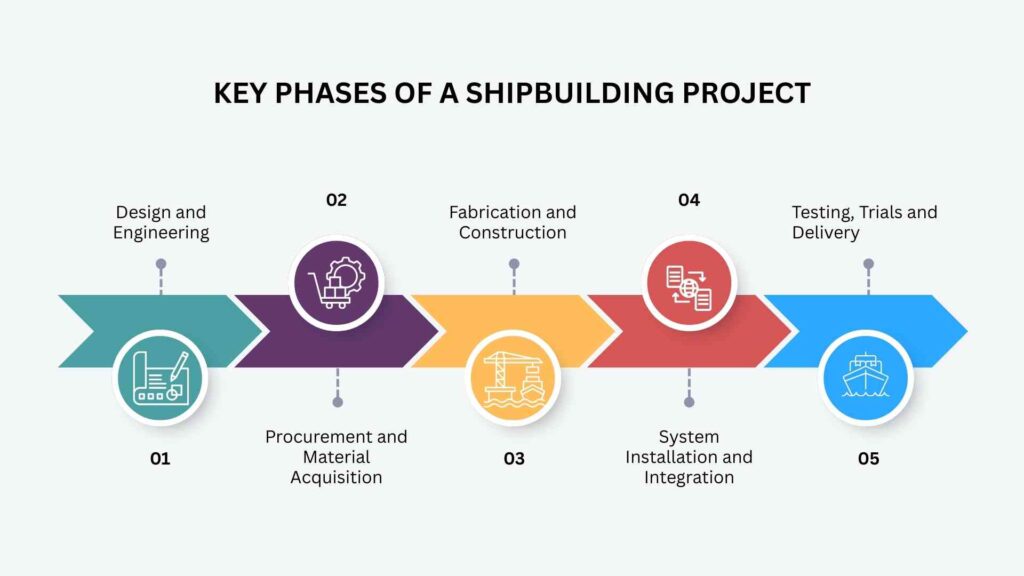
The Phases of a Shipbuilding Project and Their Cost Implications
Every shipbuilding project generally flows through several major phases. Each stage carries its own cost profile and risk dynamics:
Design and Engineering
This is the conceptual and planning stage. Detailed naval architecture, systems integration planning, regulatory compliance assessment, and prototype modeling all happen here.
Cost Drivers:
Complexity of design (e.g., specialized naval systems vs. standard commercial hulls)
Engineering hours and technical expertise
Changes due to later alterations or discovery of feasibility gaps
Impact on Budget: A poorly scoped design increases rework costs downstream and magnifies risk across every subsequent activity.
Procurement and Material Acquisition
Once plans are finalized, critical materials and components are sourced, which involves sourcing everything from steel plates and propulsion systems to electronics and interior fittings. Material costs alone can account for a substantial portion of the total budget, and procurement timing significantly impacts cash flow management.
Cost Drivers:
Material market pricing (steel, electronics, exotic alloys)
Logistics and import duties
Supplier reliability and lead times
Impact on Budget: Delays in procurement or price spikes in key commodities directly affect cash flow and schedule fidelity.
Fabrication and Construction
This represents the most visible phase, where hull sections are fabricated, assembled, and outfitted with machinery, piping, electrical systems, and accommodations. Labor costs peak during this phase, and production efficiency directly impacts the bottom line.
Cost Drivers:
Labor costs and productivity
Shop infrastructure and equipment utilization
Waste and rework due to poor planning or errors
Impact on Budget: This phase often consumes the majority of the budget and schedule. Inefficiencies here cascade into delays and cost growth.
System Installation and Integration
System installation is where mechanical, electrical, propulsion, navigation, communication, and automation systems come together into a single operational vessel. While each subsystem may be completed independently, the real challenge lies in ensuring they function seamlessly as one integrated environment.
Cost Drivers:
Complexity of electrical/hydraulic systems
Integration challenges between subsystems
Testing and commissioning requirements
Impact on Budget: Integration issues often surface late and trigger expensive fixes if they were not anticipated.
Testing, Trials and Delivery
This phase ensures the vessel meets all specifications and regulatory requirements through sea trials, system testing, and final adjustments before handover to the owner.
Cost Drivers:
Trial duration and resource allocation
Corrections from trial feedback
Compliance certification costs
Impact on Budget: Unexpected performance shortfalls can push costs dramatically higher at a point where budgets are already tight.
Major Cost Drivers That Can Impact a Shipbuilding Project
Cost Driver
Description
Steel and Raw Materials
Raw materials form the bedrock of shipbuilding expenses. Steel prices fluctuate based on global market conditions, and a large commercial vessel can require thousands of tons. Beyond steel, modern ships incorporate aluminum for superstructures, specialized alloys for critical components, and composite materials for weight-sensitive applications.
Exchange rate variations can significantly impact material costs when sourcing internationally, creating budgetary uncertainty that extends throughout the project timeline.
Labor
Skilled labor represents one of the most significant and least predictable cost factors. Shipbuilding requires diverse expertise, welders, pipefitters, electricians, painters, and specialized tradespeople. Labor costs vary dramatically by geographic location, and skilled worker shortages can drive up wages or extend schedules.
Productivity rates directly influence labor costs, with experienced teams delivering substantially better cost performance than those learning new vessel types or technologies.
System Integration Complexity
Modern vessels are floating networks of interconnected systems that must operate reliably in harsh marine environments. The integration of mechanical, electrical, hydraulic, and electronic systems creates coordination challenges that can significantly impact costs.
When systems from different vendors must interface, compatibility issues often emerge during installation, requiring engineering time, custom adapters, or even equipment replacement. The complexity multiplies with vessel sophistication, specialized vessels like research ships or cruise liners involve far more intricate system integration than basic cargo carriers.
Design Changes and Engineering Revisions
Every change order during construction triggers a cascade of costs. A seemingly minor design modification might require reworking already-fabricated components, revising documentation, reordering materials, and disrupting the production schedule.
Late-stage changes prove particularly expensive, as they can necessitate cutting out completed work and affect multiple interconnected systems.
Equipment and Propulsion Systems
Main engines, generators, propulsion equipment, and navigational systems represent major capital expenditures. These items often have long lead times, and delays in delivery can idle construction teams and extend the project timeline.
The choice between standard equipment and customized solutions significantly impacts both initial costs and long-term maintenance expenses.
Regulatory Compliance and Classification
Meeting international maritime regulations, classification society requirements, and flag state standards adds layers of cost through specialized inspections, testing, documentation, and potentially more expensive materials or construction methods.
Environmental regulations particularly drive costs upward through requirements for emissions control systems, ballast water treatment, and fuel efficiency measures.
Schedule Overruns
Time is money in shipbuilding, and schedule delays multiply costs exponentially. Extended construction periods increase labor costs, facility overhead, financing charges, and opportunity costs. Weather disruptions, supply chain problems, workforce issues, or technical challenges can push completion dates back by months, devastating project profitability.
How Cost Overruns Devastate the Bottom line
The financial impact of poor cost control extends far beyond simple budget exceedances. For shipyards, cost overruns on fixed-price contracts can transform profitable projects into money-losing ventures. When actual costs exceed estimates by even moderate percentages, profit margins evaporate entirely.
Cash flow suffers as unexpected expenses accelerate, potentially creating liquidity problems that affect other projects or operations. Reputation damage from cost and schedule overruns makes winning future contracts more difficult and may force yards to accept lower margins to remain competitive.
For vessel owners, construction cost increases may necessitate additional financing, reducing return on investment and potentially making the vessel economically unviable for its intended service. In competitive shipping markets, even small cost disadvantages can mean the difference between profitable operations and financial struggle.
Streamlining Cost Through Technology and Process Optimization
A successful shipbuilding project begins with realistic, comprehensive cost estimates that account for all major variables and include appropriate contingencies for uncertainty. Accurate projection enables better decision-making at every stage, from initial bidding through construction planning and change order evaluation.
Modern cost estimation moves beyond simple percentage markups on material and labor to incorporate historical data analysis, risk assessment, and scenario modeling. This approach identifies potential problem areas before they impact the schedule or budget, allowing proactive mitigation strategies.
Forward-thinking shipyards increasingly leverage technology to improve cost performance. Digital design tools reduce engineering hours and minimize errors that lead to costly rework. Production planning software optimizes material usage and construction sequencing, reducing waste and improving labor productivity.
Supply chain management systems provide visibility into material costs and delivery schedules, enabling better procurement decisions and reducing inventory carrying costs. Real-time project tracking allows managers to identify cost variances early when corrective action is most effective and least expensive.
How YARDOS Estimation Streamlines Cost Management
YARDOS Estimation App addresses the fundamental challenges shipbuilders face in cost estimation and project bidding through purpose-built tools designed for maritime construction complexity.
Comprehensive Cost Libraries within YARDOS Estimation App provide detailed breakdowns of labor, materials, and equipment costs specific to shipbuilding activities. Rather than starting from scratch or relying on outdated spreadsheets, estimators access current, validated cost data that reflects real-world conditions across all phases—from initial design through system integration and commissioning.
Parametric Estimation Capabilities allow rapid cost modeling based on vessel characteristics like size, type, complexity, and intended service. This enables quick feasibility assessments and “what-if” analyses that help teams understand cost implications of design alternatives before committing to detailed engineering.
Historical Data Integration leverages past project performance to improve future estimates. YARDOS Estimation App helps organizations capture lessons learned and actual cost data from completed projects, creating increasingly accurate estimates as the database grows. This is particularly valuable for the system installation and integration phase, where historical productivity data can reveal how long it actually takes to install and connect complex machinery and electrical systems.
Phase-Specific Cost Tracking allows project managers to monitor expenditures against budgets for each phase of the shipbuilding lifecycle. By understanding where costs accumulate during conceptual design, engineering, procurement, construction, system installation, and commissioning, teams can intervene early when variances emerge rather than discovering overruns at project completion.
System Integration Cost Modeling helps estimators account for the unique challenges of the installation and integration phase. YARDOS Estimation App can track labor requirements for different system types, coordination costs between trades, and the time required for testing and troubleshooting integrated systems, factors that are often underestimated in traditional estimation approaches.
Streamlined Bid Preparation transforms the traditionally labor-intensive proposal process. Rather than spending weeks compiling estimates from multiple sources and formats, teams use YARDOS Estimation App to generate comprehensive, professional bid packages in significantly less time. This efficiency allows estimators to focus on accuracy and competitiveness rather than mechanical data assembly.
Collaboration Features ensure all stakeholders work from a single source of truth. Engineering, procurement, production, and finance teams access the same cost data and assumptions, eliminating the miscommunications that often lead to budget problems. During system installation, when electricians, pipefitters, HVAC technicians, and automation specialists must coordinate closely, this shared visibility becomes even more critical.
Scenario Analysis Tools let estimators quickly model different construction approaches, material choices, or schedule options, identifying the most cost-effective path forward before committing resources. For example, teams can evaluate whether to install systems modularly before hull sections are joined or to install them after assembly—each approach carries different cost and schedule implications.
In shipbuilding, costs are everywhere, but unmanaged costs are avoidable. Understanding the major cost drivers in each project phase and adopting tools that bring visibility, consistency, and collaboration can transform risk into predictability.
What is Parametric Estimation for Complex Project
Parametric estimation offers a data-driven approach to forecasting costs in complex projects, making it invaluable for industries like aerospace engineering, shipbuilding, MRO (maintenance, repair, and overhaul), and defense, where traditional methods often fall short.
Key Challenges in Cost Control
Complex projects in these sectors face unpredictable variables such as fluctuating material prices, regulatory compliance demands, supply chain disruptions, and evolving design specifications. Labor variability, driven by specialized certifications and multi-phase execution, further complicates accurate budgeting, often leading to overruns, bid rejections, or eroded profit margins.
Fragmented data across spreadsheets and emails exacerbates issues like poor traceability, version control errors, and reliance on subjective expertise, hindering repeatability and audit readiness.
What is Parametric Estimation?
Parametric estimation leverages statistical relationships, known as Cost Estimating Relationships (CERs), between key project parameters, like weight, thrust, or hull dimensions, and historical costs to generate quick, scalable predictions.
Unlike bottom-up methods that detail every component, it excels in early-stage planning by using validated models derived from past data, providing a “reasonableness check” for more granular estimates. This top-down technique shines in low-design-maturity phases, enabling rapid iterations for proposals while improving defensibility through data traceability.
Parametric vs Bottom-up Estimation
Parametric estimation uses statistical models based on historical data and key parameters (e.g., aircraft weight or ship displacement) for rapid, high-level forecasts, ideal for early project stages with limited design details. Bottom-up estimating, by contrast, aggregates detailed costs from individual components, labor hours, and materials, offering precision but requiring full design maturity and extensive time. Parametric provides speed and scalability for initial bids, while bottom-up serves validation; hybrid approaches combine both for optimal accuracy across project phases.
Benefits for Aerospace, Shipbuilding, Maritime MRO, and Defense
In aerospace and defense, parametric models integrate engineering drivers like speed or power to forecast production costs early, supporting compliant bids amid strict audits. Shipbuilding benefits from CERs tied to naval program data, accelerating pricing for tenders and change orders while balancing realism and speed. For MRO, it handles unique scopes, like hidden damage post-teardown, by automating variable-based calculations for labor, parts, and multi-period phasing, reducing guesswork in aviation or maritime repairs.
The Challenges of Cost Control in Complex Engineering Projects
Multi-Dimensional Cost Drivers: Engineering projects involve hundreds of interdependent variables, from labor hours and material requirements to compliance testing, interoperability specifications, and configuration management. Each of these can significantly influence cost. Relying on static cost models or rule-of-thumb percentages often fails to capture these interactions.
Data Fragmentation: Large organizations frequently struggle with siloed systems. Costing teams may rely on disparate spreadsheets, disparate project repositories, or legacy enterprise systems that do not talk to each other. This makes it hard to extract clean, comparable historical data that’s needed for accurate forecasting.
Schedule and Scope Volatility: Requirements often evolve as design matures, testing reveals new issues, or operational priorities shift. Without a dynamic cost model that updates in real time, decision-makers are forced to choose between inefficient manual re-estimation or operating with outdated forecasts.
Contract and Compliance Risk: Many engagements in defense or aerospace involve fixed-price or incentive-based contracts. Inaccurate estimation not only erodes margins, it exposes firms to performance penalties, strained client relationships, and compliance concerns.
Best Practices for Parametric Estimation
To maximize the value of parametric cost models, organizations should adhere to proven practices:
Collect High-Quality Data: Parametric accuracy depends on the data feeding the model. Ensure historical project datasets are clean, relevant, and sufficiently granular. Where possible, normalize data to remove anomalies.
Select Meaningful Parameters: Not all variables are equally predictive. Invest time in identifying the parameters that truly correlate with cost, whether performance metrics, physical characteristics, or risk indicators.
Validate and Calibrate Models: Models should be tested against known outcomes to evaluate performance. Regular calibration ensures that estimates remain aligned with evolving technology and market conditions.
Integrate Across Functions: Cost estimation is not a standalone exercise. Integrate models with engineering, supply chain, and project financial systems to update forecasts as changes occur.
Document Assumptions and Limitations: Transparency builds trust. Maintain clear documentation of model assumptions, confidence levels, and scenarios where the model may not apply.
How Parametric Estimation Improves Cost Control
When implemented effectively, parametric estimation supports organizations by:
Delivering faster, data-backed cost forecasts early in the program lifecycle
Reducing reliance on manual rework when scope or requirements change
Enhancing scenario planning and risk quantification
Enabling consistent benchmarking across programs and divisions
Supporting compliance with defense acquisition cost reporting requirements
How YARDOS Estimation Helps
YARDOS Estimation streamlines parametric estimation with a centralized platform for reusable calculators, historical data libraries, and real-time collaboration tailored to MRO and complex bids. It supports variable-driven models, multi-period tracking, and role-based access, enabling faster, defensible proposals that capture institutional knowledge and minimize errors.
Cookie Consent
We use cookies to improve your experience on our site. By using our site, you consent to cookies.
Used by Google Analytics 4 to persist session state and track usage across visits. The XXXXXXXXXX portion corresponds to the Oxalis Google Analytics property ID.
1 year
_gac_
Contains information related to marketing campaigns of the user. These are shared with Google AdWords / Google Ads when the Google Ads and Google Analytics accounts are linked together.
90 days
__utma
ID used to identify users and sessions
2 years after last activity
__utmt
Used to monitor number of Google Analytics server requests
10 minutes
__utmb
Used to distinguish new sessions and visits. This cookie is set when the GA.js javascript library is loaded and there is no existing __utmb cookie. The cookie is updated every time data is sent to the Google Analytics server.
30 minutes after last activity
__utmc
Used only with old Urchin versions of Google Analytics and not with GA.js. Was used to distinguish between new sessions and visits at the end of a session.
End of session (browser)
__utmz
Contains information about the traffic source or campaign that directed user to the website. The cookie is set when the GA.js javascript is loaded and updated when data is sent to the Google Anaytics server
6 months after last activity
__utmv
Contains custom information set by the web developer via the _setCustomVar method in Google Analytics. This cookie is updated every time new data is sent to the Google Analytics server.
2 years after last activity
__utmx
Used to determine whether a user is included in an A / B or Multivariate test.
18 months
_ga
ID used to identify users
2 years
_gali
Used by Google Analytics to determine which links on a page are being clicked
30 seconds
_ga_
ID used to identify users
2 years
_gid
ID used to identify users for 24 hours after last activity
24 hours
_gat
Used to monitor number of Google Analytics server requests when using Google Tag Manager
1 minute
Marketing cookies are used to follow visitors to websites. The intention is to show ads that are relevant and engaging to the individual user.